Deciduous small tree green plum (green calyx plum) sapling price, comparison with red plum, and flowering and fruiting periods
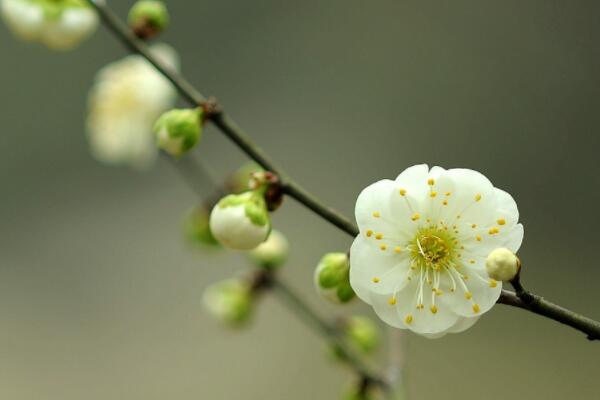
Green plum is named for its green calyx, white flowers, and green young branches. It is also called white plum blossom, green plum blossom, and white plum green plum. It belongs to the true plum (Zhenmei) system, upright-branch plum (Zhizhimei) class, green calyx type (Lü'e type) in the plum variety classification system, and is an outstanding variety among plum cultivars. So how much does a green plum sapling cost? Which is better, green plum or red plum? When does it bloom and bear fruit? How do you grow it? According to plum reference data, green plum blooms before leafing out in early spring from February to March. The flowers are borne in the leaf axils of one-year-old branches, solitary or in clusters of two, single or double, with a subtle fragrance. The drupe is spherical, with a shallow groove on one side, hairy, ripening in June, yellow when ripe. The young branches are green with no purple tinge.
How much does a green plum sapling cost?
| Seedling name | Ground diameter (cm) | Price (yuan) |
| Green plum | 2 | 12~15 |
| Green plum | 3 | 22~28 |
| Green plum | 4 | 45~55 |
| Green plum | 5 | 65~95 |
| Green plum | 6 | 120~160 |
| Green plum | 7 | 180~240 |
| Green plum | 8 | 300~350 |
| Green plum | 9 | 400~450 |
| Green plum | 10 | 550~650 |
Which is better, green plum or red plum?
One can only say that each has its own strengths.
Red plum prefers a warm climate and has a certain cold resistance. Its flowering period is very sensitive to climate change. Plum prefers relatively high air humidity, but dislikes heavy rain during the flowering period. Plum can grow well in areas with an annual rainfall of 1000 mm or slightly more, and has low soil requirements, being relatively tolerant of poor soil. It can also grow normally in mildly alkaline soil. According to experience in Jiangnan, when planted in soils with compact subsoil such as gravelly clay and gravelly loam, plum branches are well-filled and flowering and fruiting are abundant. It is a sun-loving tree species that prefers ample sunlight and good ventilation. It is a long-lived tree species.
Green plum prefers light and is suited to an environment with ample sunlight and good ventilation. It prefers a warm climate but is cold-tolerant. It likes relatively high air humidity and has some drought resistance. It has low soil requirements, but prefers moist sandy loam rich in humus. When the soil is heavy clay and drainage is poor, it is prone to root rot and death.
How do you grow green plum?
It is mainly propagated by seed, and can also be propagated by grafting and cuttings.
1. Seed propagation: first raise seedlings, then transplant.
(1) Seed collection and seed treatment: Select excellent individual plants that grow vigorously, bear fruit year after year, have large fruit with small pits, thick flesh, extremely sour taste, and no pests or diseases as mother plants for seed collection. Collect fully ripe fruit in June, pile and compost them until rotted, take them out after about 10 days and rub and wash them in running water, rinse off the flesh, dry the pits, and store them for later use. Half a month before sowing, take the seeds out and soak them in human urine for 15 days. Then remove them, rinse off the urine, dry them, and sow.
(2) Sowing: Winter sowing is preferable, or sow in late February of the following year. When sowing, on a prepared seedbed, open furrows horizontally at a row spacing of 20-25 cm and a depth of 7-9 cm. Then sow 1 seed every 6-7 cm (20 seeds per furrow), cover with fine fertile soil or farmyard manure mixed with human and livestock manure water, then cover with soil level with the bed surface. Keep the bed soil moist; seedlings can emerge in mid-April. The seeding rate is about 50 kg per mu. The emergence rate can reach more than 90%.
After emergence, loosen the soil and weed frequently. During the seedling stage, apply dilute human and livestock manure water 2 times; when the seedlings are 30 cm tall, use 250 g of urea per mu diluted in 50 kg of water for foliar topdressing, once every 7-10 days, for 2-3 consecutive times, to promote robust seedling growth. In late November, apply 1 more winter fertilizer, mainly organic fertilizer, to promote thick and strong seedling growth. After 1 year of cultivation, when the seedlings are 80-100 cm tall, they can be lifted and planted out.
2. Grafting propagation: The rootstock uses 1-2 year old seedlings of wild apricot, apricot, or plum. The scions are collected from current-year vegetative branches of excellent varieties of dark plum (Wumei) that have already flowered and fruited. Grafting period and methods: Bud grafting is carried out in July-August using the T-shaped method; branch grafting is carried out in early spring from February to March using the cut grafting method. After bud grafting survives, loosen the binding and cut the rootstock promptly.
Grafted green plum seedlings can bloom and fruit earlier, starting to flower in 1-2 years, and then increasing yield year by year. This is an important way to achieve early high yield, improved varieties, and intensive cultivation of green plum.
3. Cutting propagation: At the Autumn Equinox or after flowering in early spring, cut 1-year-old thick branches into cuttings about 20 cm long, each with 3 nodes, cut the lower end near a node into a horseshoe-shaped slant, tie every 50 cuttings into a bundle, dip the lower slanted end in 500 ppm rooting powder (ABT) or 500 ppm naphthaleneacetic acid (NAA) solution to a dipping height of about 2 cm for 10 seconds, take them out and let the solution dry slightly, then insert the cuttings. When inserting, on a prepared seedbed, at a row and plant spacing of 10×5 cm, first make guide holes with a small wooden stick, then insert the cuttings halfway into the holes, compact the soil after insertion, and immediately water thoroughly once. In winter or early spring when temperatures are relatively low, a bamboo-frame shed covered with plastic film must be used to keep the temperature inside the shed at about 20°C and the relative humidity above 80% (indicated by dense water droplets on the film). During the rooting period of the cuttings, keep the bed surface moist, and every 10 days at noon on a clear and windless day, uncover the plastic film and sprinkle water once. Around the Spring Equinox, while the cuttings sprout, the lower cut has also formed callus tissue. In mid-to-late April, the plastic shed can be removed, and cultivation, weeding, and topdressing can be carried out to promote robust growth of the cuttings. After cultivation until autumn, they can be lifted and planted out.
4. After planting green plum, field management is also required. In addition to attention to cultivation, weeding, fertilization, and deep digging to expand planting holes, attention must also be paid to shaping and pruning. Green plum has extremely strong sprouting ability. If left alone to grow on its own, the branches will certainly be chaotic, not only unattractive, but also causing insufficient light and poor ventilation, thereby affecting the growth and development of the entire tree. Green plum also has certain medicinal value. Its nature and flavor are relatively mild, and it can soothe the liver and regulate qi, regulate the spleen and stomach, and regulate qi and blood without damaging yin. This point is very rare.