Deciduous shrub Chinese fringetree (Chionanthus retusus) seedling prices, flowering months, and grafting onto osmanthus trees
Chinese fringetree, also known as luobosi flower, niujinzi, wujinzi, tea tree, and April snow, is a deciduous shrub or small tree with a tall and graceful form. How much does a Chinese fringetree seedling cost? In which month does it bloom? Can it be grafted onto osmanthus trees? How is it planted? According to Oleaceae data, the Chinese fringetree flowering period is June-July, and the fruiting period is September-October. In early summer it is covered in white flowers, as if frosted and blanketed in snow, clear and pleasant. It fruits in autumn, with elliptical drupes that are blue-black.
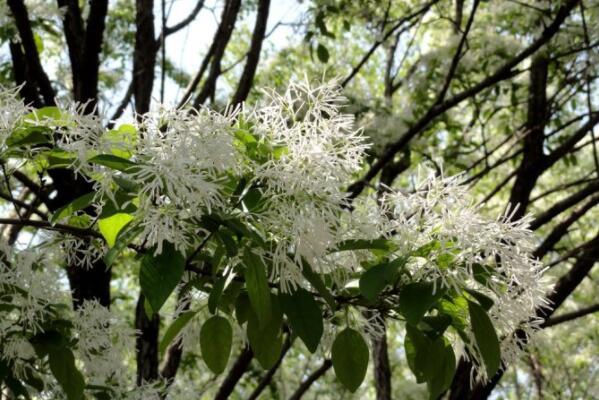
How much does a Chinese fringetree seedling cost?
| Seedling name | Ground diameter (cm) | Loading price |
| Chinese fringetree | 1 | 2~3 |
| Chinese fringetree | 2 | 6~8 |
| Chinese fringetree | 3 | 12~18 |
| Chinese fringetree | 4 | 25~40 |
| Chinese fringetree | 5 | 55~70 |
| Chinese fringetree | 6 | 120~180 |
| Chinese fringetree | 7 | 260~350 |
| Chinese fringetree | 8 | 400~550 |
| Chinese fringetree | 9 | 600~750 |
| Chinese fringetree | 10 | 800~1000 |
| Chinese fringetree | 12 | 1300~1800 |
Can Chinese fringetree be grafted onto osmanthus trees?
Chinese fringetree can be grafted onto osmanthus; both are plants in the Oleaceae family.
1. Cleft grafting method
When grafting, cut the rootstock at an appropriate point, choose the smoother side of the bark, and make a vertical downward cut slightly into the xylem, with the cut 2 cm to 3 cm deep. Cut the scion into a 2 cm to 3 cm long slanted surface, and cut a 1 cm short slanted surface on the opposite side, while keeping 2 to 3 opposite buds, and cut the branch crosswise. Immediately insert the scion into the rootstock so that the cambium layers of both are closely joined.
For large rootstocks, several scions can be grafted. After inserting the scions, immediately bind and fix them with plastic film strips, and at the same time put on a small plastic bag to retain moisture and heat.
2. Side grafting method
Side grafting is a branch grafting method in which the rootstock crown is not cut off. When grafting, at an appropriate part of the rootstock, make a slanted cut into the rootstock at an angle of 20 degrees to 30 degrees, reaching 1/3 to 1/2 of the rootstock diameter. Then cut the lower end of the scion on both sides into 1 cm to 2 cm slanted surfaces, keep 2 to 3 opposite buds, insert the scion into the rootstock cut, align it with the cambium on one side of the rootstock, and bind it with plastic film strips to retain moisture and heat.
3. Cleft grafting method
When grafting, cut the rootstock into a flat surface at a certain height, then use a cleft grafting knife to split vertically downward in the center of the rootstock cut surface to a depth of 4 cm to 5 cm, then insert the back of the knife into the cut to open it. Select 2-year-old branches with 4 to 5 opposite buds as scions, cut both sides into equal wedge shapes, then insert the scion into the rootstock cut so that the cambium layers of both are closely joined, and bind firmly with plastic film strips, while putting on a plastic bag and tying it tightly to retain moisture and heat.
4. Bark grafting method
When the sap of the Chinese fringetree has begun to flow and the bark is easy to peel. First cut a 2 cm to 3 cm long slanted surface on the back of the scion 1 cm to 2 cm below the bud, then cut a small slanted surface about 0.6 cm long at the tip on the back of the slanted surface. Then cut and smooth the rootstock at the required place, then choose a smooth part of the rootstock bark and make a vertical cut from top to bottom, reaching the xylem, about 1.5 cm long, gently lift the bark open to both sides along the cut, and insert the scion.
If the rootstock is thick, several scions can be grafted. After inserting the scions, bind and fix them with plastic film strips, then put on a plastic bag to retain heat and moisture.
5. Approach grafting method
From May to July each year, cut away 5 cm to 10 cm from both the Chinese fringetree and osmanthus at an appropriate height, making two approach grafting slanted cuts reaching 1/4 to 1/3 of the trunk diameter, align the cambium layers, and bind them well with plastic film strips. One month after approach grafting (20 days at the fastest), cut off the lower part of the scion and the upper part of the rootstock.
How is Chinese fringetree planted?
1. Chinese fringetree propagation is mainly by sowing. Before sowing, the seeds must undergo sand storage to promote germination in order to achieve a good germination rate. Sowing can be done in February, March, April, or May. Mix the seeds into wet sand and store them for about 20 days, wait until the seeds have fully absorbed water, then sow them in the seedling bed, and they will germinate and emerge in about 10 days. The key during the seedling stage is water. If the soil is found to be dry, water it in time to prevent insufficient moisture, which would cause too great a difference in germination time.
2. Transplant and set plants. In the early stage, a plant spacing and row spacing of 30*50 cm is recommended. After 2 years of growth, transplant again. After two years of cultivation, the Chinese fringetree trunk can reach more than 2 m, with a diameter of 1~2 cm, suitable for custom high-trunk seedlings. For the second transplant, a plant spacing and row spacing of 80*150 cm is recommended. With this distance, the Chinese fringetree can grow to 4~5 cm, taking about 3 years. After 2 transplants, the final transplant must be carried out. The plant spacing and row spacing should be based on the size of the trees being cultivated. If you want to grow large seedlings, leave a large distance, generally 4*5 is best.
3. Chinese fringetree is tolerant of fertilizer, cold, and drought, all very well. During the growing period it needs a large amount of fertilizer. In spring, apply 100 kg of chemical fertilizer per mu, by broadcasting or burying at the roots. After fertilizing, water more to keep moisture sufficient, which helps the roots extend and absorb nutrients. Apply chemical fertilizer once in autumn, 60 kg per mu. In winter, broadcast chicken manure, cow manure, and pig manure, 3~4 tons per mu. No watering is needed after winter fertilization.