How much does a chrysanthemum seedling cost per plant and the planting, flowering and harvesting periods for growing one mu
Chrysanthemum is also known as Shouke, Jinying, Huanghua, Qiuju, Taoju, Rijing, Nühua, Yannian and Yinyihua. It is a perennial herbaceous plant of the family Asteraceae and the genus Chrysanthemum. So how much does a chrysanthemum seedling cost per plant? When is it planted, when does it flower and when is it harvested? What are the costs and profits of growing one mu? According to the flower grower Master Wu, prices vary with the variety. Generally, you can just ask at a place that sells flowers. Chrysanthemums are usually propagated by root division, and common varieties cost 1 yuan to 5 yuan per plant.
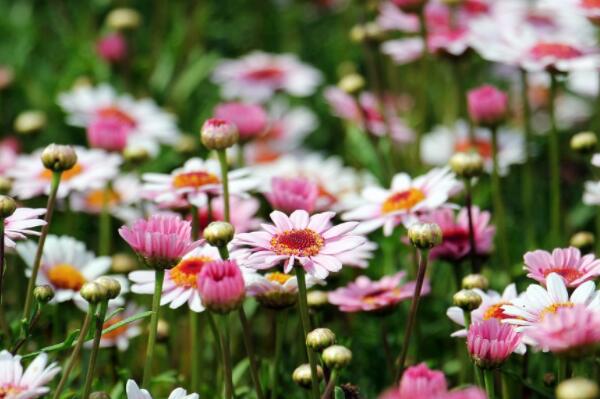
When are chrysanthemums planted and harvested?
Planting:
1. For division, after the chrysanthemums are harvested in November, cut the chrysanthemum stems off level with the ground, choose vigorous, disease-free plants, dig out all their roots, and replant them on a fertile plot, applying a layer of farmyard manure to keep them warm through the winter. The following March to April, uncover the manure and water them. In April to May, when the chrysanthemum seedlings grow to 15 cm tall, dig out the whole plant, divide it into several plants, and plant them immediately in the field. When planting, the spacing between plants and rows is 40 cm. Dig holes, plant 1-2 seedlings per hole, cover with soil and firm it down after planting, and water to settle the roots. Generally, one mu of old seedlings can plant about 15 mu of production field.
2. For cuttings, in April to May or June to August, choose thick, disease-free new shoots as cuttings. Take the middle section and cut it into small pieces 10-15 cm long, treat the cuttings with plant hormones, then insert the cuttings into the seedbed with a row spacing of 20-25 cm and a plant spacing of 6-7 cm, firm the soil and water. Roots will form in about 20 days. Apply human and livestock manure water once every month after that. When the seedlings are 20 cm tall, they can be taken out of the nursery and transplanted. 3. Transplanting. Division seedlings are transplanted in April to May, and cutting seedlings in May to June. Choose a cloudy day, a day after rain, or the evening of a sunny day. On the prepared bed surface, dig holes with a plant and row spacing of 40 cm each and a hole depth of 6 cm, then dig out the seedlings with soil. Plant 1 plant per hole for cutting seedlings and 1-2 plants per hole for division seedlings. After planting, cover with soil and press firmly, and water to settle the roots.
Flowering and harvesting:
1. Chrysanthemums that flower naturally include summer chrysanthemums, and then autumn chrysanthemums. To make chrysanthemums bloom in all four seasons, of course, plants cannot do this on their own because of their growth patterns, so chrysanthemums can be made to bloom in all four seasons artificially.
2. The flowering period of chrysanthemums is about 20 days. Generally, they bloom relatively concentratedly in early November. They should be harvested in batches, and the most suitable harvest time is when 2/3 of the flower center (tubular flowers) has opened. Fully open flowers not only lose their fragrance, but also tend to scatter after processing and have poor color.
3. Wild chrysanthemums are suitable for picking in late summer. When picking, pinch off the top of the flower stem with your thumb and index finger, and try to keep the flower shape intact. If making chrysanthemum tea, it is best to choose half-open buds, which better preserve the flavor.
What are the costs and profits of growing one mu of chrysanthemums?
Yield per mu of chrysanthemums. Chrysanthemums are planted every spring, with a growing period of one year. About 4,000 chrysanthemum seedlings are needed per mu. One mu of chrysanthemums can produce 1,000 jin to 1,500 jin of fresh chrysanthemums, and the dry product yield per mu of chrysanthemums is 100-150 kg.
Growing one mu of chrysanthemums requires costs of about 800-1,000 yuan. If the growing technique is good, the yield can be 1,500 jin per mu. At an average of 4 yuan per jin, the income can be 6,000 yuan. Of course, seedling, fertilizer and land prices differ by region, so investment and income will naturally differ, so the above figures are for reference only.