Small tree peony pomegranate seedlings price and flowering and fruiting cultivation bonsai development
Peony pomegranate, Punicaceae, Punica genus, a deciduous shrub or small tree, successfully developed and bred by the Academy of Agricultural Sciences over many years. This variety has large fruit and a sweet taste, suitable for large-scale orchard planting and cultivation; its flowers are beautiful, suitable for cultivation into fruit tree bonsai. So how much does a peony pomegranate seedling cost? When does it bloom and bear fruit? How to plant it? What is the development prospect of bonsai? According to large-scale grower Grandpa Hu, peony pomegranate seedlings of 70-120CM cost 1-8 yuan.
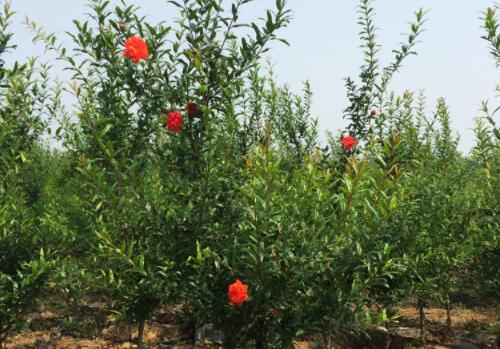
When does the peony pomegranate bloom and bear fruit?
1. The flowering period of the peony pomegranate is particularly long, from May to October, which is 20 times the flowering period of the peony; a 7-8 cm peony pomegranate tree can produce 2,000-3,000 flowers, with red flowers all over the tree. It truly is “pomegranate flowers bloom red as fire,” such an auspicious and festive scene! July, August and September are the viewing period for the peony pomegranate, with red flowers, green leaves and precious fruit all shining together!
2. Generally, two-year-old seedlings begin to flower, and they bear fruit after three years. Fruit sets right after flowering. In June, July and August the pomegranate grows rapidly, and it matures in early to mid-September. A single fruit generally weighs about 100 grams, with a skin that is yellow with a blush of red. The seeds are red, juicy, sweet with a slight tartness that is pleasant to the taste, with an especially good flavor and superior quality.
How to plant the peony pomegranate?
The peony pomegranate is generally propagated by three methods: cuttings, grafting and layering. In production, the cutting propagation method is mostly used.
1. Selection of cuttings. Generally, vigorous one-year-old branches are chosen, with a diameter of 0.5-1 cm being suitable and a length of 10-15 cm.
2. Cutting time. In spring, from late March to before budding; in summer, generally in June-July; in autumn, generally in November-December. The best cutting time is spring.
3. Cutting method. Put the cut branches into a prepared rooting agent liquid, soak for 2 hours, take them out, and insert them at a row spacing of 20 cm and a plant spacing of 15 cm.
Specific method: first lay out 80 cm wide plastic film, and insert cuttings at a row spacing of 60 cm, with the insertion depth controlled so that the branch is level with the plastic film. After cutting, immediately water once thoroughly. After about two weeks the branches will successively sprout. During this period, various weeds also successively grow. When the weeds grow to about 10 cm, remove the plastic film and remove all the weeds. During this time, the weeds grow faster than the pomegranate seedlings, so weeds must be removed about once every 10 days. When the pomegranate seedlings grow to 30-40 cm, a compound fertilizer can be applied once to the pomegranate seedlings to make the seedlings grow taller and stronger. By late autumn and early winter, when the pomegranate seedlings have generally grown to 80-120 cm, they can be lifted from the nursery to establish an orchard.
Establishment of a peony pomegranate orchard
1. Site conditions: pomegranate seedlings are afraid of freezing, so choose a site that faces shade and faces the sun. South of the Yangtze River and areas without freeze damage can be planted freely. In northern cultivation, cold protection measures should be taken in winter.
2. Planting time: in the north, it is best to plant after the soil thaws in spring, which avoids the winter planting cold protection procedure. It can also be planted in early summer. In southern regions, planting can be done in spring, autumn and winter. Autumn planting not only has a higher survival rate, but also sprouts earlier.
3. Planting method: a north-south orientation is preferable. There are three plant and row spacings: plant and row spacing 0.8 m x 0.8 m, planting 1045 plants per mu; plant and row spacing 1 m x 1.5 m, planting 445 plants per mu; plant and row spacing 2 m x 3 m, planting 111 plants per mu.
4. Management after planting: in spring, according to weather conditions, generally watering 2 times is enough. In mid to late June, apply 50 kg of compound fertilizer per mu, and water at the same time. Southern regions have more rainfall, which easily causes fertilizer leaching, so throughout the growing period it is suitable to spray 0.3% to 0.5% urea or potassium dihydrogen phosphate on the leaves 3-5 times. Carry out intertillage and weeding frequently to keep the orchard clean. During growth, the root of the seedling produces tiller buds three or four times, which should be wiped off in time. After leaf fall, carry out cold protection for overwintering according to the local temperature drop, generally mostly from late November to early December. Cold protection method: for young trees, the main trunk can be pressed down and covered with 30 cm of soil, or the trunk can be wrapped with straw bags. For trees three years old and above, it is enough to simply mound soil around them, and remove it after the soil thaws.
What is the development prospect of peony pomegranate bonsai?
The pomegranate is a symbol of auspiciousness, the peony is a symbol of wealth and honor, and the peony pomegranate is a symbol of long-lasting happiness! Peony pomegranate -- blooms peony flowers and bears pomegranate fruit, with a flowering period of 5 months.
1. Long history. It has now been cultivated for more than two thousand years.
2. Early flowering. After one-year-old seedlings are planted, they try to flower in the second year. Generally, flowering can be 15-20 days earlier than similar pomegranates.
3. Long flowering period. From May to September, the flowering period can last up to about 120 days.
4. Many flower colors. There are distinctions of bright red, pink and white, and the flower shape changes greatly over time.
5. Abundant flowers. The flowering amount at full bloom is 3-5 times that of pomegranate trees of the same age.
6. Flowers blooming within flowers. When site, climate and other conditions are good, the flowers bloom withered but do not fall, and new flowers grow from the original flowers to cover the original flowers, returning youth.
7. Large fruit. A single fruit generally weighs about 500 grams.
8. Strong adaptability. It is not strict about soil requirements, and the suitable pH range is wide.
In addition, the growth habits, cultivation and management of the peony pomegranate are the same as ordinary pomegranates. It is relatively tolerant of drought and poor soil and of acid and alkali, and can be cultivated in both mountainous areas and plains, performing well when cultivated in homes and parks. The peony pomegranate is the best tree species for building garden-style cities, developing tourist attractions, developing sightseeing agriculture, beautifying scenic spots and historic sites, making bonsai and potted plants, and beautifying courtyards. It is also a high-grade gift tree species, with very broad development prospects.