Amorpha fruticosa deciduous shrub sapling prices, flowering period, years to fruit, and planting techniques
Amorpha fruticosa, also known as cotton locust, pepper strip, cotton strip, spicate locust, purple jade locust, and lath, has a large leaf volume and is rich in nutrients, containing large amounts of crude protein, vitamins, etc., making it a nutritious fodder plant. So roughly how much does an Amorpha fruticosa sapling cost per plant? When does it bloom? How long is the flowering period? What are the planting techniques? According to Fabaceae information, Amorpha fruticosa flowers bloom around April-May.
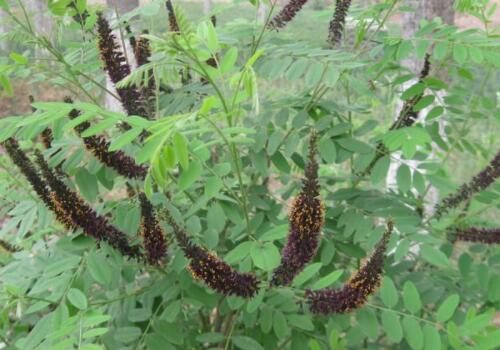
Roughly how much does an Amorpha fruticosa sapling cost per plant?
The following prices are compiled for reference only.
| Seedling name | Height (cm) | Price (yuan) |
| Amorpha fruticosa | 40 | 0.12 |
| Amorpha fruticosa | 60 | 0.16 |
| Amorpha fruticosa | 80 | 0.2 |
How many years does an Amorpha fruticosa tree take to fruit?
Amorpha fruticosa is a light-loving shrub with extremely strong resistance, tolerating cold, drought, moisture, and salt-alkali conditions, and resisting wind and sand. It can grow on barren hillsides, roadsides, riverbanks, and saline-alkali land. It can be propagated by seed and by root sprouting asexual reproduction. It has strong sprouting ability and a well-developed root system, with each clump producing 20-50 sprouts. After cutting back, one-year-old sprouts reach 1-2 m tall, bloom and fruit in 2 years, and the seed germination rate is 70-80%.
What are the planting techniques for Amorpha fruticosa?
I. Seedling-raising methods for Amorpha fruticosa saplings
1. Seedbed site selection: For Amorpha fruticosa seedling raising, well-drained sandy loam should be selected as the seedling site;
2. Seed treatment: Because the seed coat is hard and the fruit skin contains wax, water absorption is difficult and germination is slow. Before sowing, hot water can be used to soak the seeds to promote germination;
3. Sowing: Usually sown in spring, in drills, with row spacing of 20 cm, soil thickness of 1-1.5 cm. After sowing, press the soil down. The sowing rate is 2-3 kg per mu. Seedlings begin to emerge about 1 week after sowing;
4. Seedling-stage management: When seedlings are 3-5 cm tall, thin them for the first time; when 6-8 cm tall, finalize the spacing, leaving about 20 seedlings per meter. After seedlings reach 25 cm tall, drought resistance increases, and irrigation is unnecessary unless there is severe drought. One-year-old seedlings reach 80-150 cm tall and can then be lifted for afforestation. The main root is not deep, there are many fibrous roots, and lifting seedlings is relatively easy.
II. Planting methods for Amorpha fruticosa
1. Land preparation: The suitable sowing period for Amorpha fruticosa is spring and autumn (April-May, September-October). Choose a plot facing the sun, with loose texture, good drainage, no crushed stone, few weeds, relatively fertile, and near-neutral loam soil as the seedbed. Apply 500-750 kg of decomposed farmyard manure per mu, and 15-20 kg of superphosphate and calcium magnesium phosphate, plow into the soil as base fertilizer, with a plowing depth of about 30 cm. Break up clods, rake level, open furrows and make beds, with bed width of 1-2 m. Before sowing, open shallow furrows in the seedbed at row spacing of 20-30 cm, with furrow depth of 3-5 cm and width of 6-8 cm. Sow the treated seeds in drills in the furrows, cover with 2 cm of soil after sowing, press lightly, and spray thoroughly with water. The sowing rate is 4-8 kg per mu (weight when not soaked).
2. Thinning: Generally seedlings emerge 5-7 days after sowing and are fully emerged in 15 days. When seedlings are 5-6 cm tall, carry out the first thinning, removing inferior seedlings and keeping superior ones, and achieve even distribution; when seedlings are 10-15 cm tall, carry out the second thinning, requiring plant spacing to be maintained at 10 cm, with about 80,000 seedlings raised per mu.
3. Seedling-stage management: After final thinning, field management should focus on cultivating, weeding, and preventing drought. To make seedlings grow thick and strong, combine cultivating and weeding with 1 appropriate application of a small amount of nitrogen fertilizer, for example 5 kg of urea per mu is sufficient.
4. Transplanting: When plants raised from spring sowing reach about 1 m tall, transplant before winter of the same year or in the following spring; plants raised from autumn sowing are transplanted before the following winter. Before lifting seedlings, cut them off 15 cm above the ground (the thick, strong branches cut off can be used as cuttings). When lifting seedlings, take care to protect the root system, and plant immediately after lifting. Dig holes at a plant-row spacing of 1 m × 1.5 m, plant 2-3 plants or 3-4 plants per hole, and firm the soil by treading. If the soil is dry, irrigate first, then earth up and tread firmly. After transplanting, branches form in the first year, and branch length can reach about 1.5 m. After cutting back for use, branches gradually increase, and it can mature in 3-4 years.
5. Field management: Each year in spring and winter, cultivate and weed once, and apply a small amount of nitrogen fertilizer to achieve stable and high yields. Amorpha fruticosa has very strong vitality and resistance, with no diseases, but bagworm moths occasionally damage the leaves, and can be controlled by spraying pesticide or by hand-catching.
6. Harvest: New shoots harvested in the same year are not suitable for seed collection, because the one-year-old branches of Amorpha fruticosa rarely flower and set fruit; only shoots that have grown for two or more consecutive years can grow thick and strong and bear many seeds. For seed collection, mother plants must be selected and retained in a planned way, keeping 20-30 branches per clump, not harvesting in the first year, and collecting seeds in autumn of the second year. With good management, 100-150 kg of pods can be produced per mu. Harvested seeds should be dried in time and stored. Amorpha fruticosa over two years old can be harvested 2-3 times each year: the first harvest in mid-May, the second in July-August for leaves, which should not be picked exhaustively, and the third in autumn for cutting shoots.