How much does Golden Inlaid Jade Bamboo cost per plant, and how to plant and cultivate it in a courtyard
Golden Inlaid Jade Bamboo is a rare treasure among bamboos. Its unique feature lies in its tender yellow culms, where at every node where branches and leaves emerge, a natural light green shallow groove forms, with the positions alternating node by node. So how much does Golden Inlaid Jade Bamboo cost per plant? Is it suitable for planting in a courtyard? How do you plant it? According to a bamboo base in Jiangsu, Golden Inlaid Jade Bamboo has a height of 250cm and costs 1.4 yuan per plant.
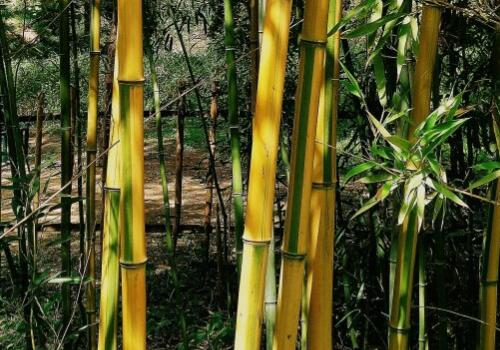
Is Golden Inlaid Jade Bamboo suitable for planting in a courtyard?
Golden Inlaid Jade Bamboo is one of the four famous ornamental bamboos in China. Golden Inlaid Jade Bamboo is like pieces of jasper inlaid in every golden bar, elegant and lovely, and a residence with luxuriant bamboo is considered a place of great fortune: “Green pines lush and bamboo rippling, the atmosphere bright and the site good for dwelling. People flourish and the family is wealthy, piling up jade and gold and wearing purple robes.” The general meaning is that where green pines flourish and emerald bamboo sways in the wind, there will surely be a flourishing family, vast wealth, and high official position. It can be seen that bamboo does not “attract yin energy,” and it is very good to plant it at home.
How do you plant Golden Inlaid Jade Bamboo?
Methods:
1. For a sweeping scenic bamboo grove landscape, based on achieving the effect in one planting, plant 100---300 plants per mu.
2. In a bamboo variety garden, 10----50 plants can be planted.
3. For ornamental bamboo landscaping in a small courtyard garden, 5----20 plants are all acceptable.
Management:
1. Intertillage and weeding: twice a year, from June to August, to a depth of 8~10 cm, with the weeds left to rot as fertilizer
2. Fertilizing and earthing up: because bamboo rhizomes are distributed shallowly, soil should be earthed up at the same time after weeding so that the weeds rot and are easily absorbed. If fertilizer is insufficient, the culms grow poorly and the new green fades too early. To enable the courtyard to grow robust bamboo every year, nitrogen, phosphorus, potassium, silicon fertilizer and organic fertilizer should be applied. About half a jin of compound fertilizer per clump. Earthing up around seedlings also helps preserve soil moisture and stabilize the bamboo against swaying, which is simple and effective.
3. Irrigation and drought resistance: ornamental bamboos prefer warmth and humidity, and the shoot stage requires even more water, hence the saying ”spring bamboo shoots after rain.” If newly established bamboo groves encounter drought during the shoot stage, they should be watered to resist drought, striving for early and vigorous growth of the young grove. In the summer of the year when ornamental bamboo is landscaped, if the drought is severe, it will seriously affect the survival rate and seedling growth, so watering to resist drought is also necessary. Watering can be done in the morning and evening, and it should be thorough and sufficient, with some rice straw spread around the mother bamboo to retain moisture and lower the temperature.
4. Thinning: after 3-5 years, some old culms can be thinned out so that new bamboo has spacious room to spread branches and take shape.
Disease and pest control:
1. Bamboo gray globular mealybug harms many bamboo species including Golden Inlaid Jade Bamboo. Adults and nymphs parasitize in the axils of small branches and inside leaf sheaths, sucking sap and causing damage. Later they form grayish brown spherical waxy shells, causing branches and leaves to wither, growth to slow, bamboo clumps to decline, and shoot emergence to be affected. Adult: the female adult is pear-shaped, slightly pointed at the front and broad at the rear, with the whole body hardened. It is 1.5-2mm in diameter, purplish brown, covered externally by a grayish brown spherical waxy shell mixed with calcareous material and debris. The male adult is about 1.3mm long, with a reddish brown head and thorax and a pale yellow abdomen. The abdominal tip has a genital spine and two tail filaments. It has 1 generation per year, overwintering as fertilized female adults in the leaf sheaths of new shoots of the current year; the following spring they continue feeding, become gravid, and the body swells into a sphere; in late April they lay eggs beneath the body, and from May to June they hatch into newly hatched nymphs, which quickly crawl into the leaf sheaths of new shoots, settle, and suck sap, while secreting white wax powder on the body. In late May, male nymphs crawl from the base of the leaf sheath to the tip, spin cocoons, and pupate; in June they emerge as male adults, and during this period the female adults also emerge; after mating, the male adults die quickly, and the female adults continue damaging until October and then overwinter successively.
2. Control methods
(1) Strengthen bamboo grove management. Carry out timely intertillage and loosening of the soil, scientific fertilization and watering, and rational cutting, maintain appropriate bamboo grove density, improve plant resistance, and reduce pest damage; according to the pest's habit of gathering to cause damage, scrape it off manually, and plants with severe damage should be dug out and removed as early as possible.
(2) Protect and utilize natural enemies such as ladybugs, parasitic wasps, and green lacewings.
(3) Chemical control. During the nymph hatching period, spray 25% quinalphos emulsifiable concentrate at 500-1000 times dilution, or 20% buprofezin emulsifiable concentrate at 1500-2000 times dilution.