Prunus subgenus Amygdalus 'Dwarf Peach' nursery stock, potted prices, flowering and fruiting periods, and whether the fruit is edible
Dwarf Peach is a variety of the peach plant in the genus Prunus, subgenus Amygdalus, belonging to the semi-double and double-flowered ornamental peach varieties collectively known as Bitao. So how much does a Dwarf Peach nursery stock cost per plant? When does it flower and fruit? Can its fruit be eaten? What are the bonsai-making and management methods? Learned from a Jiangsu landscaping base, Dwarf Peach nursery stock prices range from 3 yuan to 5 yuan.
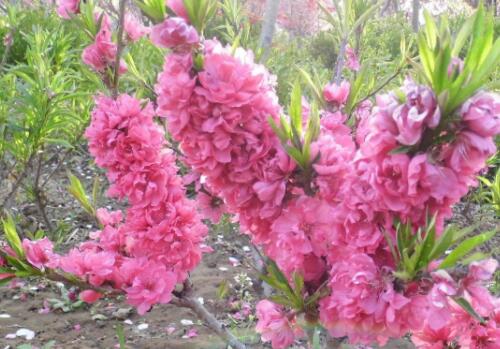
When does Dwarf Peach flower and fruit?
Flowering:
Dwarf Peach enters full bloom starting in April, with a flowering period of about half a month. The fruit ripens in September. The tree is dwarfed, with the first flower bud node at 2.1 and internode length of 0.6 cm. In the Zhengzhou area, the bud emergence stage is April 2, the first bloom stage is April 8, the early full bloom stage is April 10, the mid full bloom stage is April 21, and the final bloom stage is April 23. Flowering lasts 16 days. Flowers are double or single, rose type; buds are deep red, pink, or white; flowers are red, pink, or white; flower diameter is 4.0 cm; petals are in 5 to 6 whorls, with 27 petals; filaments are pinkish-white or white, with 37 filaments; anthers are yellow. Dwarfed, with vivid flower colors and double petals. There are red, white, and pink types.
Fruiting:
Dwarf Peach fruit ripens in September. Generally, base fertilizer is applied after leaf fall in winter. Before flower and leaf emergence in spring, a comprehensive liquid fertilizer mainly of phosphorus and potassium is applied; after the flowers fade, a phosphorus-potassium fertilizer is applied once; thereafter, a relatively dilute phosphorus-potassium liquid fertilizer is applied about every half month. Fertilization stops in summer, and after September a comprehensive liquid fertilizer is applied twice. After flowering, besides keeping some flowers with good growth and good position, thinning out useless flowers is the key to Dwarf Peach bearing excellent fruit.
Can Dwarf Peach fruit be eaten?
The shape and size of Dwarf Peach fruit vary; it is ovate, broadly elliptical, or oblate, with a diameter of (3) 5-7 (12) cm, length nearly equal to width, and color varying from pale greenish-white to orange-yellow, often with a red blush on the sun-facing side, densely covered outside with short soft hairs, rarely hairless, with a prominent ventral suture, and a short stalk sunken deep into the fruit cavity; the flesh is white, pale greenish-white, yellow, orange-yellow, or red, juicy and fragrant, sweet or sweet-and-sour; the pit is large, free or clinging, elliptical or nearly round, flattened on both sides, pointed at the tip, with longitudinal and transverse grooves and pits on the surface; the kernel is bitter, rarely sweet.
Although Dwarf Peach fruit is edible, it is generally grown only as an ornamental tree rather than as a fruit tree.
Appendix: Dwarf Peach bonsai-making and management methods
1. Selecting seedlings and pots
Dwarf Peach is a grafted seedling; the rootstock is best Dwarf Wild Peach, but because resources of Dwarf Mountain Peach are extremely scarce, Mountain Peach or Mountain Apricot is mostly used as rootstock. Rootstock seedlings of Mountain Peach or Mountain Apricot have a longer lifespan, stronger stress resistance, relatively vigorous growth, and fast shaping, but rootstock sprouts must be pruned off at any time. When selecting seedlings, pay attention to plant form and root system, mainly choosing whether the branches have flower buds; those with dense flower buds are two-year-old bud-grafted seedlings that can flower and fruit in the same year. Planted in autumn, they can be sold when they bloom the following spring; planted in spring, they can be sold with flowers within two months.
For bonsai pots, clay tiles are best; pot depth and diameter depend on the seedling root system, and the roots should have ample room to develop fully in the pot. Bonsai seedlings 25-30 cm tall are best, as first-grade stock. Before potting, trim thick roots and retain fibrous roots to store nutrients and aid survival.
2. Soil and fertilizer
Before potting, prepare the potting soil; sandy soil with good aeration and plenty of humus is best. Mix 1/4 thoroughly decomposed and long-fermented farmyard manure into the potting soil as base fertilizer (unfermented excrement must not be used). Place tiles over the drainage hole at the bottom of the pot to prevent rapid water loss, but it must not be completely sealed; slow seepage without visible running water is ideal. When potting, the seedling roots should be spread out, and soil should be added while pressing down so that the roots and soil are tightly combined, then water thoroughly. Repot and change the soil once every year in early spring.
3. Watering and topdressing
After the potted plant survives, water and topdress promptly at different developmental stages. Generally, topdressing is combined with watering. Peach trees are relatively drought-tolerant and afraid of waterlogging; potted plants should not have standing water, but during vigorous growth they need sufficient water and fertilizer. Generally, nitrogen fertilizer is applied as topdressing during the vigorous growth period to promote the rapid formation of a full tree shape. In the later growth period, apply less nitrogen fertilizer and increase phosphorus and potassium fertilizer to promote flower bud differentiation and nutrient accumulation in the branches. During the growing season, topdress once every 15 to 30 days, and water flexibly according to soil moisture.
Each topdressing amount should not be too much. Watering with decomposed soybean cake or sesame residue soaked in water serves as both watering and fertilizing, achieving two goals at once. Spraying a 0.2% urea solution works very well. After autumn begins, reduce fertilizer and water to prevent leggy branch growth, maintain plant shape, store nutrients, increase the flower bud rate, and ensure safe dormant overwintering.
For routine watering, also note that tap water and deep well water with a temperature too different from the soil temperature should not be used. For bonsai irrigation, it is best to store rainwater or sun-warmed water.
4. Shaping and pruning
Shaping and pruning is the landscaping process, and its purpose is to enhance ornamental value. No matter what kind of plant bonsai, the best works are those that leave no trace of carving and that originate from natural scenery yet surpass natural landscape. The premise of Dwarf Peach bonsai shaping is a rich quantity of flowers and fruit; abundant and vivid flowers and fruit are the key highlighted theme. Shaping and pruning follow the principle of reasonable spacing of branches, open and uncluttered growth, and good ventilation and light penetration. According to your own aesthetic sense, you can use methods such as thinning, twisting branches, pulling branches, bending, heading back, flat cutting, scar creation, flower thinning, and fruit hanging to create a unique and elegant masterpiece, and thus create a money tree.