Deciduous small tree Malus halliana seedling prices, flowering season, and whether the fruit is edible
Malus halliana (hall crabapple) is a deciduous small tree, up to 5 m tall, with a spreading crown, distributed in Jiangsu, Zhejiang, Anhui, Shaanxi, Sichuan and Yunnan in China. So how much does a Malus halliana seedling cost per plant? When does it bloom? How long is the flowering period? Can the fruit be eaten? What are the cultivation methods? According to Rosaceae information, its flowering period is March-April, and the fruiting period is September-October. It grows on mountain slopes in thickets or beside mountain streams, at an altitude of 50-1200 m.
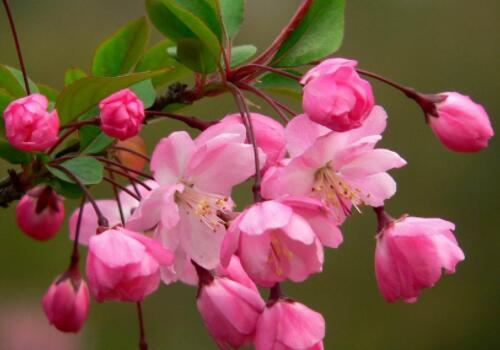
How much does a Malus halliana seedling cost per plant?
The following prices are compiled for reference only.
| Seedling name | Ground diameter (cm) | Price |
| Malus halliana | 2 | 10~14 |
| Malus halliana | 3 | 25~35 |
| Malus halliana | 4 | 65~80 |
| Malus halliana | 5 | 140~180 |
| Malus halliana | 6 | 180~260 |
| Malus halliana | 7 | 240~350 |
| Malus halliana | 8 | 360~450 |
| Malus halliana | 9 | 450~550 |
| Malus halliana | 10 | 620~750 |
| Malus halliana | 11 | 800~950 |
| Malus halliana | 12 | 1000~1200 |
Can Malus halliana fruit be eaten?
The fruiting period of Malus halliana is September-October. The fruit is round in shape with a long stalk, hanging down naturally in clusters, and looks somewhat like cherries from a distance. The fruits vary in size, the large ones no bigger than a 1-fen coin, the small ones like soybean grains, and the color also differs. The smaller grains become berry-like when ripe, red or purple, crystal clear, like agate beads.
The fruit of Malus halliana is not only ornamental, but can also be eaten by humans, with a sweet-and-sour taste. The fruit is rich in nutrients, containing a large amount of minerals and a variety of vitamins, and eating it is beneficial to health. It can also be made into preserved fruit for long-term storage.
However, what people often call "hall crabapple fruit" actually refers to the fruit of Malus spectabilis. The fruit is nearly spherical, with red skin, striking bright red in color, yellow-white flesh, and a rich fruity fragrance; eaten fresh, it is sweet, sour, fragrant and crisp.
Appendix: Cultivation methods for Malus halliana
1. Soil: It has no strict soil requirements and can grow in slightly acidic or slightly alkaline soil, but grows better in deep, loose, fertile, well-drained, slightly clayey soil.
2. Sunlight: Malus halliana likes sunlight and is not tolerant of shade; it loves a warm and humid environment, and is suitable for sunny, sheltered places.
3. Temperature: The optimum growth temperature is 15-28 degrees Celsius. Ground-planted plants can withstand low temperatures of -150 degrees Celsius in winter, and potted plants can withstand low temperatures of -5 degrees Celsius. In summer, potted plants should be properly shaded, and water should be sprayed to increase humidity and lower the temperature. In winter, it generally does not need to be moved indoors; just bury the pot in the soil.
4. Watering: During the growing season, there must be a sufficient water supply, as long as there is no water accumulation. In spring and summer, water more; during high summer temperatures, water once in the morning and once in the evening; during the plum rain period and when there is prolonged rain with no clearing, pay attention to drainage to prevent water accumulation in the pot from rotting the roots; in autumn, reduce the amount of watering to inhibit growth, which is beneficial for overwintering.