How much do red osier dogwood seedlings and seeds cost? Planting methods and symbolic meaning
Red osier dogwood, also known as Liangzi wood and red osier dogwood, blooms from May to June. The fruit is milky white or bluish white, ripening from August to October. It can be propagated by sowing, cuttings and layering. So how much do red osier dogwood seedlings and seeds cost? How do you plant it? What is its symbolic meaning? According to a seed company in Jiangsu, the planting price of red osier dogwood is around 20 yuan/jin, and it can be sown in spring, summer and autumn.
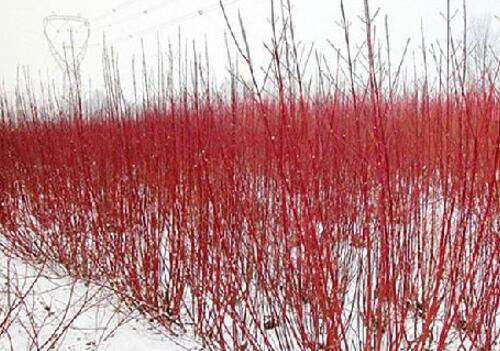
How much do red osier dogwood seedlings cost?
| Product name | Height | Crown width | Unit | Price |
| Red osier dogwood | 80 | plant | 0.8 | |
| Red osier dogwood | 150 | 50 | tree | 2.8 |
| Red osier dogwood | 150 | 60 | plant | 1.8 |
| Red osier dogwood | 100 | 30 | tree | 1.3 |
How do you plant red osier dogwood?
I. Nursery site selection
Red osier dogwood is widely distributed across most parts of our country, and in nature it often grows in mixed forests and valleys at altitudes of 150~2400 m. Red osier dogwood by nature likes warm and humid growing environments, is strongly cold-resistant, and is not tolerant of waterlogging. The nursery site for planting red osier dogwood requires loose and breathable soil, smooth drainage and sufficient sunlight, but it has no strict requirements for soil quality; sandy soil, loess soil and black soil can all be used for planting. Red osier dogwood is also a salt- and alkali-tolerant tree species, and its well-developed root system can grow in dry, rain-scarce sandy gravel soil, but for planting seedlings, good farmland that is easy to cultivate should be chosen.
II. Land preparation
1. Deep ploughing: Red osier dogwood seedlings are very sensitive to soil fertility, and poor, thin soil will cause the seedlings to be thin, small and prone to disease, so the first step after getting the land is to apply base fertilizer, with cattle, sheep and pig manure being best, at a rate of 4 tons per mu, and then plough and harrow finely once, with the standard being soft, fine, crumbly soil with no large clods.
2. Making beds: Red osier dogwood seedlings need to grow in the seedbed for one year, and to make management convenient, the land needs to be harrowed into beds of a fixed width.
III. Sowing
Once everything is ready, sowing is actually very simple. Red osier dogwood seeds themselves have a very good germination rate, and after simple pre-sprouting treatment, their germination rate is even better. Soak the seeds in clean water for 2 days, then take them out and sow, at a depth of 5 cm, mainly by drilling, with a row spacing of 30 cm and a plant spacing of 15~20 cm. After sowing, cover with plastic film to retain moisture.
IV. Seedling stage management
Red osier dogwood seeds will sprout within 10 days. The main work at the seedling stage includes loosening the soil, weeding, watering, fertilizing and controlling pests and diseases. Within 40 days after sprouting, the soil should be loosened at least once, no fertilizer is needed, and watering is decided according to weather conditions. After 40 days, begin the first fertilization, broadcasting 50 of chemical fertilizer per mu. The specific management methods also need to be decided according to the local climate and environment, and the methods must never be copied rigidly.
What is the symbolic meaning of red osier dogwood?
Red osier dogwood is a common garden tree species and carries a beautiful symbolic meaning. It symbolizes a prosperous life and good fortune year after year.
In gardens it is mostly planted in clumps on lawns or interplanted with evergreen trees, achieving an effect of red and green setting each other off. The branches and trunk are red all year round, making it a differently colored tree species for garden landscaping. The seeds contain about 30% oil and can be used for industrial purposes; it is often introduced and cultivated as an ornamental garden plant.
Landscape uses: courtyard ornament, clump planting. The autumn leaves of red osier dogwood are bright red and the small fruits are pure white. After the leaves fall, the branches and trunk are as red and vivid as coral, making it a rare stem-ornamental plant and also a good material for cut branches. In gardens it is mostly planted in clumps on lawns or interplanted with evergreen trees, achieving an effect of red and green setting each other off.