Can You Eat the Acorns of the Oak, America's National Tree? Appearance, Planting Methods and Fruiting Time
Oak, also known as the oak tree, the Mongolian oak, or the sharp-toothed white oak, is a general term for plants in the Fagaceae family, the largest flowering plant in the world, with some living up to 400 years old, and is the national tree of the United States. So what does an oak look like? When is it planted, and when does it fruit? Can its fruit be eaten? How is it grown? From Fagaceae reference materials we learn that the oak is a deciduous or evergreen tree, reaching 25 to 30 m or even more in height. The bark is dark grayish-brown, slightly smooth. The twigs are brown and hairless. The winter buds are long-ovate, 3—5 mm long, hairless, with the bud scales dark brown, numerous, and imbricate. The leaves are ovate or elliptical, 10—20 cm long and 7—10 cm wide, with an acuminate apex and a cuneate base, the leaf margin pinnately parted with 5—7 lobes on each side, the lobes bearing fine serrations, the leaf surface dark green and the underside pale green, hairless or with tufts of hair in the vein axils; the petiole is 2.5—5 cm long, hairless when old. The male inflorescences open at the same time as the leaves, several clustered together; the female flowers are solitary or 2—3 borne on a peduncle about 1 cm long.
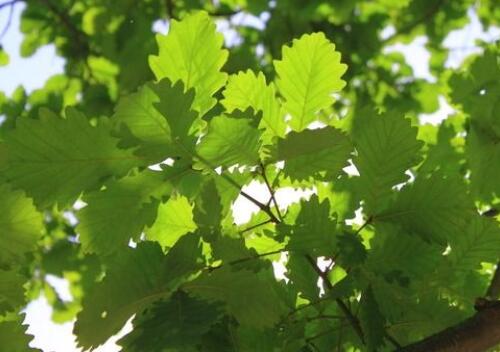
When is the oak planted, and when does it fruit?
Planting:
The best time to sow oak seeds is from February to May and from August to October each year; oak seeds sown during these two periods have the highest germination rate and grow best. Keep the sowing depth at about 1~2 cm.
Fruiting:
The oak is mainly propagated by seed and germinates in 2-3 weeks. The oak matures very late and will only flower and fruit after 10-12 years. The flowering period is generally from April to May, and the fruit ripens around October.
Can oak fruit be eaten?
1. The fruit of the oak -- the acorn -- is edible. The acorn is the fruit of the oak tree, shaped like a silkworm cocoon, hence it is also called the chestnut cocoon. The acorn has a hard outer shell, brownish-red, with a kernel inside like a peanut kernel, rich in starch, with a content of about sixty percent. It can be eaten and can also be used as a raw material for sizing yarn in the textile industry.
2. Note that some acorns (especially the black acorns of red oaks) contain large amounts of tannin; if eaten directly without treatment they will taste bitter and astringent, while the green acorns of white oaks have a lower tannin content and a sweeter taste and can be eaten raw or cooked. The basic way to prepare acorns is to boil them for a long time and change the water to remove the tannin they contain; once cooked they can be eaten directly. Acorns can also be roasted or made into dough; acorn flour often has a special fresh fragrance. Because acorns contain more oil, acorn flour must be stored with care to avoid going rancid. Acorn flour can also be used as a coffee companion.
How is the oak grown?
1. What kind of environment suits the oak
The quality of the soil directly determines how well oak seedlings grow, and also directly determines whether the seedlings grow healthily and vigorously. If the soil is good and the growing environment is good, then management will be much easier, and the quality and growth speed of the seedlings will rise accordingly. The oak is not strict about soil and can grow in sandy soil, loess, or clay; soil with a lot of sand does not matter much either. But for sowing seedlings, good-quality fields with soft, well-aerated soil, rich in organic matter, flat terrain and smooth drainage should be chosen. When summer comes the water increases, and rainwater must be able to drain away in time, otherwise large areas of seedlings may die. The terrain is mainly about favoring drainage; ordinary soil will do, with sufficient sunlight. The oak is cold-resistant, does not fear low rainfall, and has strong tolerance to waterlogging.
2. Land preparation
1. Plowing: Oak seedlings are especially sensitive to soil fertilizer; when the soil has enough fertilizer, they can grow lush and green with a healthy plant body. But the soil of a very few fields is of average fertility, so if you want the seedlings to grow sturdy and healthy, you need to apply enough organic fertilizer before sowing, broadcasting 4.5~6.5T of cow dung and pig manure per mu. After applying the fertilizer, plow once and harrow once, so that the soil and nutrients are fully and evenly mixed together, with no large clods, which is good for sowing and germination.
2. Making beds: To make irrigation, weeding, fertilizing and other management work easier throughout the entire growth period of oak seedlings, Changjing Landscape recommends that everyone make the land into fixed beds 1.4 m wide and 16~22 m long, with the details depending on the topography.
3. How is the oak grown
Oak seeds are generally medium in size and have fairly strong germination ability. Before sowing you can do some simple germination-promoting treatment; the actual process is particularly simple: soak them in cold water for a day, then take them out and dry them in the shade before planting. The sowing depth should be appropriate or preferably shallow, with the covering soil no more than 5 cm deep. Row sowing is commonly used; after sowing you can also lay plastic film, or moisture-retaining material such as rice straw, to increase the germination rate. After planting, you can use manual raking or mechanical raking to cover the soil; after covering with soil, irrigate once, and they will germinate in about 6~9 days.
4. How is the oak cared for
There is little management and protection work during the oak's seedling stage; it basically has no pests or diseases, and its growth condition is good. The main work is only irrigation, weeding, and preventing pests and diseases. During the peak growth period of the Astragalus, unlimited water and fertilizer are needed. During this period, 30 kg of compound fertilizer can be applied per mu as a top dressing. During the time when the oak grows fastest, sufficient water is also needed; at this time, the number and timing of waterings should be decided according to the rainfall conditions.