Which fig variety is the best? Investment cost and planting methods for two mu of land
The fig is a flowering plant belonging to the genus Ficus in the mulberry family (Moraceae). It mainly grows in tropical and temperate regions and is a subtropical deciduous small tree. So which fig variety is the best to plant? Roughly how much does it cost to invest in two mu of land? The fig planting methods are compiled for you as follows:
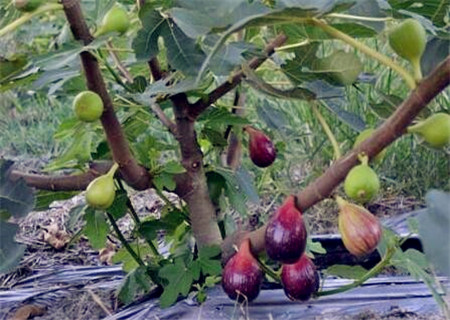
Which fig variety is the best to plant?
Figs fall into five classifications: Huangguo No. 1, Lüguo No. 1, Masui Dauphine, Brunswick, and Penglai Persimmon. There is not much difference in nutritional value among figs; green figs are the best, and Laoyang figs are the first choice.
Huangguo No. 1: Selected from superior individual large yellow fig plants, it is a dual-purpose variety for summer and autumn crops.
Lüguo No. 1: The canopy is naturally round-headed, the tree vigor is strong, and the tree posture is semi-spreading. This variety is dual-purpose for summer and autumn crops, mainly autumn crops.
Masui Dauphine: Dual-purpose for summer and autumn crops, produced in Japan.
Brunswick: A dual-purpose variety for summer and autumn crops, with few summer fruits and mainly autumn fruits. The summer fruits are oval and green-yellow when ripe.
Penglai Persimmon: A dedicated autumn-crop variety, with very few summer fruits.
Roughly how much does it cost to invest in planting two mu of figs
Investment per mu for open-field fig planting:
First-year investment: 1. Land rent; 2. Seedling cost; 3. Land preparation and planting cost; 4. Fertilizer; 5. Drainage and irrigation; 6. Loosening soil and weeding (generally intercropping is possible); 7. Others. The last four items generally total about 1,000 yuan.
Investment in each subsequent year: 1. Land rent; 2. Fertilizer; 3. Drainage and irrigation; 4. Tending and weeding; 5. Others. The last four items generally total about 1,000 yuan. If cold protection is needed, about 500 yuan should be added, depending on the region.
What time is suitable for planting figs
The planting time for figs varies depending on the growing region. The suitable period for field planting in North China should be around Qingming, in Northeast China it is best around Guyu, and in the south they can be transplanted and field-planted after leaf fall in autumn, but the flowering and fruiting period should be avoided.
Fig planting methods
Training and pruning
Trunk determination for plastic greenhouse planting: the trunk height of the border row is 30 cm, increasing by 10 cm row by row toward the middle. For solar greenhouse planting, the trunk height of the first row at the front is 30 cm, increasing by 10 cm successively toward the back; if planting in north-south rows, the principle of lower in the south (front) and higher in the north (back) within the row should also be followed for trunk height, forming a certain gradient to adapt to the space inside the greenhouse and make rational use of light.
Figs are relatively light-loving, so the tree shape should preferably be an open-center or flat form without a central leader. The main tree shapes used in production include natural open-center, natural round-headed, cup-shaped, horizontal “I” shape, and horizontal “X” shape. However, the tree shapes suitable for protected cultivation are mainly the horizontal “I” shape, horizontal “X” shape, and clump shape. Generally, with a row spacing of 2-3 m × 1.5-2.0 m, the “I” shape is used for pruning; with a row spacing of 2-3 m × 2.0-2.5, the “X” shape is used for pruning.
1) Horizontal “I” shape. This is a tree shape used more often in Japan and is especially suitable for protected cultivation. It requires a trellis, similar to the single-arm trellis form of grapes. In its tree structure, two main branches grow on the trunk, extending horizontally to the left and right along the row direction. On each main branch, fruiting mother branches are arranged on both sides at intervals of about 20 cm, with a spacing of about 40 cm on the same side.
2) Horizontal “X” shape. In the tree structure, four main branches grow on the trunk, with every two main branches forming one side along the row direction, extending horizontally forward while maintaining a certain distance. Fruiting mother branches are arranged on both sides of the main branches at intervals of 20 cm. The whole tree presents a flat “X” shape along the row direction, similar to the double-arm trellis of grapes.
12