Causes of flower and fruit drop in pomegranate trees and the pesticides used to improve fruit set and prevent fruit rot
Pomegranate trees generally refer to the pomegranate, also known as An pomegranate, Shanliye, Danruo, Ruoliumu, Jinying, Jinpang, Tulin, Tianjiang, and are cultivated in both northern and southern China. So what causes flower and fruit drop in pomegranate trees? How can fruit set be improved and fruit rot prevented? What pesticide should be sprayed?
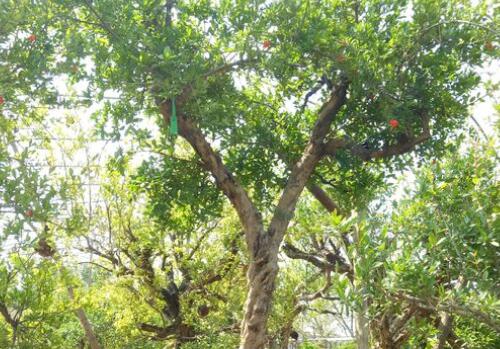
What causes flower and fruit drop in pomegranate trees?
1. Because fertilizer and water are sufficient, the nutrients accumulated by the tree are not enough, the proportion of fruiting flowers is not high, and there are many empty flowers, causing flower drop;
2. Cultivation and management are extensive, fertilizer and water cannot keep up, tree vigor is weak, and nutrients are not supplemented in time before and after flowering, causing flower and fruit drop;
3. Rainy weather during the flowering period affects insect activity, pollination and fertilization of pomegranate are poor, causing flower and fruit drop;
4. Low temperatures during the young fruit formation period cause fruit drop.
How can the fruit set rate of pomegranate trees be improved? What pesticide should be sprayed?
1. Control the tree's growth vigor and regulate the contradiction between branch growth and fruiting: for vigorously growing trees, methods such as root cutting, pinching, branch twisting, branch bending, and branch pulling can be used to promote flower bud differentiation and make them flower and bear fruit.
2. Strengthen fertilizer and water management: apply good post-harvest fertilizer in autumn, increase the application of organic fertilizer, enhance tree vigor, strengthen fertilizer and water management at the bud stage, improve the tree's nutritional status, and increase the proportion of normal flowers. For young vigorous trees, apply less or no nitrogen fertilizer.
3. Manually remove empty flowers: when the flower buds have just appeared and can be distinguished as to whether they are normal flowers (the flower buds are gourd-shaped), commonly known as "gege flowers", remove the degenerated flowers, commonly known as "guniang flowers", paying special attention to removing the degenerated buds and flowers below the terminal normal flowers of fruiting branches. For flower branches that are entirely degenerated flowers, cut them back to a vigorous position, so as to preserve the tree's nutrients and improve the fruit set rate.
4. Spray trace elements: spraying boron fertilizer (0.2%-0.3% borax) or amino acid foliar fertilizer at 500-600 times dilution during the flowering period can effectively reduce flower and fruit drop. Spraying 0.2%-0.3% monopotassium phosphate and other foliar fertilizers during the young fruit stage can enhance the freezing resistance of young fruits and has a great effect on reducing fruit drop caused by late spring cold.
5. Prune useless new branches inside the canopy: after budding in spring, promptly prune useless new branches inside the canopy to reduce nutrient consumption and reduce flower and fruit drop. Pruning of useless new branches should be done as soon as they emerge.
6. To control aphids, simply use: 40% dimethoate emulsifiable concentrate at 800 times dilution, or 30% Taoxiaoling emulsifiable concentrate at 2000 times dilution, or 20% fenpropathrin emulsifiable concentrate at 3000 times dilution, or 20% fenvalerate at 2000 times dilution, or 20% fenvalerate-malathion emulsifiable concentrate at 3000 times dilution for control, with very good results.
How can pomegranate fruit rot be prevented?
1. Winter orchard cleaning. After winter pruning, promptly remove diseased and insect-damaged branches and leaves, rotten fruits, and mummified fruits, scrape off old cracked bark and disease and insect spots on the trees, and bury them deeply or burn them to reduce sources of disease and insects. After leaf fall and before budding, spray the whole orchard once with 3-5 degrees Baume lime sulfur mixture, and whitewash the trunks. The whitewash can be prepared with 10 parts quicklime, 0.5-1 part salt, 2 parts lime sulfur mixture stock solution, 40 parts water, and 2 parts clay.
2. Fruit management. After fruit thinning and fruit setting, use 50% phoxim at 100 times dilution plus 70% thiophanate-methyl at 800 times dilution as medicated cotton to plug the fruit calyx tube. After spraying the whole orchard once with fungicide and insecticide, bag the fruits, which can effectively prevent disease and insect damage and mechanical injury, and reduce fruit cracking.
3. Chemical control. During the pomegranate growth period, spray 40% carbendazim at 800 times dilution or 70% thiophanate-methyl at 1000 times dilution or M-45 Dacotech wettable powder at 800 times dilution to control dry rot, brown spot, and other diseases; in early to mid-May, spread phoxim poisoned soil on the ground or spray 50% phoxim at 100 times dilution, and shallowly turn the orchard soil so that the medicated soil is mixed, to control overwintering larvae of the peach fruit borer and the peach fruit moth. Then, according to insect conditions, in mid to late May, at intervals of 10-15 days, spray 50% phoxim at 1500-2000 times dilution or 2.5% deltamethrin at 3000-5000 times dilution for control.