Rare Plant Chinese Tulip Tree Sapling Prices, Planting, Flowering and Propagation Methods
The Chinese tulip tree, also known as the horse jacket tree and double-floating tree, is a rare plant endemic to China. It is a large deciduous tree, reaching up to 40 m tall with a diameter at breast height of more than 1 m, and its branchlets are gray or grayish brown. So how much does a Chinese tulip tree sapling cost? When should it be planted and when does it bloom? How do you propagate and plant it?
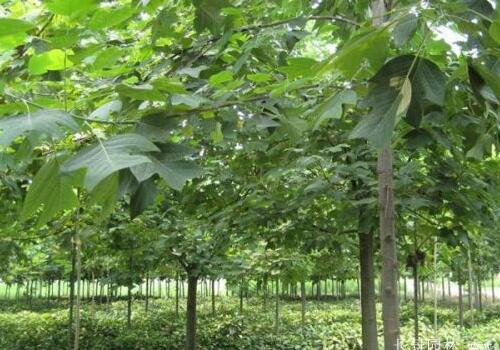
How much does a Chinese tulip tree sapling cost?
Prices vary with different sapling specifications. The following prices are compiled for reference only.
| Sapling name | Diameter at 1 m height (cm) | Unit price (yuan) |
| Chinese tulip tree | 8 | 130~180 |
| Chinese tulip tree | 10 | 240~280 |
| Chinese tulip tree | 13 | 450~500 |
| Chinese tulip tree | 14 | 800~950 |
| Chinese tulip tree | 15 | 1100~1300 |
| Chinese tulip tree | 16 | 1500~1800 |
When should the Chinese tulip tree be planted and when does it bloom?
Planting:
The Chinese tulip tree is propagated from seeds and must be hand-pollinated. In autumn, the seeds are collected and selected, then stratified in damp sand to overwinter, and sown for seedling propagation in the following spring. In the third year, once the seedlings are more than 1 m tall, they can be lifted from the nursery and planted out. The roots should be protected when transplanting. The growing medium should be deep, fertile, well-drained acidic or slightly acidic soil.
Planting is generally carried out in early to mid-March. A relatively shaded valley or the lower and middle slopes of a hillside should be chosen.
Flowering:
The aggregate fruit of the Chinese tulip tree is 7-9 cm long, and the winged nutlets are about 6 mm long with blunt or bluntly pointed tips, containing 1-2 seeds. The flowering period is May, and the fruiting period is September-October.
How do you propagate and plant the Chinese tulip tree?
1. The propagation site for the Chinese tulip tree should be a wind-sheltered, sunny spot with deep, fertile, moist, well-drained sandy loam. Deep plow in late autumn and early winter, apply base fertilizer and level the soil the following spring, dig drainage ditches, and build raised beds with the beds oriented east-west. There are two propagation methods: sowing and cuttings. Sowing propagation uses drills with a row spacing of 20-25 cm and a sowing rate of 10-15 kg per 667 sq m. Sow in early March, then cover with fine soil and straw. Seedlings generally emerge after 20-30 days, after which the straw is removed, and timely cultivating and weeding, moderate shading, and timely watering and fertilizing are required. One-year-old seedlings can reach 40 cm tall.
2. Cutting propagation
(1) When selecting cuttings, consider the position effect and the condition of the mother tree; both hardwood cuttings and softwood cuttings can be used.
(2) Hardwood cuttings. Select healthy 1-year-old shoots more than 0.5 cm thick, cut them into 15-20 cm cuttings with a slanted lower cut, and each segment should have 2-3 buds. Insert two-thirds of the cutting into the soil. Before cutting, soak the base of the cuttings in 50 mg/L No. II ABT rooting powder plus 500 mg/L carbendazim for about 30 min. Cuttings should be taken and inserted promptly; after insertion, shade facilities are needed and water should be sprayed frequently. The survival rate can reach about 75%.
(3) Softwood cuttings. Cut current-year semi-lignified shoots, retaining 1-2 leaves or half a leaf, and use the full-light mist method for cutting from June to September. Use perlite or relatively clean, medium river sand as the cutting medium, and keep the leaf surface moist; the survival rate is generally 50%-60%. Fifty days after cutting, apply foliar fertilizer to the cuttings to increase the survival rate and promote cutting growth.
(4) Planting is generally carried out in early to mid-March. A relatively shaded valley or the lower and middle slopes of a hillside should be chosen. For garden landscaping and street trees, choose a site with deep, fertile, moist soil. The planting site should be thoroughly cleared in late autumn and early winter, and holes should be dug at fixed points with a diameter of 60-80 cm and a depth of 50-60 cm. In early to mid-March of the following year, apply fertilizer, backfill soil, and then plant. The saplings used are generally 2-year-old; after lifting, take care to prevent moisture loss from the saplings and protect the roots, and plant as soon as possible after lifting. A plant-to-row spacing of 2×2 m to 2×3 m is suitable.