Sowing Time, Blooming Duration and Planting Methods of the Oilseed Crop Sunflower
The sunflower can be grown not only as an ornamental flower but also for oil pressing; it is an important oilseed crop in China with very high cultivation value and is grown in all parts of the country. So when should sunflowers be sown? How long does it take from sowing to flowering?
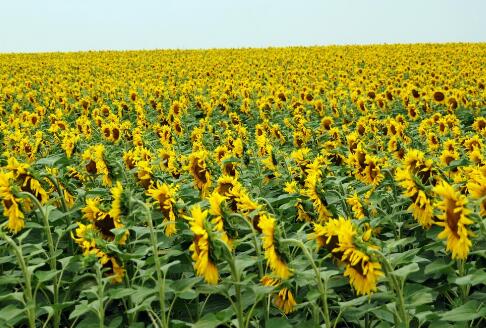
Normally, sunflowers are sown in April, bloom from July to August, and their seeds ripen from August to September. In fact, sunflowers can bloom all year round, and the secret lies in "accumulated temperature". That is, during the growth process, as long as the plant has accumulated a certain amount of warmth, it will be able to flower.
It generally takes 6 to 9 days for a single flower head to go from the opening of the ray florets to the completion of the opening of the tubular florets. From the second day to the fifth day is the full-bloom stage of that inflorescence. The number of flowers opening during these 4 days accounts for about 75% of the total. Flowers mostly open between 4 and 6 in the morning, and pollination and fertilization take place the following morning. Unfertilized stigmas can remain without wilting for 7 to 10 days. Self-pollination in sunflowers sets seed at an extremely low rate, only about 3%, whereas cross-pollination gives a high seed-setting rate.
The sunflower is one of the world's four major oilseed crops and was introduced into China around the Ming Dynasty. China's main sunflower-producing areas are distributed across the Northeast, Northwest and North China regions, such as Inner Mongolia, Jilin, Liaoning, Heilongjiang, Shanxi and other provinces and autonomous regions. The main production areas lie between 35° and 55° north latitude. For every 1° difference in average latitude, the temperature differs by 1.5°C. The sunflower has great production potential and can be extended to the Southwest, Central South and East China regions.
Sunflower Planting Methods
1. Site selection and land preparation
For sunflower cultivation, choose a plot with level land, medium fertility, convenient irrigation and drainage, and relatively low soil clay content; it should not be planted in successive cropping. It reproduces by seed, and peat soil is suitable for sowing. Before sowing, dress the seed with New High-Lipid Film, which can repel soil pests, isolate viral infection and raise the seed germination rate.
2. Sowing at the right time
Sunflowers are generally sown from March to April, and the suitable temperature for sowing is 18 to 25°C; seedlings usually emerge about 5 to 7 days after sowing. The basic principle for choosing the sowing date is to sow appropriately early or late according to the patterns of salinization, so that the seedlings avoid salt-alkali damage. Spring sowing or summer sowing is carried out according to the growth period of the variety.
3. Inspecting the field and filling in seedlings
The sunflower is a dicotyledonous crop, and its seedlings have a hard time pushing through the soil. In addition, poor land preparation or sowing quality, or surface soil crusting after rain, or damage by disease, insects, rodents and birds, can easily cause missing plants and gaps in the rows. To ensure a full stand from one sowing, the field must be checked row by row during the emergence stage, and where plants are missing in patches or whole rows, reseeding must be done promptly.
4. Thinning and final singling
In sunflower cultivation, thinning should be done early to prevent seedlings from crowding one another and affecting the raising of strong seedlings and even later yield; on saline-alkali land and in plots with heavy pest damage, final singling can be appropriately delayed. At the same time, sunflowers should be singled early, which helps raise strong seedlings and also benefits flower head development; final singling should be carried out when there are 2 pairs of true leaves.
5. Cultivation and weeding
Sunflowers are generally cultivated 2 to 3 times, which serves to control weeds and loosen the soil, break up crusting, conserve water, reduce evaporation and lessen salt-alkali damage. The first cultivation is carried out at the 1 to 2 pairs of true leaves stage together with thinning and final singling, the second cultivation 1 week after final singling, and the third cultivation before the rows close, together with trenching, earthing up and fertilizing.
6. Trenching and topdressing
Sunflowers rather like fertilizer; trenching and topdressing are usually carried out at the third cultivation, mainly with nitrogen and phosphorus fertilizer, applying 5 kg of diammonium phosphate and 10 kg of urea per mu, mixed evenly and worked into the soil. Trenching and earthing up can effectively ensure the growth and development of secondary roots, prevent lodging and reduce branching on the base below the cotyledon node.
7. Irrigation at the right time
Sunflowers are irrigated by the furrow method. For varieties with a plant height of 1.5 m, the first watering should be done at the flower bud stage, the second at the early flowering stage and the third at the grain-filling stage. For varieties with a plant height of about 2 m, the first watering is done 4 to 5 days before flowering (in severe drought, watering is brought forward), the second 6 to 7 days after the first, and the third at the grain-filling stage.
8. Pollination management
Sunflowers have a low seed-setting rate from self-pollination and a high rate from cross-pollination, so during cultivation, manual supplementary pollination should be carried out in good time, using methods such as touching flower head to flower head, powder puffs or cotton gloves to transfer pollen, or collecting pollen from the father parent and gently dabbing it onto the stigma of the mother parent with a small brush; pollination is done 3 to 4 times during the full-bloom stage.
Why sunflowers always face the sun
The following is a description, analyzed from the perspective of biological science, of why sunflowers turn toward the sun:
During the period from germination until the flower head opens fully, the sunflower does indeed turn toward the sun; its leaves and flower head follow the sun from east to west during the day, though not instantly. Botanists have measured that the direction the flower head points lags about 12 degrees behind the sun, that is, 48 minutes. After the sun sets, the sunflower's flower head slowly swings back, and at about 3 a.m. it again faces east, waiting for the sun to rise.
Under sunlight, the auxin content on the shaded side of the sunflower increases, stimulating the cells on the shaded side to elongate and turn the plant toward the sun. After the sun sets, the auxin is redistributed, causing the sunflower to turn back to the east.
After the flower head opens fully, it no longer turns toward the sun but remains fixed facing east. Sunflower pollen is afraid of high temperatures; if the temperature is above 30°C, it will be scorched, so fixing the head facing east can avoid direct midday sunlight and reduce the amount of radiation. However, the flower head being exposed to sunlight in the morning helps dry the dew that condenses at night, reducing the possibility of mold attack; in addition, the morning temperature is lower, and the sunlight makes the sunflower's flower head a warm little nest that can attract insects to help with pollination.
The auxin in the receptacle of the sunflower is distributed on the shaded side, so the stem on the shaded side grows faster, and the stem bends toward the light source.
The sunflower gets its name because in the early growth stage the tip of the young plant and in the middle stage the young flower head follow the sun very noticeably. People believe that the sunflower facing the sun is related not only to light exposure but also closely to the effect of gravity.