Baby's Breath Seed Planting Methods, Timing, and Color Varieties That All Girls Love
Baby's breath (Gypsophila paniculata), a perennial herb in the carnation family (Caryophyllaceae), genus Gypsophila. Its roots and stems can be used medicinally. It is cultivated for ornamental purposes. Do you know the planting methods for baby's breath seeds that all girls love? When is the best time to plant them? How many colors are there? The flower language of baby's breath is: willing to play the supporting role in love, only wishing to be by your side.
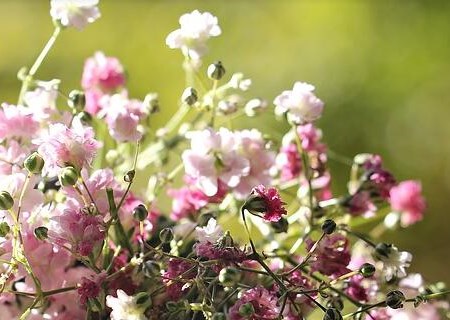
I. Planting Methods for Baby's Breath
When sowing baby's breath, place an appropriate amount of soil in a container, water it thoroughly first, then sow the seeds. During the germination stage, baby's breath needs light, so the seeds can be left exposed or only covered with a thin layer of soil. Keep the soil moist and maintain the temperature at around 20°C; germination usually occurs in about one week.
After baby's breath germinates, place it in a spot with light, keep the soil moist, and maintain a relatively stable temperature. It can be transplanted in about 3 weeks.
When transplanting baby's breath, choose a flower pot with a 10 cm diameter. You can plant a single seedling or plant 2——3 seedlings together, but choose a larger pot in that case.
When growing baby's breath, note the following: apply some fertilizer appropriately, maintain sufficient light, water based on the principle of "dry-wet cycle" (water when dry), and make sure the temperature does not get too high.
II. When Is the Best Time to Plant
Choose loose soil to make a seedbed, sow in September, cover with a thin layer of fine soil, and germination occurs in about 10 days. Before winter, move to a cold frame to overwinter. The optimal germination temperature is 15-20°C. The optimal growing temperature is 10-25°C. Sowing period: early autumn to early spring.
Seedling transplanting: After baby's breath seedlings have established, transplant them with soil to open ground the following spring. After the seedlings have established and survived, pinch once to encourage more branching. Once the plant height reaches over 20 cm, reduce the amount of watering. Slight drought can promote flowering, and flowering generally occurs in mid-to-late May.
In cold regions, spring sowing is suitable; in areas where the soil does not freeze, autumn sowing can be done. The optimal germination temperature is 21-22°C. Seedlings emerge in 7-10 days. After transplanting, pinch when the plant grows to about 8 nodes, and remove buds when side shoots reach 5-10 cm, removing weak ones and keeping strong ones. Water frequently in the early stage after transplanting, and moderately control water when flower buds begin to form.
This species can also be directly sown in open ground before the ground freezes in November, or sown in early spring.
III. What Varieties of Baby's Breath Are There
Million Stars (Xiannv)
The most widely used in cut flower production, accounting for about 80%. It is a small-flowered type. The flowers are white, and it is highly adaptable, able to withstand summer heat and winter cold. It is relatively easy to cultivate and easy to produce year-round. It can also be cultivated in summer, can bloom year-round, and the flowers are pure white.
Perfect (Wanmei)
Large flowers, short internodes, thick and upright stems, relatively large flowers, crystal white. Suitable for making corsages and dried flowers. During high temperatures, it tends to form rosette-like clusters; at low temperatures, flowering stops. It is difficult to cultivate and expensive.
Diamond (Zuanshi)
A large-flowered variety selected from Million Stars. It has short internodes, and flowering is delayed at low temperatures. Year-round production is relatively difficult. The plant is relatively short, grows vigorously and easily, blooms in autumn, and the flowers are pure white.
Flamingo (Huolieniao)
Flowers are light pink, flowers are small, stems are slender, blooms in spring.
Red Sea (Hong Haiyang)
Flowers are deep peach-red, flowers are large, stems are thick. In high-altitude cold regions, plant in spring and sell in autumn. The flower color is very vivid and does not fade easily. In warm regions, it can bloom from autumn to spring. It is a newly bred variety.