Dwarf sunflower seed planting method and timing: will it produce sunflower seeds?
The dwarf sunflower is an emerging ornamental flowering plant variety for open-ground cultivation. Its history of artificial cultivation is relatively short, but it has developed very quickly and has now become a new favorite in the flower family. So do you know what the seed planting methods for dwarf sunflowers are? When should they be planted? Will they produce sunflower seeds? Dwarf sunflowers are highly favored for their high ornamental value. Dwarf sunflowers are annual herbs. The plant height is 50-70 cm.
I. Planting methods and pest and disease control
1. Variety selection
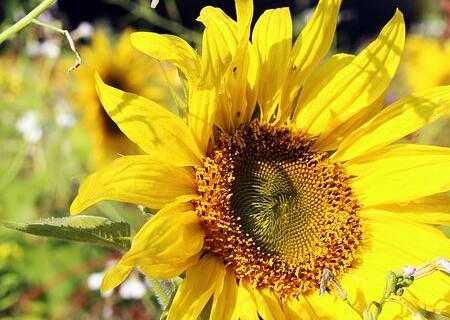
It is recommended to choose the Big Smile variety among dwarf sunflowers. This variety has a plant height of 30 to 40 cm, a flower diameter of 10 to 17 cm, bright golden-yellow single petals, and a black flower center. Generally, it can bloom 50 to 55 days after sowing, and it is suitable for potted planting and flowerbed planting.
2. Sowing
Seedling raising adopts seed propagation. Sowing is generally carried out in April. The optimum temperature for germination is 15 to 18°C. Shallow pots or shallow boxes can be used for sowing, and the medium should be loose, have good water retention, and be sterile, etc. Sowing is best done by dibbling, with 2 seeds per hole. After sowing, cover with 1 to 2 cm of medium to maintain the humidity needed for germination, increase stability during the seedling stage, and reduce the occurrence of seedlings with seed coats. Generally, germination occurs 7 to 14 days after sowing. After emergence, pay attention to ventilation and cooling, control humidity, and gradually expose them to light. (The seeds do not need to be soaked. When planting the seeds, place the pointed end downward. Put two seeds in a small flowerpot with a diameter of about 20 cm. If you are worried about a low germination rate, it is also fine to put a few more seeds at the beginning.)
3. Cultivation
When just planted, keep the soil moist. After emergence, as long as the leaves are not wilting, it does not count as lacking water. Do not water too much, otherwise the roots will rot. When watering, note that in hot weather, water early in the morning, and if watering in the evening, do it later. After emergence, keep two to three seedlings; too many is not good for growth. Dwarf sunflowers like sunlight, so remember to maintain sufficient light, preferably more than 8 hours per day. Pay attention to applying sufficient base fertilizer, mainly phosphorus and potassium fertilizers, and apply nitrogen fertilizer lightly.
Planting and care: after the seedlings emerge uniformly, thin them gradually, keeping 1 plant per hole. When the seedlings are 7 to 8 cm tall, they can be planted out. The potting soil is best as sandy soil rich in humus and with good drainage. When planting out, apply sufficient base fertilizer at the bottom of the pot. When digging up the seedlings, carry as much soil as possible and damage the roots as little as possible, so that the plants recover more quickly.
During the growing period, fertilize once every 20 days, but before flowering, apply 2 to 3 additional light applications of phosphorus and potassium fertilizer. Keep the soil moist at all times, especially during high summer temperatures and drought, when timely watering is needed. To make the terminal bud of the main stem grow robustly, side (axillary) buds can be removed. For those with slightly taller stems, set up supports to prevent lodging from the wind. During flowering, perform artificial pollination, which can increase the seed-setting rate.
4. Pest and disease control
Common pests and diseases include powdery mildew and black spot. When powdery mildew occurs, white round powdery spots begin to appear on the leaves, and after they expand they join into one mass, after which small brown dots appear on the white powdery layer, and plant growth stops. When black spot occurs, dark brown or light yellow lesions of varying sizes appear on the leaves, later developing into brown spots. The lesions connect into large patches, causing the leaves to turn black and die. When the disease occurs, remove the remaining plants and spray 75{bf} chlorothalonil wettable powder at 500 times dilution or 70{bf} thiophanate-methyl wettable powder at 800 times dilution for control. The main insect pests are mirid bugs and red spider mites, which can be controlled by spraying 40{bf} omethoate emulsifiable concentrate at 800 times dilution or 73{bf} propargite emulsifiable concentrate at 1500 times dilution.
II. When to plant
Usually, sunflowers are sown in April, bloom from July to August, and the seeds mature from August to September. In fact, sunflowers can bloom all year round, and the secret is "accumulated temperature." That is, during the growth process, as long as the plant has accumulated a certain amount of temperature, it can bloom. From the opening of the ray florets to the completion of opening of the tubular florets, a flower head generally takes 6 to 9 days. From the second day to the fifth day is the full blooming period of the inflorescence. The number of flowers opening during these 4 days accounts for about 75% of the total number of opened flowers. Flowers mostly open from 4 to 6 in the morning, and pollination and fertilization occur the next morning. Unfertilized stigmas can remain without withering for 7 to 10 days. The seed-setting rate of self-pollination in sunflowers is extremely low, only about 3%, while the seed-setting rate of cross-pollination is high.
III. Will dwarf sunflowers produce sunflower seeds?
Of course they will produce sunflower seeds, and they also have the effect of treating insomnia and enhancing memory. They have a certain preventive effect on cancer, high blood pressure, and neurasthenia. As a kind of nut, sunflower seed kernels are also relatively rich in oil and energy. At the same time, after being roasted, sunflower seed kernels are hot in nature. Eating too many may not only cause excessive energy intake, but may also lead to internal heat. Sunflower seeds are tasty, but you should not eat too many.