Oleaceae Forsythia (Golden Bell) - How much per jin? Cultivation methods introduced
Forsythia, also known as Golden Bell or Huangshoudan, can be planted as a flowering hedge or embankment-protecting tree. Forsythia blooms in early spring before its leaves emerge, with branches full of golden yellow, gorgeously lovely, making it an excellent early-spring ornamental flowering shrub. Its stems, leaves, fruits, and roots can all be used medicinally. So do you know the price of Forsythia per jin? How is it cultivated? According to market information, the price of Forsythia is about 20-25 yuan per jin, but prices vary considerably depending on quality, variety, place of origin, and market conditions. Medicinal Forsythia is divided into two types: Qingqiao and Laoqiao. Qingqiao is harvested in early September when the fruit peel is still green and unripe, briefly boiled in boiling water or steamed in a steamer for about 0.5 hours, then removed and sun-dried. Laoqiao is harvested in early October when the fruit is fully ripe and has turned yellow with the fruit shell splitting open, then sun-dried and sifted to remove seeds and impurities.
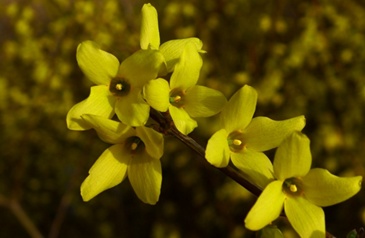
I. Morphological characteristics of Forsythia flowers
Deciduous shrub, up to 3 m tall. Stems clustered, erect; branches spreading, arching and drooping; branchlets yellowish brown, slightly four-angled, with numerous and prominent lenticels, pith hollow. Simple leaves, a few leaves 3-lobed or cleft into 3 leaflets, opposite, ovate, broadly ovate, or elliptic-ovate, 3-10 cm long, glabrous, apex acute, base rounded to broadly cuneate, margin coarsely serrate. Flowers open before leaves, usually solitary, rarely 3 in axillary clusters; calyx lobes 4, oblong; corolla yellow, lobes 4, obovate-elliptic; stamens 2; pistil longer or shorter than stamens. Capsule ovoid, surface scattered with warty dots. Flowers in March-April before leaves.
II. Properties of Forsythia flowers
This product is oblong-ovate to ovate, slightly flattened, 1.6-2.5 cm long, 0.5-1.3 cm in diameter. The surface has irregular longitudinal wrinkles and numerous raised small spots, with 1 distinct longitudinal groove on each side.
Apex acute, base with a small fruit stalk or the stalk already fallen off. “Qingqiao” mostly does not split open, surface greenish brown, with fewer raised grayish-white small spots; texture hard; seeds numerous, yellow-green, slender, with a wing on one side. “Laoqiao” splits open from the apex or splits into two valves, surface yellow-brown or reddish-brown, inner surface mostly light yellow-brown, smooth, with one longitudinal septum; texture brittle; seeds brown, mostly already fallen off. Odor faintly fragrant, taste bitter.
III. Suitable ecological and climatic conditions for Forsythia cultivation
1. Temperature conditions. Forsythia often grows in sparse shrub thickets on semi-shaded slopes or sunny slopes at altitudes of 200-2000 m. It prefers a warm, humid, and sunny ecological climate environment, and has characteristics such as cold resistance, drought resistance, waterlogging resistance, barren tolerance, and strong twig sprouting ability. It can grow in environments with an annual average temperature of 8-12°C, with the optimal growth temperature being 18-20°C. Growth is inhibited when the maximum temperature exceeds 35°C or the minimum temperature falls below -15°C. The suitable temperature for the sowing period is 10-15°C, the optimal temperature for the flowering period is 18-20°C, and the annual frost-free period during the growing season is greater than 170 days.
2. Precipitation conditions. Forsythia can grow in fertile and barren land, on cliffs, and in rock crevices, and is suitable for subtropical and warm temperate climates. Within its natural distribution area, it requires an annual precipitation of 800-1000 mm and a relative humidity of 60%-75% as suitable. Excessive precipitation and overly high humidity can easily lead to lodging and pod mildew.
3. Light conditions. Forsythia requires a sunny ecological environment, with annual sunshine hours greater than 1500 hours, annual accumulated temperature ≥0°C of 4000-6000°C, average temperature of the hottest month above 25°C, and average temperature of the coldest month of -5 to 5°C. It is not very demanding regarding soil, and can grow normally in neutral, slightly acidic, or slightly alkaline soil, but grows better in well-drained, humus-rich sandy loam, which is favorable for quality and yield formation.
IV. Forsythia cultivation methods
1. Site selection and land preparation. Choose a plot that is sunny, with fertile soil, loose texture, and good drainage, sandy loam. Plow in autumn to a depth of 20-25 cm, and apply base fertilizer together with land preparation, applying 2000-2500 kg of barnyard manure per mu, then harrow fine and level. For direct seeding land, use a plant spacing of 150 cm × 200 cm, with a hole depth and hole diameter of 30-40 cm; for seedling land, make flat beds 1 m wide, with the length depending on the terrain.
2. Growing environment. It prefers a warm, humid environment. It likes light and is cold-resistant, and can overwinter outdoors south of the Yangtze River. It prefers sunny slopes, is not demanding regarding soil, is drought and barren tolerant, fears waterlogging, and is most suited to deep, fertile calcareous soil.
3. Propagation methods. Mainly seed propagation and cutting propagation, and also layering and division propagation.
(1) Seed propagation by direct seeding. In the south, in early to mid-March; in the north, in early April. Dig a small hole about 3 cm deep in the prepared planting hole, select mature, plump, disease-free seeds, sow 5-10 seeds per hole, cover with soil and press lightly so that the seeds and soil are closely combined. Generally, it blooms and bears fruit after 3-4 years.
Seedling raising and transplanting: On a leveled and finely harrowed seedbed, open furrows 1 cm deep at a row spacing of 20 cm, evenly scatter the seeds mixed with fine sand into the furrows, cover with soil and press lightly, using 2 kg of seeds per mu. For spring sowing, seedlings emerge in about half a month. When the seedlings are 5 cm tall, thin them; when 10 cm tall, loosen the soil and hoe weeds, and apply 10 kg of urea per mu, applying it with irrigation water to promote seedling growth. Transplant in autumn of the same year or before bud break in spring of the following year. Use a plant spacing of 200 cm × 150 cm, hole diameter 30 cm, apply 5 kg of mixed fertilizer, mix evenly with soil, plant 2-3 seedlings, fill with soil to half the hole, lift the seedlings slightly so the roots spread out, then fill with soil to the top and firm it. If the soil is dry, water after transplanting, and after the water seeps down, cultivate soil to conserve moisture.
(2) Cutting propagation. On cloudy and rainy days in summer, cut the middle and upper parts of 1-2 year old tender branches into 30 cm long cuttings, open furrows 20 cm deep on the seedbed at a plant spacing of 5 cm × 30 cm, place them obliquely in the furrows, then cover with soil and press firmly, keeping the bed moist. They can take root and survive the same year, and are transplanted before bud break in spring of the following year. Generally, they can bloom and bear fruit in the same year of transplanting or the following year.
4. Field management: During the seedling stage of seed propagation, when the seedlings are 20 cm tall, weed, loosen the soil, and thin the seedlings. When thinning, leave 2 plants per hole, and water in a timely manner. When the seedlings are 30-40 cm tall, apply diluted human and animal urine once to promote growth. When the main trunk is 70-80 cm tall, cut off the top shoot to encourage more lateral branches and cultivate main branches. Afterward, select and retain 3-4 strong branches on the main branches to cultivate into secondary main branches, which then produce lateral branches. Through pruning and shaping, form a natural open-center tree shape with a low trunk and low crown, hollow inside and rounded outside, ventilated and light-transmitting, with sparse small branches and early fruiting. At any time, cut off weak twigs, water sprouts, and diseased and pest-infested branches. During the fruiting period, apply farmyard manure and phosphorus and potassium fertilizers to promote early fruit set and ripening.
5. Shaping and pruning. The main trunk is 80-100 cm tall; cut off the top shoot to promote lateral branches. Afterward, select and retain 3-4 lateral branches on the main branches to cultivate into secondary main branches, and the secondary main branches then develop lateral branches. Through pruning and shaping, form a natural open-center tree shape with a low trunk and low crown, hollow inside and rounded outside, ventilated and light-transmitting, with sparse small branches and early fruiting. Every year after leaf fall in winter, cut off dead branches, old branches, weak branches, diseased and pest-infested branches, and water sprouts to promote the growth of new fruiting branches.
V. Value and uses of Forsythia
1. Landscaping:
Forsythia blooms in early spring before its leaves emerge, the flowers have a light and beautiful fragrance, and the branches are full of golden yellow, gorgeously lovely, making it an excellent early-spring ornamental flowering shrub. It is suitable for arrangement beside houses, at pavilion steps, at wall corners, under hedges, and along roadsides, and is also suitable for planting beside streams, ponds, rocks, and under rockeries. Because of its well-developed root system, it can be planted as a flowering hedge or embankment-protecting tree.
2. Medicinal:
Its stems, leaves, fruits, and roots can all be used medicinally. It can also be brewed as tea.
3. Comprehensive utilization:
Used as a natural food preservative or in cosmetics; the seeds can be pressed for oil, making it an important oil crop.
VI. Forsythia culture
1. According to the Shennong Bencao Jing, Forsythia mainly treats cold and heat, rat fistula, scrofula, carbuncle swelling and malignant sores, goiter and tumor, and accumulated heat.
2. According to the Mingyi Bielu, Forsythia removes white worms.
3. According to the Yaoxing Lun, Forsythia mainly promotes the free flow of the five types of strangury, treats inability to urinate, and eliminates guest heat in the heart.