How much does one Cymbidium goeringii 'Dasuxin' orchid cost? Blooming period, care, and differences from 'Xiaosuxin'
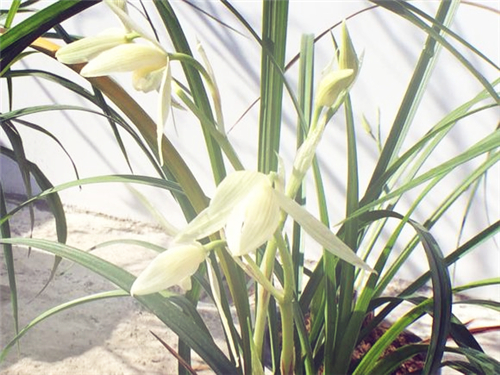
Dasuxin, also known as Dasuxin orchid or Yuandan, is a common flower in the Orchidaceae family. It originates from parts of Yunnan and is named for its snow-white flowers that resemble heavy snow. Many people now like to grow it indoors. So how much does one Dasuxin orchid cost on the market? When does it bloom? How do you grow it? What is the difference between it and Xiaosuxin?
Market price:
Dasuxin costs about 150 yuan per plant; this is the price without a pot. If it comes with a pot, the price will be higher. It is generally available at flower markets or online, though prices vary slightly depending on where you buy it, but not by much.
Blooming time:
The blooming period of Dasuxin is in spring, between January and March. It mostly blooms around New Year's Day, and the blooming period lasts about one month.
Growing techniques:
1. Temperature and light
The suitable growing temperature for Dasuxin is between 15-28°C. In winter, as long as the temperature does not drop below 0°C, it can generally overwinter safely. In summer, when temperatures rise above 30°C, attention should be paid to heat protection and cooling, and the maximum temperature should not exceed 35°C.
2. Humidity requirements
The humidity requirements for Dasuxin mainly refer to two aspects: air humidity and potting soil humidity. Dasuxin has higher air humidity requirements than other orchid species, maintaining it at 60%-80%. However, it still needs a relatively good ventilation environment. It is necessary both to create conditions to increase air humidity and to strengthen ventilation in the growing environment.
3. Soil requirements
When planting Dasuxin, the soil generally used should be rich in humus. The soil must contain abundant humus, with more organic matter such as bark, leaves, and peanut shells mixed in. The amount of these organic materials added should be no less than 30%.
4. Fertilization
Dasuxin is relatively fond of fertilizer and should be fertilized more during the vigorous growth period. If the soil is fertile, the amount of fertilizer can be reduced, and some foliar fertilizer can be applied. Plant-based fertilizers cannot be used directly; they must be fermented before application.
Differences from Xiaosuxin:
1. Xiaosuxin
Local people say there are at least 8 kinds of Xiaosuxin, while others say there are more than 20; opinions vary. Large and small Xiaosuxin are scattered among the people, so it is indeed difficult to classify and count them. Here are a few of the more common types.
Based on the plant, they can be divided into three types: tall-stemmed, medium-stemmed, and short-stemmed.
The tall-stemmed variety has leaves 60-80 cm long and 0.8 cm wide, with 7-8 leaves. The leaf sheaths are high, and the leaves grow upward to about two-thirds of their height before spreading out, appearing upright and vigorous, with a majestic momentum.
The medium-stemmed variety has leaves 30-50 cm long and 0.6-0.7 cm wide, with 5-7 leaves. The plant shape is similar to the tall-stemmed type.
The short-stemmed variety has leaves 20-30 cm long and 0.5 cm wide, with 5-7 leaves. It has a semi-drooping leaf type, with fine leaves swaying gracefully, small and exquisite.
Based on flower color, they can be divided into white-stemmed white flowers, green-stemmed green flowers, and green-stemmed white flowers. The flowers all have willow-leaf petals, with rolled and slanted lips (very few are upright).
2. Dasuxin
Yunnan Dasuxin has a history of more than one hundred years of domestication and cultivation. Its blooming period is from January to March, with snow-white flowers, multiple flowers on one stem, at least three and at most seven, commonly four to five. The petals are 3.5-4 cm long, making it a relatively long lotus-type flower, with large flowers rising above the leaves. It is grand and spectacular. Dasuxin is easy to cultivate and blooms very readily, with a pure and distant fragrance, and is deeply loved by orchid enthusiasts everywhere. It has won numerous awards at orchid exhibitions at home and abroad.
Dasuxin is usually divided into three types by production area: Shigu type, Heqing type, and Weishan type.
Shigu-type Dasuxin is produced in Shigu Town, Lijiang area. The plant height is 30-35 cm, leaves are 50-70 cm long and 1.2-1.5 cm wide, with 7-8 leaves per plant. This type has tall leaves that bend and droop in an orderly way, giving the whole plant a dignified and tension-filled feel. The flowers are large and white; the only shortcoming is that the water-mark on the lip is slightly heavier. Among the Shigu type there is also a peach-cheek type, with the same leaf and flower shape, except that there is a faint red color above the lateral lobes of the lip, while the rest is pure white.
Heqing-type Dasuxin is produced in Heqing County. The plant height is 25-30 cm, leaves are 40-50 cm long and 1.2 cm wide, with 7-8 leaves per plant, and a drooping phoenix-tail leaf shape. The water-mark on the lip is relatively light.
Weishan-type Dasuxin is produced in Weishan County and is also known as Yuandan orchid. The leaves are 40-60 cm long and 1.2-1.5 cm wide, with 7-9 leaves per plant, with a curved ring-shaped leaf form, also called jade-ring shape. The leaves droop over the edge of the pot, and the flowers rise far above the leaf surface, very graceful. The water-mark on the lip is relatively light. Among the Weishan type there is also a fully pure-colored variety, which is extremely rare.
In addition, there is another upright-leaf type of Dasuxin, with leaves 20-30 cm long and 1.0-1.2 cm wide. The leaves stand upright like sharp swords pointing to the sky, strong and powerful, very spirited.