What are the cultivation methods and precautions for the beautiful trailing abutilon? In which month should cuttings (layering) be done? What if it does not bloom
Trailing abutilon, also known as hanging bell flower, prefers a warm, humid and sunny environment, and also tolerates partial shade; it is neither cold-tolerant nor drought-tolerant, and is suited to loose, breathable soil rich in humus. So do you know the cultivation methods and precautions for trailing abutilon? In which month should cuttings (layering) be done? What if it does not bloom?
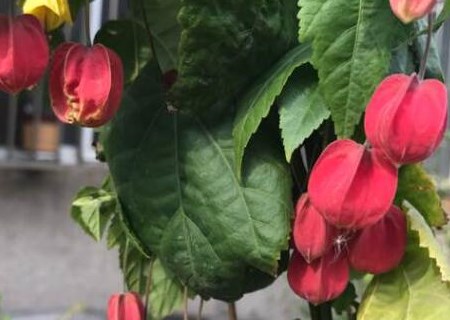
I. Cultivation methods and precautions for trailing abutilon
There are only two common methods, namely layering and cuttings. Friends who have grown this plant may know that cuttings are much more common than layering, and the second method is generally the one we use. So here we will mainly introduce it. As for layering, first, it is uncommon, and second, the layering of this plant is no different from that of other plants, so there is not much need to introduce it in detail.
Specific steps for doing cuttings
Cut about ten cm from the plant's branch (choose the top one) for use; at this time note that you should cut from below the node. Then, remove part of the leaves from the lower part of the branch.
The main considerations when choosing the medium are air permeability and water permeability; equal amounts of peat and river sand can be mixed together.
Insert the branch prepared in the first step into the medium, about forty to fifty percent, then place them together in a place with warm sunlight for cultivation.
After waiting for a period, about three weeks or so, roots will grow. During this time, if the temperature is very low, you can cover the plant with a bag to ensure the temperature is suitable for its growth.
Precautions
Ensure sufficient light, at least three to four hours a day.
Also, considering that the plant likes a relatively warm and moist environment, watering also requires special attention. Generally, when the soil begins to dry about one cm from the surface, it should be watered promptly; do not let it dry out completely before watering. Of course, the soil should also not be left in a waterlogged state.
The next factor is naturally fertilizing. To ensure that the plant just inserted into the soil gets sufficient nutrients, it is best to apply a general-purpose fertilizer once. If it is winter, then there is no need.
II. In which month should cuttings (layering) be done
1. Simple layering. Suitable for plants with soft branches and vines or for tree species with many easily bent branches near the ground (such as lily magnolia, wintersweet, etc.). Bend branches 1-2 years old near the ground of the mother plant in all directions, notch them below, then press them into a pit, fix them with hooks, cover with soil and press firm; the shoot tip is exposed vertically upward above the ground and tied to a support. (Principle: the phloem in the notched part of the layered section cannot continue transporting nutrients, so they accumulate at the wound and gradually develop into roots.)
2. Horizontal layering. Suitable for tree species with longer branches that root easily (such as apple dwarf rootstock, climbing roses, etc.). Also called continuous layering or trench layering. Dig a shallow trench along a prostrate branch, notch the branch at appropriate intervals and fix it horizontally in the trench, remove the downward-growing buds on the branch, and fill with soil. After rooting and sprouting, cut them off one by one at the internodes, with each seedling retaining a section of the mother plant.
3. Wavy layering. Suitable for vines with particularly long branches and stems (such as grapes, etc.). Bend the branches and stems up and down into a wavy shape, bury and press the parts touching the ground in soil, and after they root and the parts protruding above the ground sprout and grow for a certain period, cut them section by section into new plants.
4. Mound layering. Suitable for trees with strong tillering at the root collar or that grow in clumps (such as lily magnolia, sorbaria, Rosa xanthina, plum, pomegranate, etc.). Notch the base of the branches at the root collar, then mound soil over and press them; after rooting, divide and cut them into new plants.
5. Air layering. Created by China, also called Chinese layering or high layering. Suitable for tall plants or those not easily bent, and mostly used for valuable tree species (such as camellia, osmanthus, longan, lychee, sapodilla, etc.). Choose 1-3 year old branches, make a ring cut of 2-4 cm, scrape off the cambium or make a longitudinal wound, wrap the cut with plastic film, a split bamboo tube, a clay pot, etc., bind tightly to fix, fill inside with moss or rich soil, water often to keep moist, and after rooting cut away to form a new plant.
Plants that can be layered: pomegranate, Chinese rose, banana shrub, magnolia, etc.
III. What to do if trailing abutilon does not bloom
1. Analysis of the reasons for not blooming
Temperature
The first thing to mention is of course temperature. If the temperature is too low, the plant's rhizome and leaves may not have problems for the time being, but the flowers will be the first to suffer. A natural drop in winter temperature or a higher altitude where you live may both lead to a temperature unsuitable for the plant to bloom.
Insufficient nutrients
The second reason is insufficient nutrients. The soil itself originally contains little nutrients, or you forgot to fertilize when it should have been done; both count under this reason. If nutrition cannot keep up, even if the plant blooms on schedule, the quality will certainly not be satisfactory.
Light
The third is insufficient light. Never neglect this; without sunlight a plant cannot survive, let alone bloom.
Water
The fourth is water. This possibility is not great, but it can still count as one.
2. Solutions
If the altitude is high and the temperature is low, or if winter has arrived, be sure to move the plant indoors for care. It is best to ensure that the temperature around the plant is not lower than fifteen degrees, so that the flowers can bloom normally.
When first planting, it is best to choose potting soil rich in nutrients. However, if the soil choice cannot be controlled, then supplement nutrients through fertilizing; applying liquid fertilizer once about every month is enough.
As for the third reason, just place it in a place with more sunlight. Even in winter indoors, it should still be taken out regularly to get some sun.
The last one is water. Generally, just keep the soil in the pot slightly moist; it should not be too dry and should not accumulate a lot of water. In summer, it can also be sprayed with water appropriately.