How much does a tigertail orchid cost approximately? Introduction to planting time, methods and flowering period
Tigertail orchid grows on trees in forests, at an altitude of 1300-1400 m. The stem is short and inconspicuous. The leaves are nearly basal, 5-6 in number, distichous and imbricate, laterally flattened, thick and fleshy, with a joint at the base. So how much does a tigertail orchid cost approximately? When does it bloom after planting? How do you grow it? From the Changsha flower and bird market we learned that tigertail orchid belongs to the orchid family, and that it must be distinguished from the iris, since it is not the same plant; tigertail orchid generally grows on sunny slopes, at forest edges and in waterside wetlands, and has not yet been introduced and cultivated artificially. Its flowers are large and beautiful and can be used for ornamental purposes. Generally, tigertail orchid costs 1—2 mao per plant, and is usually purchased in quantities of 1000 plants or more.
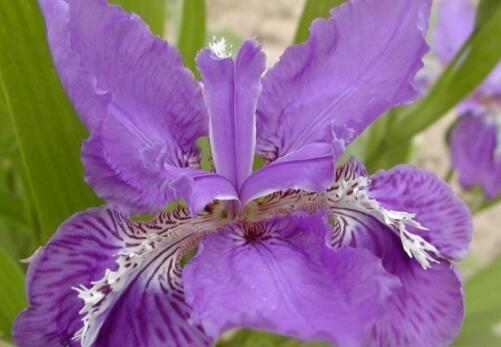
When does tigertail orchid bloom after planting?
Planting:
It can be done in both spring and autumn, generally dividing the clumps once every three years. Any plant that grows vigorously, with densely clustered pseudobulbs, can be divided; after division, each clump must retain at least 5 pseudobulbs that remain connected together.
Flowering:
The iris capsule is elliptical, about 2.5 mm long and about 2 mm wide; the fruit stalk is extremely short. The flowering and fruiting period is August to December.
How do you grow tigertail orchid?
1. What kind of environment is suitable
The quality of the soil determines how well blue-flowered iris seedlings grow and develop. If the soil is very good and the growing environment is very good, then the gardener will have much less trouble caring for them. Blue-flowered iris is not strict about soil and can grow in sandy soil, loess or cinder soil, but soil with too much sand gives poor seedling emergence. Blue-flowered iris is afraid of waterlogging and requires terrain that drains easily; when summer comes and rain increases, water must be able to drain away immediately, otherwise large-scale seedling death easily occurs. The key for the land is that it drains standing water well; ordinary soil is generally fine, with sufficient sunlight exposure.
2. Land preparation
1. Plowing: Blue-flowered iris responds especially quickly to fertility. When the soil is fertile enough, the flowers bloom large and beautiful and the plants are robust. But most landscape sites have soil of ordinary fertility, so if you want beautiful flowers, you still need to apply sufficient base fertilizer before sowing, spreading 4.5~7.5 tons of cow dung or pig dung per 660 sq m; after fertilizing, plow once and harrow once, so that only then are the soil and fertilizer mixed evenly together, with no large clods, making sowing easy and improving the germination rate.
2. Making beds: To make it easier to water the blue-flowered iris seedlings during their 1-year growth period, remove weeds, spread fertilizer and carry out the other management measures that need to be done, Changjing Landscape recommends making the land into fixed-standard beds 1.5 m wide and 15~20 m long, with the details decided according to the topography.
3. How to plant blue-flowered iris
The seeds of blue-flowered iris are of ordinary granule size and have very strong emergence ability, so shallow sowing is recommended, with the soil covering depth not exceeding 5 cm. Usually the broadcast sowing method is used: choose conditions with a light breeze, mix the blue-flowered iris seeds into moist sand, then scatter them onto the soil; after sowing, you can cover them with soil by hand raking or mechanical raking, and after covering with fine soil, irrigate once; after about 7~10 days the germination rate can be improved.
4. How to care for blue-flowered iris
The workload of managing blue-flowered iris during the seedling stage is very small; it has few diseases and grows and develops well. The important matters are basically concentrated at flowering time. Before the flowers open, apply 45 kg of chemical fertilizer per 660 sq m; spreading fertilizer before the flowering period is to make the flowering period longer, the number of flowers greater and the colors more beautiful. After flowering, no more fertilizer is needed. When blue-flowered iris is in bloom, it requires sufficient water; at this time, judge according to the rainfall conditions whether watering is needed.