How do you grow the perennial herb white clover, and what is it used for?
White clover is a short-lived perennial herb, with head-shaped inflorescences growing in the leaf axils and long flower stalks. The papilionaceous corolla is white or pink, the receptacle is cup-shaped and covered with fine hairs, and each inflorescence has 20 to 40 florets. Do you know what methods there are for planting white clover seeds? What is it used for? The taproot is relatively short, the lateral roots are well developed, and there are many root nodules.
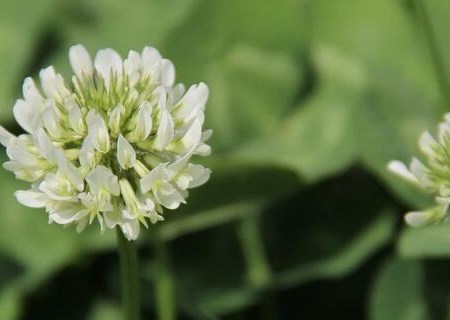
I. Methods for planting white clover seeds
1. Sowing and seed treatment. The best time to sow white clover is in spring and autumn, and the optimum growth temperature is 19-240C. For spring sowing, you can sow from the end of March to the end of April, once the temperature is stable above 150C. Autumn sowing generally starts in mid to late September. Before sowing, the seeds should be soaked. For every jin of seeds, add 1.5 jin of water, plus 1 gram of ammonium molybdate, and soak for 12 hours. Add 5-10 kg of calcium magnesium phosphate fertilizer and 5-10 kg of fine soil or yellow sand, mix evenly, and then sow.
2. Land preparation. White clover seeds are tiny and the seedlings have poor ability to push through the soil, so before sowing the land must be leveled and raked fine to help emergence. In areas with heavy, clayey soil and high rainfall, ditches should be opened and beds made to improve drainage. For mountain planting used for fresh forage, it is best to choose a more shaded site or one with relatively moist soil. For intercropping in orchards, before sowing it is necessary to weed and loosen the soil between the fruit tree rows, level the ground, and sow 1-2 days before rain.
3. Planting methods. For planting between fruit tree rows, either broadcasting or drilling can be used; for drilling, leave a row spacing of 15 cm. Sowing should be shallow rather than deep, generally 0.5-1.5 cm. For single-species sowing, the sowing rate is 0.5-0.75 kg per mu, by broadcasting or drilling, with a row spacing of 30 cm for drilling. It is better to sow after mixing the seed with an equal amount of fertile soil. When mixed with meadow fescue, ryegrass, and others, the sowing rate should be reduced appropriately. During the seedling stage, weeds should be removed in good time to help white clover form a lawn.
4. Fertilization. White clover is a leguminous plant and has its own nitrogen-fixing ability, but during the seedling stage the rhizobia have not yet formed, so a small amount of nitrogen fertilizer needs to be added. Applying a small amount of nitrogen fertilizer helps strengthen the seedlings, and increasing the application of phosphorus and potassium fertilizer has a very good yield-increasing effect. After the lawn has formed, only phosphorus and potassium fertilizer need to be added. Before sowing, apply 20-25 kg of superphosphate per mu, as well as a certain amount of barnyard manure as a base fertilizer. If the plants are short and the leaves are yellow at emergence, apply a small amount of nitrogen fertilizer; generally, 15 days after emergence, apply 2.5 kg of urea, 5 kg of potassium fertilizer, and 5 kg of calcium magnesium phosphate fertilizer to promote strong seedlings and increase forage yield.
5. Field management. White clover grows slowly during the seedling stage and is easily invaded by weeds, so weeds should be removed frequently during the seedling stage, especially for spring-sown crops. When sown in September, it buds and flowers in April of the following year, reaches full bloom in mid-May, and the grass layer is 15-20 cm high at flowering, which is the suitable time for cutting and use. After cutting, it regrows strongly and quickly forms a second grass layer covering the grassland. In hot seasons, white clover stops growing. In the 2-3 years after the grass layer cover has formed, large weeds should be removed in good time. If missing plants occur due to high temperature and drought in summer, reseeding can be done in autumn to restore grassland productivity. If planted on a large scale as grazing land, light grazing can be carried out 1-2 months after sowing, when the weeds are 20-25 cm high, to suppress weed growth. White clover has few diseases, but if cutting is not timely, brown patch and powdery mildew sometimes occur; it can first be cut and used, then treated with Bordeaux mixture, lime sulfur mixture, or carbendazim.
II. What are the uses of planting white clover?
[Landscape use] White clover flowers and leaves both have ornamental value, a long green period, and a long flowering period. It is not tolerant of trampling, and can be used as a lawn along paths and ditches, on embankments for slope protection and soil conservation, and as enclosed lawns on green spaces at factories, mines, government offices, schools, and other places. It can also be used as forage grass and green manure, and the whole plant can be used as medicine. White clover seeds
[Feeding value] The grass has excellent palatability and is favored by all kinds of livestock and poultry. Its nutritional composition and digestibility are higher than those of alfalfa and red clover. On natural grassland, the feeding value of the grass population also increases as the proportion of white clover increases.