How to Grow Rainbow Dianthus from Seed, Its Benefits and Effects, and How It Differs from Summer Dianthus
Rainbow Dianthus, also known as bearded pink, American pink, and ten-pattern brocade, is a perennial herb in the family Caryophyllaceae, with lance-shaped leaves and petals that are usually red-purple with white speckled markings; its capsule is ovate-oblong, and it flowers and fruits from May to October. Do you know the methods for growing Rainbow Dianthus from seed? What benefits and effects does it have? And how does it differ from Summer Dianthus? The plant is cold-tolerant but not tolerant of severe heat, and Dianthus can be used whole or its roots used as medicine. It has the effects of clearing heat, promoting urination, breaking blood stasis, and promoting menstruation. There are more than 300 species in the same genus.
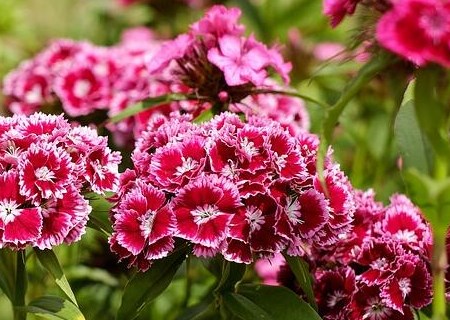
I. Methods for Growing Rainbow Dianthus from Seed
[Propagation Methods]
Seeding, cuttings and division are commonly used for propagation. The optimum temperature for seed germination is 21 to 22°C. Seed propagation is generally carried out in September. Sow in an open-air seedbed, keep the soil moist after sowing; sprouts appear 5 days after sowing, and seedlings emerge in about 10 days. The optimum temperature for seedling growth is 10-20°C. When the seedlings have 4-5 leaves, they can be transplanted, and they will bloom the following spring. They can also be sown directly in the open field in September, or sown in pots in a cold room in November-December and planted out in the open field the following April. Cutting propagation is carried out from October to late February to March of the following year; during the period of lush branches and leaves, cut tender shoots 5-6 cm long as cuttings, and roots form 15-20 days after insertion. Division propagation mostly uses old plants divided after flowering, and can be done in autumn or early spring. For example, divide in April, pay attention to drainage in summer, strengthen fertilizer and water management after September, and they will bloom again in early October.
II. What Benefits and Effects Does Rainbow Dianthus Have
The Shennong Bencao Jing says: “It mainly treats obstruction and various urinary blockages, inability to urinate, brings out thorns, resolves carbuncles and swellings, brightens the eyes and removes film, breaks the fetus and induces abortion, and discharges blocked blood.” Modern research: the fresh herb contains moisture, crude protein, nitrogen-free extract, vitamin A-type substances and a small amount of alkaloids, etc.; the flowers contain eugenol, phenylethyl alcohol, benzyl benzoate, benzyl salicylate, etc.; the whole herb contains saponins, sugars and vitamins. Pharmacological experiments show a diuretic effect and an inhibitory effect on the isolated heart.
Dianthus is bitter in nature and cold. It has the effects of clearing heat, promoting urination, breaking blood stasis and promoting menstruation. It treats inability to urinate, gonorrhea, edema, amenorrhea, carbuncles and swellings, red eyes with film opacity, and weeping sores and toxic swelling. Common formulas are as follows:
1. Acute nephritis: Dianthus superbus 12 grams, Polygonum aviculare 12 grams, dandelion 30 grams, cogongrass rhizome 30 grams, decoct in water and take.
2. Red, rough and obstructed urination (retention of urine): Dianthus superbus, Polygonum aviculare, plantain seed, talc, gardenia, akebia stem, rhubarb and licorice in equal parts, grind together into a fine powder, take 6 grams each time, and swallow with decoction of rush pith after meals.
3. Blood in urine. Blood in stool: Dianthus superbus 30 grams, gardenia 15 grams, grind together into a fine powder, take 15 grams each time, decoct with scallion root, rush pith and ginger, and take warm frequently. Suitable for cases caused by excess heat in the lower jiao.
4. Red, swollen and painful eyes: an appropriate amount of Dianthus superbus, grind into a fine powder, and mix with goose saliva to apply to the corners of the eyes.
5. Amenorrhea due to blood stasis. Dianthus superbus 15 grams, red peony root 15 grams, turmeric 15 grams, safflower 10 grams, decoct in water and take.
6. Early-stage carbuncle and swelling: fresh Dianthus superbus 15 grams, fresh dandelion 15 grams, pound into a paste and apply externally to the affected area.
III. Differences Between Summer Dianthus and Rainbow Dianthus
Differences in Alternative Names
Everlasting Dianthus is also called fringed dianthus and groundcover dianthus.
Rainbow Dianthus, also known as bearded pink, American pink, and ten-pattern brocade.
Differences in Growing Environment
Everlasting Dianthus prefers warmth and ample sunlight, and is not cold-tolerant. It requires deep, fertile soil, and for pot cultivation requires loose soil with good drainage.
Rainbow Dianthus is cold-tolerant but not tolerant of severe heat, and prefers sunny, high, dry, ventilated sites and fertile loam with good drainage.
Differences in Distribution Areas
Everlasting Dianthus: the Yangtze River basin and areas to its north.
Rainbow Dianthus is mostly distributed in Northeast China, North China, the Yangtze River basin and Southeast Asia.
Differences in Flower Color
The flower colors of Everlasting Dianthus include purple, pink and white, and it is fragrant.
Rainbow Dianthus is usually red-purple, with white speckled markings, toothed tips, and bearded hairs at the throat.