Boston Ivy Seed Planting Methods, Uses, and Differences from English Ivy
Boston ivy is a common name for several plants - also known as kunshilong, maple vine, little bug lying grass, red silk grass, red kudzu, crawling mountain tiger, red grape vine, and bashanhu - a plant in the grape family (Vitaceae). Do you know the seed planting methods for Boston ivy? What uses does it have? How does it differ from English ivy? It commonly climbs on walls and rocks. The roots and stems of Boston ivy can be used as medicine to break blood stasis and reduce swelling and toxicity; the fruit can be used to make wine.
I. Boston Ivy Seed Planting Methods
1. Sowing
Sowing is very simple. Generally, first prepare the sowing soil by plowing the soil fine and leveling it, then sow the seeds together with fine sand on top of the planting soil, and afterward cover with a thin layer of loose, organic-rich soil. The seeds will likely sprout into seedlings very quickly.
2. Seedling Management
After the seeds have sprouted into seedlings, water them frequently to keep moisture sufficient, which benefits the growth and development of the seedlings.
Beautiful Boston Ivy
3. Transplanting
When the Boston ivy seedlings have grown three or four leaves, you can choose a day with insufficient sunlight to transplant them. After transplanting, apply manure fertilizer, then gradually provide careful care. The Boston ivy will begin to grow vines and start climbing.
4. Suitable Environment
Boston ivy has a very strong ability to adapt to its environment; generally, with careful care after planting, it will grow successfully. They prefer moist environments, do not need to avoid direct sunlight, and are very tolerant of drought and cold. You can prune the Boston ivy appropriately from time to time, so that it grows very beautifully.
II. What Uses Does Planting Boston Ivy Have
1. Boston ivy is not only beautiful for greening but also has effects such as purifying air, cooling temperature, preventing noise, and preventing dust.
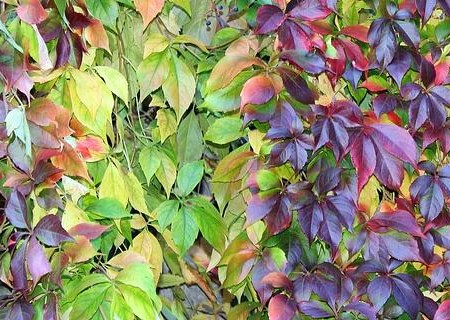
Boston ivy (Japanese ivy) is a well-known ornamental plant, especially outstanding in vertical greening. Boston ivy takes up little space, grows fast, and has a large greening coverage area. A vine with a stem diameter of 2 cm, planted for two years, can cover 30 to 50 sq m of wall surface. Boston ivy has an extremely strong climbing ability and can climb from the base of a wall all the way up to the top, hence its name. In spring and summer, dense green leaves cover the wall, and from a distance, it looks as if a green tapestry is hanging on the wall. In spring the young leaves, and in autumn the frosted leaves, may be red or orange, colorful and very brilliant, like hanging up a huge brocade, hence the alternate name "dijin" (brocade).
In summer, the branches and leaves are dense, often climbing on walls or rocks, suitable for planting on house walls, enclosing walls, garden entrances, bridgeheads and stone embankments, and other places. It can be used for greening house walls and park rocks, both beautifying the environment and cooling temperatures, regulating air, and reducing noise.
Because Boston ivy's stems and leaves are dense and cover the house wall surface, it can not only block strong sunlight, but also, due to the air flow between the leaves and the wall, lower indoor temperatures. As a barrier, it can both absorb noise from the environment and adsorb flying dust. Boston ivy's tendril-type suction cups can also absorb moisture from the wall, helping to make a damp house drier; and in dry seasons, it can increase humidity.
2. Medicinal Value
① Activating Blood and Detoxifying
Boston ivy is warm in nature and astringent; the root and stem parts of Boston ivy can be used as medicine. The usage is to take 50 grams of Boston ivy medicinal material and decoct it in water, or take it with wine. It has the effects of dispelling wind and dredging collaterals, and activating blood and detoxifying.
② Treating Traumatic Injuries
Boston ivy can be used both externally and internally. Take an appropriate amount of Boston ivy root, crush it, dip it in wine, and apply it to the painful area. It can both reduce swelling and relieve pain, and activate blood and resolve stasis. It is commonly used for traumatic injuries and carbuncle and furuncle swelling and toxicity, with very good results.
③ Dispelling Wind and Dredging Collaterals
Boston ivy has a relatively strong effect of dispelling wind and dredging collaterals, and is commonly used to treat rheumatic joint pain and muscle and bone pain.
III. What Is the Difference Between Boston Ivy and English Ivy
1. Morphological Differences
English Ivy
English ivy has woody stems, with stems reaching 3-5 m in length, much branched, with aerial roots on the stems; young tender branches are covered with soft hairs, in a rusty scale-like form; leaves are leathery and alternate; umbels are solitary or 2-7 terminal, yellow-white or green-white; fruit is spherical, berry-like, yellow or red; flowering period is May-August, fruiting period is September-November.
Boston Ivy
Boston ivy's morphology is similar to wild grape vines; the vine stem can reach 18 m in length; cymes often grow on short branches between two leaves, in inconspicuous clusters, yellow-green or berry purple-black, mostly bisexual, monoecious; berries are small and spherical, blue-black when ripe, covered with white powder; flowering period is June, fruiting period is September-October. The most obvious characteristic is that Boston ivy has relatively strong climbing ability.
2. Habit Differences
English Ivy
English ivy has strong adaptability to the environment, prefers a relatively cool climate, has strong cold resistance, and is not strict about light requirements; it can grow anywhere, and usually grows in shady, moist environments.
Boston Ivy
Boston ivy has strong adaptability, prefers shady and moist environments, but is not afraid of strong light; it is cold-tolerant, drought-tolerant, and tolerant of poor soil; in areas south of the warm temperate zone, it can also remain semi-evergreen or evergreen in winter; it is tolerant of pruning and afraid of waterlogging. It mostly grows in places with fertile soil and will grow attached to buildings.
3. Distribution Differences
English Ivy
English ivy is native to Europe, Asia, and North Africa, and is distributed in central China, east China, southwest China, Gansu, and Shaanxi in China.
Boston Ivy
Boston ivy is native to eastern Asia, the Himalayan region, and North America, and is distributed in Henan, Liaoning, Hebei, Shanxi, Shandong, Jiangsu, Anhui, Zhejiang, Jiangxi, Hunan, Hubei, Guangxi, Guangdong, Sichuan, Guizhou, Yunnan, and Fujian in China.
4. Family and Genus Differences
English Ivy
English ivy is an evergreen woody climbing plant in the plant kingdom, Angiosperms, Dicotyledons, Rosidae, Apiales, Araliaceae, tribe Schefflereae, genus Hedera.
Boston Ivy
Boston ivy is a perennial large deciduous woody climbing plant in the plant kingdom, Angiosperms, Dicotyledons, Rosidae, Vitales, Vitaceae, genus Parthenocissus.
From the difference in family and genus, one more point can be seen: English ivy is an evergreen plant, while Boston ivy is deciduous.