Can red-flowered black locust trees be planted in a home courtyard? Price, planting and flowering time and methods
Red-flowered black locust generally refers to Robinia hispida, also known as bristly locust, Jiangnan locust, pink-flowered bristly locust, pink-flowered black locust, red bristly locust, thornless locust and purple sparrow flower, and it has high ornamental value. So can red-flowered black locust trees be planted in a home courtyard? How much does one cost? When should it be planted and when does it bloom? How should it be planted? According to the Suqian garden nursery stock base, red-flowered black locust with a meter diameter of 15 cm costs 650 yuan each; red-flowered black locust with a meter diameter of 12 cm costs 300 yuan each; red-flowered black locust with a meter diameter of 10 cm costs 180 yuan each; red-flowered black locust with a meter diameter of 8 cm costs 85 yuan each.
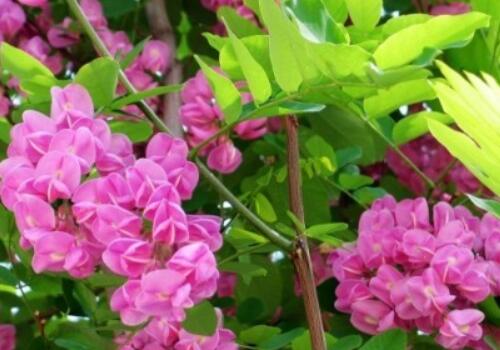
Can red-flowered black locust trees be planted in a home courtyard?
1. Locust trees are yin in nature and can nourish the soul. Remember, yin and yang are always balanced; when yin flourishes, yang declines, and when yang flourishes, yin declines. If you want to plant a locust tree, unless the yang energy of your home's yang dwelling can exceed the yin energy of the locust tree, it will have an adverse effect on the health of your family members.
2. If you want to plant a locust tree, it is best to keep it some distance from the door of your home. Otherwise, once the tree grows up, if the extending sections of its branches point directly at your windows or front door, that becomes an extremely unfavorable feng shui configuration, so be cautious.
When should red-flowered black locust trees be planted and when do they bloom?
Planting:
Red-flowered black locust can be sown in spring, in early spring, and no later than April at the latest. If planting on a large scale to form a forest, in windy seasons you can choose autumn, or in early spring choose a warm and humid place for sowing. Because ground temperatures vary from place to place, the sowing period will also differ, so for the specific sowing time, please take local temperatures into account.
Flowering:
Red-flowered black locust is a deciduous tree, 15-25 m tall; bark brown, with longitudinal cracks. Pinnate compound leaves have 7-25 leaflets, alternate, elliptical or ovate, 2-5.5 cm long and 1—2 cm wide, with a rounded or slightly notched apex and a small pointed tip, and a rounded base. The crown is elliptical to obovate, the flowers are purplish red, and the flowering and fruiting period is April-June.
How should red-flowered black locust trees be planted?
1. When lifting red-flowered black locust seedlings, try as much as possible to keep the root system of the nursery stock intact, and heel them in promptly to prevent the roots from losing water. Before transport, dip them in mud slurry, and use thin plastic to wrap the entire root system of the nursery stock in plastic. When loading, handle them gently and do not trample them. When transporting the nursery stock, to prevent the seedlings from losing water and drying out, it is best to cover them with a tarpaulin. During transport, check the temperature and humidity inside the package. If the temperature inside the package is high, open the package to ventilate it appropriately; if the humidity is low, spray water promptly.
2. Robinia hispida does not have high water requirements, and large seedlings can usually rely on natural rainfall to grow. For newly planted small seedlings, watering management should be appropriately strengthened. When planting, the first three waterings should be done well, after which water once a month, and at the end of autumn water thoroughly with enough freezing water. In early spring of the following year, water promptly with thawing water, and the rest of the time it can rely on natural rainfall; at the end of autumn, water well with freezing water. After three years from transplanting, it is enough to water only the thawing water and freezing water each year.
Robinia hispida is relatively tolerant of poor soil, but sufficient fertilizer can make the nursery stock grow vigorously. Especially when newly planting nursery stock, applying an appropriate amount of fertilizer can help the seedlings quickly restore their tree vigor. When planting, it is best to apply fermented cow and horse manure; cow and horse manure has a mild fertilizer effect and a long duration, and will not cause root burn. In early June, apply urea once, which can promote the growth of branches and leaves in the nursery stock, and at the end of autumn, in conjunction with watering freezing water, apply a shallow application of leaf mold once. From the second year onward, it is enough to apply leaf mold once each year when watering freezing water.
3. In North China, Robinia hispida mostly appears as a large shrub or small tree. When pruning this kind of nursery stock, first pay attention to the beauty of the overall crown shape, and keep the crown shape umbrella-like. Remove overly dense branches promptly, and shorten overly long branches. Remove diseased and pest-infested branches, dead and dry branches, and useless branches promptly. For suckers sprouting from the rootstock, wipe them off promptly.
4. A common disease of Robinia hispida is violet root rot, which often causes the roots to rot and makes the tree easy to blow over in strong winds. If it occurs, in July-August you can spread plant ash on the roots of the tree, using 1 kg per tree, then turn up the soil and rake it fine. Bristly locust is also susceptible to powdery mildew and sooty mold. If powdery mildew occurs, you can spray with a 1000-fold solution of 15% triadimefon wettable powder, once every 7 days, and 2-3 consecutive sprays can effectively bring the disease under control. If sooty mold occurs, first kill the aphids and scale insects, and spray with a 1000-fold solution of 50% carbendazim, once every 7 days, and 3-3 consecutive sprays can effectively bring the disease under control.