A Detailed Guide to Larkspur Seed Planting Methods, Medicinal Value and Flowering Period Length
Larkspur is a perennial herbaceous plant of the genus Delphinium. It gets its name because its unusual flower shape closely resembles little swallows. It is native to southern Europe and is cultivated in every province of China, where it is deeply loved by people. So do you know what the seed planting methods for larkspur are? What medicinal value does it have? How long is its flowering period? According to a larkspur grower, Old Wang, the larkspur flowering period generally lasts about 20 days, and larkspur blooms roughly between August and September each year.
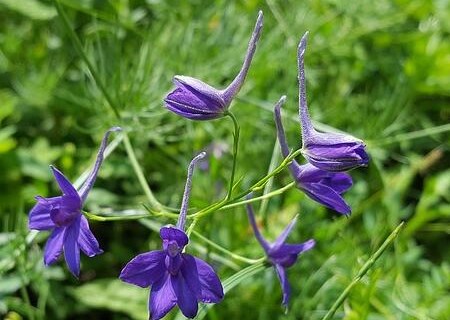
I. Larkspur Seed Planting Methods
The fruit of larkspur contains many seeds, and the seeds are rather small. After collection, dry them and store them indoors in a cool, dry place. To make larkspur bloom in multiple seasons, it can be sown in stages, but in southern cultivation the flowering period should be staggered to avoid the heat of midsummer.
Perennial larkspur of the same genus but different species can also be propagated by cuttings and division. Larkspur cutting propagation is carried out in spring, with cuttings taken and inserted into a moist sand bed or sand tray. Division can be done in both spring and autumn; dig up the small shoots sprouting around the old plant together with their roots, divide them into small plants and plant them. If divided in spring, they can bloom that same year.
1. Sowing
Larkspur can be sown in both spring and autumn. If sowing in autumn, it must be done in mid-September.
2. Care
After sowing larkspur, the soil must be kept moist. The simplest method is to cover it with some grass, then gradually remove the covering as the seedlings emerge.
3. Repotting
When larkspur grows 2 true leaves, it needs to be transplanted with soil into a small pot, and repotted once more after the seedlings grow larger.
4. Watering
When repotting larkspur, apply dry manure as a base fertilizer. To prevent the plant from growing too tall, apply 5000 PPM paclobutrazol once, or 1500 PPM daminozide, once every half month until flower buds appear. Watering larkspur should follow the principle of alternating dry and wet; during the flowering period, water appropriately more so the soil does not become too dry.
5. Fertilizing
During the growing period, apply fertilizer once every half month to larkspur, and apply phosphorus and potassium fertilizer 2-3 extra times before flowering. Keeping the soil moist during the larkspur flowering period can extend the viewing period. According to the growth condition of the larkspur, apply cake fertilizer water 1-3 times per month.
6. Height Control
After repotting larkspur, paclobutrazol can be used to control plant height. The specific method is: apply 0.5% paclobutrazol once every 2 weeks.
7. Seed Collection
Larkspur seeds mature in August-September. Because the seeds of the flowers that bloom first mature first, and the follicle splits open naturally once ripe, they must be harvested in time to avoid scattering.
8. Pests and Diseases
Common larkspur problems include black spot, crown and root rot, and chrysanthemum foliar nematode, which damages leaves, flower buds and stems. When disease occurs in larkspur, promptly remove the diseased plants, burn them in a centralized manner, and spray with 50% thiophanate-methyl wettable powder diluted 500 times for control. Common pests of larkspur include aphids and noctuid moths, which can be killed by spraying with 10% chlormephos EC diluted 2000 times.
II. What Medicinal Value Does Larkspur Have
The whole plant and seeds can be used as medicine to treat toothache. The juice soaked from stems and leaves can kill insects.
1. Functions and indications: Seeds: taken orally, with effects similar to aconite, can treat asthma and edema. Root: mainly treats abdominal pain. [9]
2. Functions and indications: Seeds: taken orally, with effects similar to aconite, can treat asthma and edema. Root: mainly treats abdominal pain.
Medicinal Selected Prescriptions
① To treat wind-heat toothache: larkspur 5 fen to 1 qian. Decoct in water and gargle, do not swallow. (Handbook of Commonly Used Chinese Herbal Medicines of Northeast China)
② To treat scabies and tinea: larkspur combined with Sophora flavescens, ground into powder and applied. (Handbook of Plateau Chinese Herbal Medicine Treatment)
③ To treat head lice: fresh whole plant of Thalictrum, pounded, soaked in water and used to wash the head. (Jilin Chinese Herbal Medicine).