Fuchsia (Lantern Flower) Seed Planting and Pruning Methods, Benefits and Effects
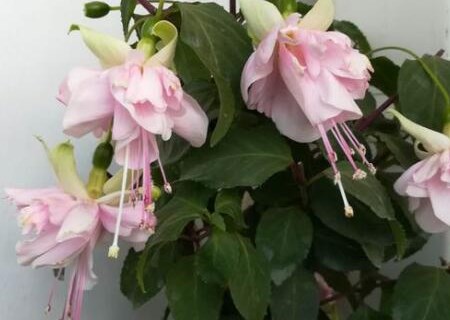
Fuchsia, also known as the lantern flower, thrives in cool, humid climates. It has many varieties, with the main flower colors being red, purple, and white. People love growing it, so do you know what the seed planting methods for fuchsia are? How do you prune it? What are its benefits and effects?
Fuchsia Seed Planting Methods
Cutting Propagation
Softwood cuttings are usually taken in late spring or early autumn using branches of the current year's growth, or hardwood cuttings are taken in early spring using branches from the previous year. The materials used are nutrient soil, river sand, peat soil, or similar media for cuttings. For home propagation, it is difficult to obtain an ideal cutting medium due to limited conditions, so it is recommended to use the pre-mixed and sterilized cutting medium provided by this site; medium-coarse river sand can also be used, but it should be rinsed several times with clean water before use. Do not use sea sand or river sand from saline-alkali areas, as they are not suitable for the growth of flowering plants.
When taking softwood cuttings of fuchsia, select sturdy branches of the current year's growth as cuttings during late spring to early autumn when the plant is growing vigorously. After cutting the branches off, select the robust parts and cut them into sections 5-15 cm long, with each section having more than 3 leaf nodes. When cutting the cuttings, note that the upper cut should be made horizontally about 1 cm above the topmost leaf node, and the lower cut should be made at an angle about 0.5 cm below the bottommost leaf node. Both cuts should be smooth (the knife must be sharp).
When taking hardwood cuttings, after temperatures rise in early spring, select healthy branches from the previous year as cuttings. Each cutting usually retains 3-4 nodes, and the cutting method is the same as for softwood cuttings. The optimum temperature for cutting rooting is 20°C-30°C. Below 20°C, rooting is difficult and slow; above 30°C, the upper and lower cuts of the cuttings are prone to infection by pathogens and rot, and the higher the temperature, the greater the proportion of rot. When low temperatures are encountered after cutting, the main measure for keeping warm is to wrap the flower pot or container used for cuttings with plastic film; when temperatures are too high after cutting, the main cooling measure is to shade the cuttings, blocking 50-80% of sunlight, and at the same time mist the cuttings 3-5 times a day. On sunny days with higher temperatures, mist more frequently; on cloudy and rainy days with lower temperatures and higher humidity, mist less frequently or not at all.
After cutting, the relative humidity of the air must be maintained at 75-85%. The basic requirement for cutting rooting is that before the cuttings have rooted, they must be kept fresh and tender to carry out photosynthesis and produce rooting substances. However, unrooted cuttings cannot absorb enough water to maintain their internal water balance, so misting must be used to reduce water evaporation from the cuttings: under shaded conditions, mist the cuttings 3-5 times a day. On sunny days with higher temperatures, mist more frequently; on cloudy and rainy days with lower temperatures, mist less frequently or not at all. However, excessive misting makes cuttings prone to infection by pathogens and rot, because many kinds of pathogens exist in water. Cutting propagation cannot do without sunlight, because the cuttings still need to continue photosynthesis to produce nutrients and rooting substances to supply their rooting needs. However, the stronger the light, the higher the temperature inside the cuttings, the more vigorous the transpiration, and the more water consumed, which is not conducive to the survival of the cuttings. Therefore, after cutting, 50-80% of sunlight must be blocked. After the root system grows out, gradually remove the shade net: on sunny days, remove the shade net at 4:00 PM each day and cover it again before 9:00 AM the next day.
Layering Propagation
Select a sturdy branch and remove a ring of bark about 15-30 cm below the tip. The width of the wound after peeling should be about 1 cm, and the depth should be just enough to remove the outer bark. Cut a piece of plastic film 10-20 cm long and 5-8 cm wide, place some moistened garden soil on it, and wrap the girdled area as if bandaging a wound. Tie the upper and lower ends of the film tightly, with the middle bulging out. Roots will form in about four to six weeks. After rooting, cut off the branch together with the root system, and it becomes a new plant.
Potting and Transplanting
When potting small seedlings or repotting large plants that have been grown for several years, first place a 2-3 cm thick layer of coarse-grained medium at the bottom of the pot as a drainage layer, sprinkle a layer of fully decomposed organic fertilizer on top as a base fertilizer about 1-2 cm thick, then cover with a thin layer of medium about 1-2 cm thick, and then place the plant in, so as to separate the fertilizer from the root system and avoid burning the roots. The medium used for potting can be one of the following: vegetable garden soil: cinder = 3:1; or garden soil: medium-coarse river sand: sawdust (mushroom residue) = 4:1:2; or one of paddy soil, pond mud, or leaf mold. After potting, water thoroughly once and place in a shaded environment for one week of care. When transplanting small seedlings, first dig the planting hole, sprinkle a layer of organic fertilizer at the bottom of the planting hole as a base fertilizer about 4-6 cm thick, then cover with a layer of soil and place the seedling in, so as to separate the fertilizer from the root system and avoid burning the roots.
How to Prune Fuchsia
Shaping and Pruning at the Seedling Stage
So-called seedling-stage pruning is shaping the fuchsia before it has taken form. The main goal is to cultivate a beautiful plant shape during care, and different pruning methods should be determined according to the growth characteristics of different varieties.
Cross-shaped pruning method: This method is suitable for varieties with a small branching angle (branches pointing upward), such as 'Zijinchui'. When the seedling is taller than 20 cm, pinch off the top to promote the sprouting of new branches. Because side branches generally grow symmetrically, when pruning, keep the two symmetrical branches above and remove all the branches and leaves below. When the side branches grow to about 10 cm, pinch off the tops. After new branches grow out, just let them grow, and be careful to cut off side branches growing inward or downward at any time. After pruning in the same way, keep 8-10 flowering branches for potted plants with a diameter of 15 cm to 18 cm.
Tower-shaped pruning method
This method is suitable for varieties with a large side-branch angle (branches spreading horizontally) and strong growth vigor, such as 'White Calyx' and 'Maiden's Skirt'. When the plant is small, do not pinch off the top. When it grows to 20 cm, cut off all branches and leaves below 10 cm. After the side branches grow, to avoid overlapping branches, a layered pruning method can be used. Keep one symmetrical branch at each layer, remove one pair of symmetrical branches, then keep another layer of symmetrical branches, and repeat this process.
Natural-form pruning method
Suitable for varieties with creeping branches and weak growth, as well as large-flowered and double-flowered varieties. Prune them into a natural form according to their shape. When the seedling grows to 30-40 cm, pinch off the top of the main stem, remove adjacent overlapping branches, and shorten long branches to promote branching. Cut off side branches growing inward at any time to promote a beautiful plant shape.
Shaping and Pruning During the Flowering Period
In the natural environment of northern China, the full flowering period of fuchsia is from April to July. Therefore, pruning should stop in late March of spring to ensure blooming in mid-April. Because fuchsia flowers best at the top and the flowering branches keep elongating, when the flowering branches reach a certain length they should be pinched off, and the new branches that grow can continue to bloom. During flowering, cut off the small branches and leaves in the center of the plant at any time to avoid consuming nutrients and to facilitate ventilation and light penetration.
Shaping and Pruning After Flowering
In July, when temperatures rise and reach 30°C, the plant will enter a semi-dormant state. The leaves will gradually become limp, and at this point heavy pruning is needed to reduce nutrient consumption and help it survive the summer safely. Cut off all the longer branches, leaving only the main framework branches, remove all old leaves, and place it in a cool place. If flower buds sprout at this time, remove them promptly as well. In September, new branches will grow, and the plant shape will be relatively compact at this point.
What Benefits and Effects Does Fuchsia Have?
Fuchsia enters the kidney meridian and has good therapeutic effects on some symptoms of kidney deficiency and kidney depletion, as well as soreness and weakness of the waist and knees, weakness of the limbs, and impotence caused by kidney deficiency and kidney depletion. It can be used as an auxiliary treatment alongside Chinese medicine or Western medicine, and fuchsia has very few side effects, so it can be used as a natural medicinal material.