Corn Poppy Annual Herbaceous Plant Seed Planting Method, Differences from Opium Poppy, and Price
Corn poppy (Papaver rhoeas), an annual herbaceous plant, whose flowers and whole plant are used as medicine, contains various alkaloids and has antitussive, antidiarrheal, analgesic and sedative effects. As an ornamental plant, it is commonly cultivated throughout China. So do you know what the seed planting methods for corn poppy are? What is the difference from opium poppy? What value does it have?
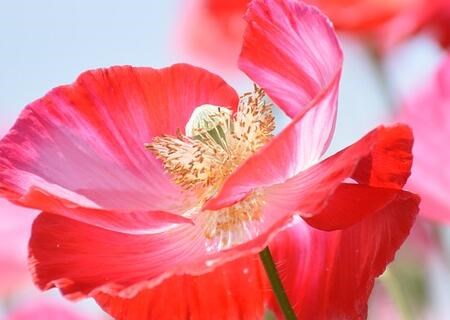
Corn Poppy Seed Planting Methods
1. Propagation Methods
Corn poppy is mainly propagated by sowing, usually grown as a biennial. The corn poppy flower and plants of the same genus all have taproots with very few fibrous roots, and they do not tolerate transplanting, so direct sowing propagation should be used. If needed for garden landscaping, it is best to raise seedlings in nutrient pots or small paper pots and transplant them together with the pot, otherwise they are very difficult to survive or will grow poorly. The sowing period is determined according to climate characteristics; the Northeast region is relatively cold, so sowing can be done as early as possible in spring when growth begins. The seeds are tiny, so sowing must be done carefully, using drill sowing with a row spacing of 25-30 cm, and covering the surface with dry grass in severe winter to protect against cold. The suitable temperature for seed germination is 20°C. At home, they can be sown directly in flower pots.
Sowing propagation. Sowing can be done in both spring and autumn. Generally, spring sowing is in March-April with a flowering period in June-July; autumn sowing is in September-November with a flowering period in May-June of the following year. If the purpose is to collect seeds, it is best to use autumn sowing. The soil should be prepared finely, made into beds and watered thoroughly, then broadcast or drill sown. Because the corn poppy seeds are tiny, the soil must be leveled and finely broken up when sowing; after broadcasting, there is no need to cover with soil, or a thin layer of fine sandy soil can be spread. The covering soil thickness should be such that the seeds are no longer visible (0.2-0.3 cm). In North China, because winters are severely cold and seedlings find it hard to overwinter, direct sowing is mostly done at the time of “Minor Snow” in early winter, so that they can sprout and grow as early as possible in spring.
2. Cultivation Techniques
Site Selection
It likes places with sufficient light and good ventilation; it is cold-tolerant but not tolerant of moisture or heat, and should not be planted in overly fertile soil or grown in continuous cropping. It should not be raised or planted in low-lying, damp places with heavy water and fertilizer or poor light; otherwise it will grow poorly and is prone to diseases. It is not strict about soil requirements, but loose, fertile sandy loam is best, with a row spacing of 20 cm; after sowing, cover with plastic film, or sow in early spring when the surface just thaws, and gradually remove the plastic film after seedlings emerge.
Pot Cultivation
In January, use a flower pot with an inner diameter of 20 cm, fill it more than half full with loose old pot soil, press it level, scatter 20 to 30 seeds, cover with soil just until the seeds are no longer visible, and after sowing, soak the pot in water to let moisture seep up. When seedlings emerge, thin them out several times, removing the weak and keeping the strong, and finally keep 3 to 5 plants to grow on. When the seedlings are 30 cm tall, gradually fill in planting soil up to the rim to prevent the plants from having thin stems and lodging. Maintain sufficient light and fresh ambient air, with nighttime temperatures not lower than 5°C, and avoid drought and waterlogging; they can bloom in March and continue until “May Day”.
Thinning
Corn poppy is usually grown as a biennial. When the seedlings have 5-6 leaves, thin them out, with a plant and row spacing generally of 30×30 cm. Corn poppy does not tolerate transplanting, so direct sowing in the garden is best.
Fertilizing
Apply 2-3 times of dilute liquid fertilizer before flowering, but do not apply too much fertilizer, otherwise diseases and pests are likely to occur. For ground planting, apply two light fertilizer applications before overwintering, and apply one more liquid fertilizer before flowering. Apply the last topdressing before flowering to promote large, brightly colored flowers and vigorous blooming.
Watering
During the seedling growth period, do not water too much, but keep the soil moist. For ground planting, generally there is no need to water frequently; for pot cultivation, water once every 3~5 days depending on the weather and pot soil conditions, and about 60% of the field soil's maximum water-holding capacity is better for the development of corn poppy. Water less during overwintering, and water more during spring growth.
Management
After transplanting, maintain a temperature of about 20°C, and buds will emerge in 7-10 days. If diseased plants are found, treat them promptly and pay attention to field sanitation. Do not let the nursery area become hot and damp or poorly ventilated. Avoid continuous cropping. If the withered stems that have already flowered are cut off in time, the flowering period can be extended and the flowers will be larger and more beautiful. The seeds mature uniformly, so they can be harvested all at once.
3. Disease and Pest Control
A common disease is seedling-stage wilt, which can be sprayed with a 1000-fold solution of 25% thiophanate wettable powder. Usually, after the cotyledons emerge, spray weekly with a 1000-fold solution of chlorothalonil or thiophanate-methyl, for 2-3 consecutive times.
A common pest is aphid damage; adults and nymphs cluster densely on tender shoots and suck the sap from the leaves. Commonly used sprays for killing them include 35% omethoate EC at 1000-1500 times, 2.5% bifenthrin EC at 3000 times, 50% pirimicarb EC at 1000-1500 times, 10% cypermethrin EC at 3000 times, 2.5% lambda-cyhalothrin EC at 3000 times, 40% chlorpyrifos EC at 1500 times, 40% omethoate EC at 1000 times, and 2.5% derris extract EC at 1500 times.
What Is the Difference Between Corn Poppy and Opium Poppy
1. Overall, the entire leaf and stem of corn poppy have fine hairs, while the leaf and stem of opium poppy do not have so many fine hairs and are relatively smooth and greasy overall.
2. The plant height is also different. Corn poppy is generally about 30-100 cm tall, while opium poppy is about 30-150 cm tall.
3. The flower type is different. The corn poppy flower is solitary and terminal, with bright colors, a stalk 10 cm long, and drooping before opening; there are 2 sepals, oval, green, 1-1.8 cm long, covered with rough hairs on the outside; there are 4 petals, nearly round, 2-3.5 cm long, purplish red, with white edges and a small dark purple blotch at the base, about 0.8 cm long; the anthers are oblong and yellow; opium poppy flowers may be double-flowered, and most are red.
4. The leaves are different. The leaves of corn poppy are lanceolate, 3-15 cm long and 1-6 cm wide, pinnately parted, with the lower part fully divided, coarsely serrate at the margins, and covered with pale yellow bristles on both sides. The leaves of opium poppy are irregular, with serrated leaf margins and not divided.
5. The stem of corn poppy is relatively thin and has fine hairs, while the stem of opium poppy is slightly thicker and hairless.
6. The fruit is different, and this is also the main difference. The fruit of corn poppy is only about 1 cm, with fuzz. The fruit of opium poppy is relatively long, 4-7 cm, with a smooth surface.
What Value Does Corn Poppy Have
1. Ornamental
The flowers of corn poppy are rich and varied in color. When in bloom, the thin petals are as thin as silk and as smooth as satin. The light flower crowns are like patches of red clouds and pieces of colored silk. Even without wind they seem to sway on their own, and when the wind moves they seem about to float away, making them quite beautiful. The flowering period is also long, making them suitable for planting in flower beds and flower borders, and they can also be potted or used as cut flowers. Planted in masses in parks, the scenery is very pleasant. Because a single plant has many flower buds, one fading as another opens, it can maintain a fairly long ornamental period. When used as cut flowers, they must be cut when the buds are half open and immediately immersed in warm water to prevent too much milky sap from flowing out, otherwise the flower stems will quickly shrivel and the flowers will not fully open.
2. Medicinal
Whole plant (corn poppy), flowers, and fruits: bitter, astringent, cool. Analgesic, antitussive, antidiarrheal. Used for cough, dysentery, and abdominal pain.
The flowers and whole plant are used as medicine, contain various alkaloids, and have antitussive, antidiarrheal, analgesic and sedative effects; the seeds contain more than 40% oil.
[Tibetan medicine] Jiaman: the flowers treat blood stasis pain and upper body restlessness and pain caused by reckless movement of heat pathogen, from "Chinese Tibetan Medicine".