How to Grow Dianthus barbatus (Sweet William) from Seed, Differences from Dianthus chinensis, and Winter Cold Hardiness
Dianthus barbatus, also known as Sweet William, is a perennial herb in the Caryophyllaceae family. In landscaping, Sweet William can be used in flower beds, flower borders, raised flower platforms, or as potted plants, and can also be used to accent rock gardens and lawn edges. So do you know what the seed planting methods for Dianthus barbatus are? What is the difference from Dianthus chinensis? Is it cold-hardy in winter? When does it bloom? According to Baidu Baike, the flowering and fruiting period of Dianthus barbatus is from May to October each year.
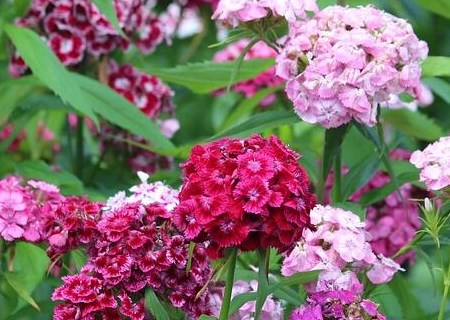
Seed planting methods for Dianthus barbatus
1. Harvesting
After the flowers drop, we can begin collecting seeds. After harvesting, they are generally not sown immediately; they are first soaked in water for two days, then the seeds are scooped out and mixed with sand before moving on to the next step.
2. Timing
For sowing, September is generally chosen, but if you are planting in the north, it is best to do it earlier rather than too late, generally between August and September is best, so that when it grows up it will have many branches and thus produce more flowers. But if you are planting in the south, there are not so many restrictions on timing; as long as the temperature is kept between 5 and 22 degrees, you can sow.
3. Sowing
We scatter the seeds mixed with sand evenly over the seedbed or the ground where they are to be sown, then cover them with a thin layer of soil to better keep the seeds warm. After that, you can water them; when watering, be sure to water thoroughly and just keep the temperature suitable, and after about five days the seeds will begin to sprout.
4. Care
After the seeds sprout, seedlings will appear in about 10 days. At this point we need to control the temperature well; generally the most suitable temperature for seedling growth is between 10 and 20 degrees, so the seedlings can grow better. When the seedlings have grown 4 to 5 leaves, we can begin transplanting them. After transplanting, these seedlings will bloom the following spring. In addition, if you choose open-field planting, or sow in pots in November to December, then if you want to transplant them, it will not be so early; you must wait until April of the following year before you can begin transplanting.
What is the difference between Dianthus barbatus and Dianthus chinensis
1. Different ecological habits
Dianthus chinensis is a perennial herb with strong cold resistance and can overwinter exposed on the ground; it needs calcareous soil with good drainage;
Dianthus barbatus is a perennial herbaceous plant with fibrous roots, has average cold resistance, but is relatively adaptable to soil.
2. Different stems
The stems of Dianthus chinensis are clustered, upright and smooth in appearance;
The stems of Dianthus barbatus grow upright and have four ridges; compared with Dianthus chinensis, Dianthus barbatus has longer internodes and is more robust.
3. Different leaves
The leaves of Dianthus chinensis are linear-lanceolate, with pointed tips, and the base clasps the stem;
The leaves of Dianthus barbatus are broadly lanceolate, oblong-lanceolate, or relatively narrow elliptic.
4. Different flowers
The flowers of Dianthus chinensis are solitary, opposite, or clustered at the top, with a flower stem length of about 2 to 3 cm, and the flowering period is April to May;
The flowers of Dianthus barbatus are small and numerous, with short pedicels, densely gathered into a head, and the flowering period is May to July.
Is Dianthus barbatus cold-hardy in winter
Dianthus is a perennial herb with strong vitality that can overwinter naturally and can be used for large-scale landscape greening. The idea you mentioned of planting around trees is good, but one shortcoming is that it is not a shade-tolerant plant and does not grow vigorously under trees.