Wisteria, also known as Chinese wisteria: seed planting methods, yellowing and leaf drop treatment, and reasons for not blooming
Wisteria has strong adaptability to its growing environment. People enjoy eating the purple flowers, either blanched and served as a cold salad or coated in batter and deep-fried, and using them to make flavored wheat foods such as “ziluo cakes” and “ziluo pastry.” People very much like growing wisteria. So do you know what seed planting methods exist for wisteria? Why does it not bloom? What should you do when the leaves turn yellow and drop?
I. Wisteria seed planting methods
Wisteria is easy to propagate and can be grown by sowing, cuttings, layering, division, and grafting, mainly by sowing and cuttings, but because seedling plants take a long time to raise, cuttings are the most widely used method.
1. Cutting propagation
Cutting propagation generally uses hardwood cuttings. In mid-to-late March, before the branches sprout, select sturdy 1- to 2-year-old branches, cut them into cuttings about 15 cm long, and insert them into a prepared seedbed, with the insertion depth at 2/3 of the cutting length. After insertion, spray water, strengthen care, and keep the seedbed moist. The survival rate is very high, and the plants can reach 20-50 cm in height in the same year and can leave the nursery after two years.
Root cuttings make use of the fact that wisteria roots readily produce adventitious buds. In mid-to-late March, dig out roots 0.5-2.0 cm thick, cut them into cuttings 10-12 cm long, and insert them into the seedbed, keeping the insertion depth so that the upper cut end of the cutting is level with the ground. Other management measures are the same as for branch cuttings.
2. Seed propagation
Seed propagation is carried out in March. Harvest the seeds in November, remove the pod skins, dry them in the sun, and store them in bags. Before sowing, soak the seeds in hot water; when the boiled water has cooled to about 30°C, remove the seeds and rinse them briefly in cold water, then keep them moist and pile them for a day and a night before sowing. Alternatively, store the seeds in moist sand and soak them in clean water for 1-2 days before sowing.
Layering, division, and grafting are all carried out in mid-to-late March.
3. Cultivation and transplanting
This is mostly done by planting out in early spring. Before planting out, a trellis must first be built, and the thick branches should be tied to the trellis separately so that they climb along it. Because wisteria has a long lifespan and thick branches with dense leaves, the trellis material must be solid and durable. When young trees are first planted out, the branches cannot form flower buds; only later do they set flowers and buds. If it still does not bloom after several years of planting, the first reason is that the tree is too vigorous with too many branches and leaves, and the second is that the tree is weak and finds it hard to accumulate nutrients. For the former, partially cut the roots and thin out the branches and leaves; for the latter, increasing fertilizer application will enable it to bloom. Fertilizer should include a suitably larger amount of potassium fertilizer. During the growing season, generally apply topdressing 2-3 times. After flowering, the middle branches can be shortened to retain 5-6 buds, and weak branches should be cut off to promote flower bud formation.
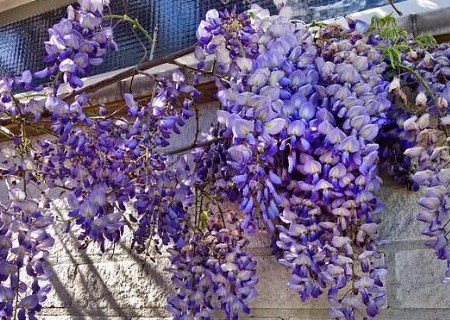
Buds appear in March, and full bloom occurs in April, with 20-80 pea-like flowers per raceme. Wisteria likes sunlight and tolerates slight shade. Because wisteria is a large climbing plant, in order to make it grow well, a certain trellis is generally set up for cultivation. Wisteria also has relatively shorter species and cultivars that can be grown as potted plants or made into bonsai.
II. Why wisteria does not bloom
1. Cause analysis
(1) Seedling plants
The reason wisteria does not bloom is that seedling plants were grown, that is, plants raised from seed. Such plants usually need 7 years of care before they bloom, while normal grafted plants bloom within 3 years.
(2) Improper pruning
Beginners at growing flowers do not know how to prune and only cut off the branches and vines that grow too fast, but those are actually the reproductive branches. So during pruning, if you do not understand it, do not cut; even if you are going to prune, first cut off the dead branches and remaining leaves, and then seek help from a professional.
(3) Insufficient light
Whether planted in the ground or in a pot, the plants should receive at least 6 hours of light. During care, this is affected by factors such as different planting or placement positions and weather conditions. If conditions allow, light can be supplied artificially.
(4) Not repotting and changing the soil for a long time
The soil contains a large amount of trace elements, which are necessary conditions for root growth. When you have not repotted or changed the soil for a long time, the elements in the soil are exhausted, and the plant lacks the accumulation of nutrients, making it very difficult to bloom!
(5) Variety and other objective factors
There are many varieties of wisteria. In the same care environment, some bloom less and some bloom later! These are uncontrollable factors. How it should bloom is all related to the choice you made at the beginning.
The rest comes down to personal reasons. Care depends on luck, and whether the timing of each watering and fertilizing is correct will all affect flowering!
2. Solutions
(1) Strengthen management and supplement nutrition
For plants that do not bloom because improper care has caused a lack of nutrients, strengthen care and apply topdressing 2-3 times during the growing season to ensure the supply of nutrients. Loosen the soil and repot in a timely manner to ensure there are sufficient trace elements in the soil.
(2) Choose excellent varieties that bloom
Sometimes it is not your fault that it does not bloom; the plant itself blooms late or even does not bloom. So choose varieties that bloom more easily for cultivation.
(3) Prune reasonably
Pruning should be based on the plant's own growth vigor. If it grows too fast, promptly cut off weak branches and dead branches. When the plant grows too slowly, do not prune even if the time is suitable, so as not to affect flowering!
III. What to do when the leaves turn yellow and drop
1. Overwatering: the young leaves at the top of the plant turn pale yellow, the old leaves also gradually turn yellow, and the new shoots shrivel. This is caused by long periods of rain or excessive watering, making the inside of the pot too wet, the soil lacking oxygen, and the roots rotting. You should loosen the soil often, control watering, and avoid heavy rain spraying.
2. Dry soil: the leaf color at the top is normal, while the lower leaves gradually dry, turn yellow, and drop upward. This is caused by the pot soil being too full or water not penetrating for a long time, causing the lower leaves and branches to age. Water appropriately and keep the soil moist.
3. Lack of fertilizer: the plant's leaves are thin and yellow. This is caused by the plant being too large for the pot, or by not repotting or changing the soil for a long time, as well as insufficient fertilizer. Gradually increase water and fertilizer and repot in a timely manner.
4. Fertilizer damage: the plant's leaves become uneven and do not spread out smoothly, the new leaves are thick and fleshy, and the old leaves gradually turn yellow. Water frequently, suspend fertilization, and scatter a few vegetable seeds in the pot, then pull out the seedlings after they sprout, so as to consume the fertilizer in the pot and restore the plant to normal growth.
5. Alkalinity: for acid-loving plants, the leaves gradually turn yellow, which is caused by the soil being alkaline. You can water with water soaked with green grass and apply a little ferrous sulfate, and the leaves will turn green.
6. Inappropriate light: potted flowers are often placed indoors, and the plants easily develop yellow leaves. For sun-loving plants, insufficient light will also cause yellow leaves. For some plants that like a cool environment, high temperatures and exposure to the sun will also cause the leaves to turn yellow and drop.