How to make a pear tree bonsai? Key points of indoor care and fruit thinning techniques
The pear tree is a perennial deciduous fruit tree of the genus Pyrus in the rose family (Rosaceae), a tree species widely distributed around the world. China's pear cultivation area and output are second only to apples. So can pear trees be made into bonsai? How are they made? Can they be kept indoors? What are the fruit thinning techniques for pear trees? According to bonsai enthusiast Mr. Lu, potted pear trees can be placed on a balcony in a bright, well-ventilated spot. The pear tree is a light-loving, drought-tolerant plant that can be managed extensively; top-dressing with phosphorus and potassium fertilizers is better, as it can promote flowering and fruiting.
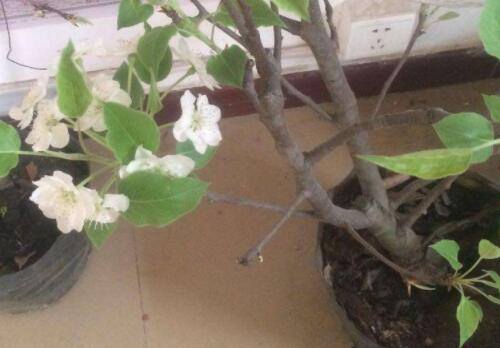
How are pear tree bonsai made?
1. Material selection
For pear tree propagation, Pyrus ussuriensis, Pyrus calleryana, Pyrus betulifolia, Pyrus pyrifolia and others can be chosen as rootstock, with pear varieties that are vigorous, of good quality and easy to fruit used as scion, grafted by bud grafting or branch grafting. Rootstock can be propagated artificially, or old pear trees culled from orchards can be used, or old stumps of dwarf, oddly shaped, early-branching, quaint and sturdy wild pear varieties can be collected from the mountains and fields; after "nurturing the stock" to restore vigor, they are allowed to grow new branches before grafting. Generally, digging and transplanting are done after leaf fall in autumn or before sprouting in spring. First plant them in the ground or in a larger clay pot. Before planting, shape the plant, cut off overly long main roots, and keep more lateral roots and fibrous roots; excess branches should also be cut off. After planting, water thoroughly and keep in a wind-sheltered, sunny place for care to ensure survival.
2. Shaping
Pear trees are suitable for making many different forms of bonsai, such as straight-trunk style, slanting-trunk style, curved-trunk style, double-trunk style, forest style, waterside style, and lying-trunk style. Because the leaves are relatively large, the crown mostly adopts a natural shape and does not need to be wired into flat pads. Since pear trees grow vigorously with a large annual growth increment and strong development of terminal branches, no matter what form of bonsai it is, the methods of heading back and pinching are needed to control the growth of strong vigorous branches, so that they form a short, compact and naturally beautiful crown, and to promote the transformation from vegetative growth to reproductive growth, which is beneficial to flower bud formation. The pear tree's fruit is large and is the main ornamental point of the bonsai. When cultivating the crown, the size, quantity and distribution of the fruit should be determined according to the plant's form and nutrient reserves, so that there is a certain variation. And through methods such as branch pulling, branch twisting, bending and cutting back, adjust the direction of branches, increase the number of skeletal branches, control vigorous branches, and promote the growth of short branches, so as to cultivate robust fruiting branch groups, making the bonsai full of branches and leaves with a moderate fruit set. The pear tree has a well-developed root system, and the roots can be raised as needed to enhance the bonsai's sense of vicissitude and antiquity.
3. Care
(1) Pear trees like a warm, humid environment with plenty of sunlight, and have strong adaptability to the environment, tolerating both cold and high temperatures. During the growing season, they can be kept in a well-ventilated, sunny place for care; if there is insufficient light, the branches will grow weakly and flower buds will not form plumply. In winter, they can be kept in a cold room or outdoors in a wind-sheltered, sunny place to overwinter, and they can overwinter safely as long as the pot soil does not freeze.
(2) Pear trees have a relatively large fertilizer requirement. When potting, apply sufficient base fertilizer, and during the growing season apply 1 application of well-rotted organic liquid fertilizer every 15-20 days. During the bud break stage, flower bud differentiation stage and fruit enlargement stage, when fertilizer demand is relatively large, in addition to normal fertilization, the amount of phosphorus and potassium fertilizer should also be increased, by spraying a 0.2%-0.3% potassium dihydrogen phosphate solution on the leaves 2-3 times, to meet the nutritional needs of flowering and fruiting.
Appendix: Pear tree fruit thinning techniques
Fruit thinning is an important technical step in pear tree production. Whether the fruit load is reasonable and whether the fruit thinning technique is in place will directly affect the yield and quality of pears, and affect the economic benefits of pear production. Leaving too much fruit causes many small fruits, uneven fruit size, poor fruit quality, weakened tree vigor and other phenomena, and also affects the next year's yield; leaving too little fruit affects the current year's yield. To achieve sustainable development in pear tree production, one must master fruit thinning techniques well and achieve a reasonable fruit load.
1. Fruit thinning time for pear trees: carried out 10 days after the pear flowers fade; in Jianchuan, the "Qingming" solar term is suitable.
2. Fruit thinning method: For the fruit spur branch, the principle of one fruit per spur should be followed; each fruit spur keeps only one fruit, and after thinning the spacing between fruits should be kept at about 20 cm. For fruit thinning on one-year-old branches, the fruit load should be determined according to the thickness of the branch, generally controlled at 1-2 fruits so that the branch does not droop.
When thinning fruit, attention should be paid to selecting and keeping good fruit, cutting off diseased, insect-damaged and deformed fruit. On one inflorescence, as far as possible keep the best one of the 2nd to 4th fruits from bottom to top, and thin out the excess fruit.
3. Fruit load: To ensure pear fruit quality, in well-managed mature pear orchards, the yield per mu is generally controlled within 3000 jin. Calculated at 3000 jin per mu, the fruit load per mu of pear orchard is about 6000 fruits. Calculated at 30 pear trees planted per mu, the fruit load per pear tree is about 200 fruits.