How much is Pinellia ternata per jin? Detailed explanation of cultivation methods and medicinal value
Pinellia ternata, also known as Diwen, Shoutian, etc., belongs to the order Arales. It is widely distributed in the Yangtze River basin of China as well as the Northeast, North China and other regions. It is a medicinal plant with the effects of drying dampness and transforming phlegm, directing qi downward and stopping vomiting, and when used raw, it reduces boils and swellings; veterinarians use it to treat suohouhuang. It is also distributed in Tibet, at an altitude of about 3000m. So how much is Pinellia ternata of the order Arales per jin? How is it cultivated? What medicinal value does it have? It is understood that one kilogram of Pinellia ternata costs 150—250 yuan.
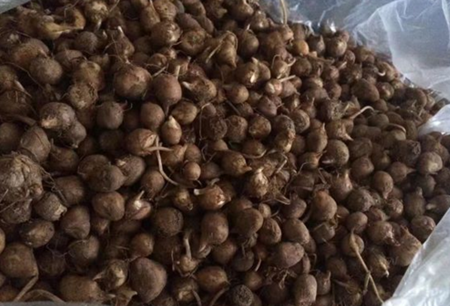
I. Cultivation techniques of Pinellia ternata
1. Site selection and land preparation
It is advisable to choose moist and fertile sandy loam or loam with strong water and fertilizer retention, loose texture, good drainage and irrigation, and a neutral reaction for planting; semi-shaded and semi-sunny gentle-slope mountain land can also be chosen. When planting Pinellia ternata in plain areas, it is necessary to choose a plot that can be irrigated and drained and has relatively high terrain, and drainage ditches must be dug well before planting. After selecting the land, in October to November, plow the soil deeply to about 20cm, remove stones and weeds, and let it weather and mature.
2. Propagation methods
First, tuber propagation. After Pinellia ternata has been cultivated for 2~3 years, the underground tubers can be dug up after the seedlings wither in June, August and October each year. Select medium and small tubers with a transverse diameter of 0.5~10cm, robust growth and no pests or diseases as seeds; small seed tubers are superior to large seed tubers. Mix them with fine sandy soil of moderate dryness and moisture, store them in a ventilated and cool place, and take them out for planting in the winter of that year or the spring of the following year. Spring planting is preferable; autumn and winter planting gives low yield.
Second, bulbil propagation. In summer and autumn, use the mature bulbils under the leaf stalks for row planting, with a row spacing of 10~16cm and a plant spacing of 6~10cm; open holes, place 3~5 bulbils in each hole, and cover with soil 1.6cm thick. At the same time, apply an appropriate amount of mixed fertilizer, which can both promote the germination and growth of bulbils and add fertilizer for the mother tubers, helping to increase yield.
Third, seed propagation. Pinellia ternata more than two years old can bloom and bear fruit successively from early summer to autumn and winter; this method is used when seedlings are insufficient or for breeding. About 10d after flowering in autumn, when the spathe withers, collect the mature seeds and store them in wet sand.
3. Field management
When about 50% of seedlings have emerged, the plastic film should be removed to prevent the temperature inside the film from being too high and burning the seedlings. Before removing the film, uncover it from both ends of the bed at noon for ventilation and heat dissipation, and seal it again in the evening; do this for several consecutive days to harden the seedlings, then remove it completely. After seedling emergence, remove weeds in the field at any time while loosening the soil. After removing the film, the ground should be watered and the soil loosened in time to preserve moisture. During the bulbil enlargement period, more water is needed, and the soil should be kept moist and loose. In the rainy season, accumulated water should be drained. Bulbil growth requires earthing up; from June to August, mature bulbils and seeds fall to the ground one after another, and at this time earthing up should be carried out and fertilizer applied twice. All flower buds growing during the growth period should be removed to promote tuber growth and enlargement, thereby increasing yield. After Pinellia ternata withers in November, collect the aboveground stems and leaves and the fallen bulbils, among which the plastic film is laid flat on the surface of the high bed.
4. Pest and disease control
White star disease: occurs from April to May. In the early stage of the disease, spray 50% thiophanate-methyl wettable powder 500-fold solution, or 50% carbendazim wettable powder 500~1000-fold solution, or 50% Tuzet wettable powder 500-fold solution, once every 7~10d, for a total of 2~3 sprays.
Leaf spot disease: in the early stage of the disease, spray 1:1:120 Bordeaux mixture or 65% zineb 500-fold solution, or 50% carbendazim 800~1000-fold solution, or thiophanate-methyl 1000-fold solution for control, once every 7~10d, for 2~3 consecutive sprays; or spray with 1kg garlic plus 20~25kg water; at the same time, pull out diseased plants and burn them.
Control of red hawk moth: spray 90% crystalline trichlorfon 800~1000-fold solution, once every 5~7d, for 2~3 consecutive sprays.
II. Medicinal value of Pinellia ternata
Dries dampness and transforms phlegm, directs qi downward and stops vomiting, and disperses stuffiness and nodules. It is used for cough and asthma with profuse phlegm, phlegm-fluid dizziness and palpitations, wind-phlegm dizziness, phlegm syncope headache, vomiting and nausea, chest and epigastric stuffiness, and plum-pit qi; when used raw externally, it treats carbuncles and swelling and phlegm nodules; veterinarians use it to treat suohouhuang.
III. Banxia Houpo Tang
Banxia Houpo Tang originates from Jin Gui Yao Lue and is a specialized formula mainly for treating the sensation of a foreign body in the throat.
Jin Gui · Women's Miscellaneous Diseases, Pulse, Syndromes and Treatment No. 22 states: “If a woman feels as if there is roasted meat in her throat, Banxia Houpo Tang governs it.” The so-called “roasted meat” is commonly used in traditional Chinese medicine as a metaphor for phlegm obstructing the throat, which cannot be spit out or swallowed down; the ancients called it “plum-pit qi,” and it is especially common in women. It manifests as a foreign body sensation in the throat, inability to swallow or spit it out, poor mood, chest tightness, white greasy tongue coating, and a stringy slippery pulse. This pattern is mostly seen in what modern medicine calls pharyngeal neurosis and chronic pharyngitis.
This formula contains many pungent, warm, bitter and drying substances, and is only suitable for those with phlegm and qi mutually bound without heat. If there is malar flushing, bitter taste in the mouth, red tongue with little coating, belonging to qi depression transforming into fire and damage to yin with insufficiency of fluids, then even if the characteristics of plum-pit qi are present, this formula should not be used.
〖Formula aliases〗Houpo Tang, Da Qi Qi Tang, Si Qi Tang, Houpo Banxia Tang, Qi Qi Tang, Si Qi Yin
〖Source〗Jin Gui Yao Lue, lower volume.
〖Composition〗Pinellia ternata one sheng (130g), magnolia bark three liang (45g), Poria four liang (60g), fresh ginger five liang (75g), perilla leaf two liang (30g)
〖Formula song〗Banxia Houpo soothes phlegm and qi, Poria and ginger together with perilla; add jujube and decoct together, named Si Qi, phlegm congelation and qi stagnation can all be removed.
〖Indications〗A woman feels as if there is roasted meat in her throat; when the qi of joy, anger, sorrow, thought, worry, fear and fright forms phlegm and saliva, shaped like torn cotton or like a plum pit, between the throat, unable to be coughed out or swallowed down, this is what the seven qi cause; or stuffiness and fullness in the middle epigastrium, with qi not flowing smoothly, or excessive phlegm and saliva with upward qi urgency, or vomiting and nausea due to phlegm-fluid binding in the middle. The tongue coating is white and moist or white and greasy, and the pulse is stringy and moderate or stringy and slippery.
〖Effects〗Moves qi and disperses nodules, directs qi downward and transforms phlegm.
〖Usage〗Use seven sheng of water, decoct to obtain four sheng, divide into four warm doses, taken three times in the day and once at night. [Note: this formula comes from Zhang Zhongjing, and the units of measurement are from before the Han Dynasty; 1 sheng of water = 200 milliliters, 1 sheng of Pinellia ternata = 130 grams, one liang = 15 grams]
〖Notes〗Houpo Tang (Sheng Ji Zong Lu, volume 124), Da Qi Qi Tang (San Yin, volume 8), Si Qi Tang, Houpo Banxia Tang (Yi Jian Fang), Qi Qi Tang (Zhi Zhi, volume 5), Si Qi Yin (Xing Yuan, volume 4).