Rutaceae Murraya paniculata seed planting methods, value and flowering period explained
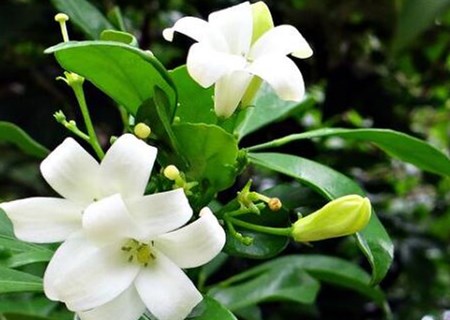
Murraya paniculata grows in low hills or sparse forests or dense forests in high-altitude mountainous areas. It prefers a warm and humid climate, and is best cultivated in a sunny location with deep, loose, fertile, slightly alkaline soil. So do you know what the seed planting methods for Murraya paniculata are? What value does it have? When does it bloom? According to grower Uncle Li, Murraya paniculata generally blooms between April and September each year, and sometimes it also blooms in autumn and winter. After Murraya paniculata blooms, it produces fruit, with the fruiting period between September and December.
I. Murraya paniculata seed planting methods
1. Sowing propagation
Pick plump, mature, bright red fresh fruit, rub it in clean water, remove the peel and the impurities and shriveled seeds floating on the water surface, and dry them in the shade for later use. Sowing can be done in both spring and autumn, but spring sowing is generally used more often. Spring sowing can be done from March to May, and when the temperature is 16°C~22°C, germination occurs 25~35 days after sowing. Autumn sowing is best done from September to early October. Before sowing, choose a nursery site with good water and fertilizer conditions as the seedling plot. Deeply plow, break up the soil, and rake it level to make beds, with a bed width of 1~1.2 m. Drill sowing or broadcast sowing. For drill sowing, use a row spacing of 30 m; for broadcast sowing, mix the seeds evenly with fine sand and spread them evenly on the seedbed, then cover with 1.2 cm of soil after sowing, then cover with grass and irrigate. When 2~3 true leaves appear, begin thinning the seedlings, keeping a plant spacing of 10~15 cm. Combine this with weeding and apply human and livestock manure as a topdressing. After application, spray water on the leaf surface to avoid burning the seedlings with fertilizer. When the seedlings are 15~20 cm tall, transplant them.
2. Cutting propagation
It is suitable to carry out in spring or during the rainy season in July~August. Cut vigorous, moderately mature 1-year-old or older branches with grayish-green bark as cuttings; tender branches of the current year should not be used. The cuttings should be 10~15 cm long with 4~5 nodes. Remove the leaves between the 1st~2nd nodes to reduce water evaporation from the leaf surface. To expand the rooting surface and water absorption, the cut should be made at an angle and smooth to improve the cutting survival rate. At a temperature of 18°C~25°C, rooting occurs 35~40 days after cutting. If the temperature is below 18°C, rooting will be delayed by 5~7 days. If treated with "Root Sun" rooting agent, rooting will be faster. Treatment method: mix 350-fold rooting agent solution with yellow mud into a slurry, dip the cut end of the cutting into the mixed slurry, and after treatment wait for the mud to dry before inserting it into the nursery pond. When inserting into the nursery pond, first make holes with a stick and then insert the seedlings, to prevent the yellow mud slurry from coming off the cuttings and affecting the rooting effect. The cutting medium can be river sand or yellow mud directly, with a plant and row spacing of 9 cm x 12 cm. After cutting, cover with 70%~80% shade netting, then water thoroughly, and afterward spray water 1~2 times a day, keeping the soil in the bed moist. At a temperature of 18°C~25°C, rooting can occur 20~25 days after cutting.
3. Layering propagation
It is generally carried out during the rainy season. Part of a semi-aged branch is ring-barked or cut and buried in the soil, and after it roots and sprouts, it can be separated in late autumn or the following spring and then transplanted.
II. What value does Murraya paniculata have?
1. Feng shui effect
Plants all have spirituality. Plants contain the five stars, and between plants and all things there exists the effect of magnetic fields. The microparticles of each object can influence each other and transfer changes to each other. As for Murraya paniculata, it is a white-series plant belonging to metal among the five elements, that is, plants with white bark, white flowers, or white leaves. It regulates the human lungs, and its feng shui meaning is "sweetness lasting long," so Murraya paniculata can bring good feng shui to the home, implying that your family will be warm and sweet forever.
However, plants have yin and yang, that is, yin and yang attributes. Sun-loving plants, if planted (placed) in a dark and damp environment, will become weak, produce no flowers, bear no fruit, or die. Murraya paniculata is a yang plant, so it should be placed in a sunny place; otherwise, the plant may not grow well and may ruin the feng shui, achieving the opposite effect.
2. Ornamental value
Murraya paniculata has an elegant tree posture, vigorous branches and trunk, remains evergreen all year round, blooms white and fragrant flowers, and has eye-catching red fruit, making it an excellent bonsai material. It is suitable for viewing all year round, and the effect is best in early summer when new leaves unfold. The branches and leaves of Murraya paniculata can be used as medicine, with the effects of promoting qi to relieve pain and activating blood to disperse stasis. It can treat stomach pain and rheumatic arthralgia, and when used externally it can treat toothache, bruises and swelling, insect and snake bites, etc. In addition, the flowers, leaves, and fruit of Murraya paniculata all contain essential oils, which can be used to extract cosmetic fragrances and food fragrances, and the leaves can be used as a flavoring spice.
3. Medicinal value
Murraya paniculata is produced in Sichuan and Hunan. Murraya paniculata is sour, bitter, and pungent in taste, warm in nature, and enters the liver meridian. It has the effects of activating blood and reducing swelling, and detoxifying and stopping diarrhea. Murraya paniculata is often used to treat traumatic injuries and dysentery. It can be taken orally: decocted in soup, 9-15 g. External use: appropriate amount, mashed and applied. Murraya paniculata can treat colds, headaches, stomach pain, toothache, rheumatic bone pain, and traumatic swelling and pain. Murraya paniculata activates blood and resolves stasis. It treats amenorrhea, abdominal masses, uterine bleeding, infantile malnutrition, and mumps.