How to Grow Downy Rosemyrtle (Rhodomyrtus tomentosa): How Many Years Until It Fruits and How Many Jin per Mu Is the Yield?
Downy rosemyrtle, that is, Rhodomyrtus tomentosa, also known as renzi or gangnian, grows 1-2 m tall. It is mostly wild. Its flowers are beautiful, so it can be used as a garden ornamental plant. So how do you grow downy rosemyrtle? How many years does it generally take to bear fruit? How many jin per mu is the yield?
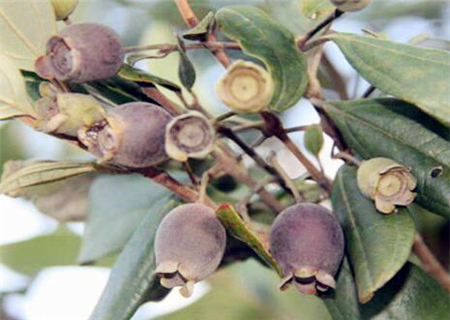
How many years does downy rosemyrtle generally take to bear fruit? Its flowering period is especially long, from April to September, blooming and fruiting at the same time.
Planting Methods
Seed Propagation
Before sowing, the seeds must first be selected. Whether the seeds are well chosen directly affects whether sowing will succeed.
It is best to use seeds harvested in the current year. The longer the seeds are stored, the lower their germination rate. Choose seeds that are plump, not damaged or deformed, and free of pests and diseases. For home seed disinfection, it is common to soak the seeds in hot water at about 60°C for a quarter of an hour, then use warm water to promote germination for 12-24 hours. To disinfect the sowing substrate, the best method is to put it in a pot and heat it until hot, which will scald any pests and diseases to death. Soak the seeds in warm water (at a temperature similar to face-washing water) for 12-24 hours, until the seeds absorb water and swell. For very common seeds that germinate easily, this step can be skipped. For tiny seeds that are difficult to pick up with your hands or other tools, you can wet one end of a toothpick with water and stick the seeds one by one onto the surface of the substrate, then cover with substrate 1 cm thick, and then place the sowing pot into water with the water depth at 1/2-2/3 of the pot's height, letting the water slowly soak upward (this method is called the "pot immersion method"); for larger seeds that can be picked up with your hands or other tools, place the seeds directly into the substrate and sow them in spots at a spacing of 3×5 cm.
After sowing, cover with substrate to a thickness of 2-3 times the size of the seeds. After sowing, you can use a sprayer or a fine-holed watering can to moisten the sowing substrate, and later water again when the pot soil is slightly dry. Still be careful not to water too forcefully, so as not to wash the seeds out; after sowing in late autumn, early spring, or winter, when a cold wave brings low temperatures, you can wrap the flowerpot with plastic film to help keep it warm and moist; after the seedlings emerge, promptly uncover the film, and let the seedlings receive sunlight before 9:30 every morning or after 3:30 in the afternoon, otherwise the seedlings will grow
very weak and delicate; after most of the seeds have sprouted, appropriate thinning is needed: pull out the diseased and unhealthy seedlings so that the remaining seedlings have a certain amount of space between them; when most of the seedlings have grown 3 or more leaves, they can be transplanted.
Cutting Propagation
When doing softwood cuttings, from late spring to early autumn when the plant is growing vigorously, choose robust branches of the current year as cuttings. After cutting off the branches, select the sturdy parts and cut them into sections 5-15 cm long, each section bearing more than 3 leaf nodes. When cutting the cuttings, note that the upper cut should be made horizontally about 1 cm above the topmost leaf node, and the lower cut should be made at an angle about 0.5 cm below the bottommost leaf node. Both the upper and lower cuts should be smooth (the knife must be sharp). When doing hardwood cuttings, after temperatures rise in early spring, choose robust branches as cuttings. Each cutting usually retains 3-4 nodes, and the cutting method is the same as for softwood cuttings.
Field Management
Humidity: Downy rosemyrtle likes a moist climate environment and requires the relative air humidity of the growing environment to be 70-80%. If the relative air humidity is too low, the lower leaves turn yellow and fall off, and the upper leaves lose their luster.
Temperature: Because downy rosemyrtle originated in tropical regions and likes high-temperature and high-humidity environments, it has very strict requirements for winter temperature. It stops growing when the ambient temperature is below 10°C, and cannot safely overwinter when frost occurs.
In summer:
(1) Strengthen air convection so that the heat inside the plant can be released;
(2) Place it in semi-shade, or provide it with 50% shade;
(3) Give it appropriate misting, 2-3 times a day.
In winter:
(1) Move it indoors to a bright place for care;
(2) Outdoors, you can wrap it with film to overwinter, but every two days at the warmer midday period you must uncover the film to let it breathe. Light: It likes a semi-shaded environment, and can be given plenty of sunlight in autumn, winter, and spring, but in summer it needs more than 50% shade. When keeping it indoors, place it in as bright a place as possible, such as a well-lit living room, bedroom, study, and similar locations. After keeping it indoors for a period (about one month), move it outdoors to a shaded place (with winter insulation conditions) for care for a period (about one month),
Fertilizer and Water
For potted plants, in addition to adding organic fertilizer when potting, appropriate fertilizer and water management should also be carried out during routine care.
Spring, summer, and autumn: These three seasons are its peak growing seasons. Fertilizer and water management follows the cycle of "Huabao" -- clear water -- "Huabao" -- clear water, with an interval period of about 1-4 days.
Winter: During the winter dormant period, the main task is to control fertilizer and water well. Fertilizer and water management follows the cycle of "Huabao" -- clear water -- clear water -- "Huabao" -- clear water -- clear water, with an interval period of about 3-7 days. On sunny days or during high temperatures, the interval is shorter; on rainy days or during low temperatures, the interval is longer or no watering is done. For field-planted plants, in spring and summer, according to drought conditions, apply fertilizer and water 2-4 times: first dig a small ring-shaped trench 30-100 cm outside the root crown (the larger the plant, the farther from the root crown), with the trench width and depth both 20 cm. Spread 25-50 jin of organic fertilizer into the trench, or 1-5 liang of granular compound fertilizer (chemical fertilizer), then water thoroughly. After winter begins and before spring begins, apply fertilizer once more in the above manner, but do not water.
How Many Jin per Mu Is the Yield of Downy Rosemyrtle Planting?
The yield per mu is about 616 kg.