When Does Sesame Bloom? Planting Methods and Per-Mu Income Introduction
Sesame, also known as zhima or hu ma, is a common oilseed crop in China, rich in vitamins, various trace elements and protein. Regular consumption can help nourish the blood and regulate cholesterol, which is why many people enjoy eating it. So does sesame bloom? When does it bloom? How do you grow it? And roughly how much can you earn from one mu?
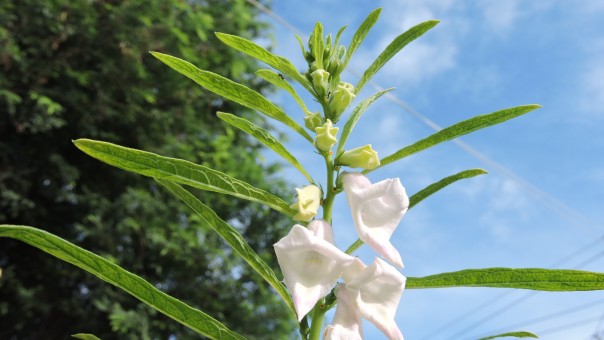
Sesame does bloom, and it grows fastest once it enters the flowering stage. During this period it absorbs 70%-80% of the nutrients it takes in over the entire growth cycle.
Flowering time:
Sesame is divided into summer-sown and autumn-sown types. The suitable sowing period for summer sesame is late May to early June, with flowering in early to mid-July; the sowing period for autumn sesame is early to mid-July, with flowering in early to mid-August. The flowering period also varies somewhat depending on the variety: early-maturing varieties bloom about 10 days earlier, and late-maturing varieties about ten days later.
Planting techniques:
1. Choose good seed: The quality of the seed directly determines the yield level, and good seed is the foundation of high yield. Seed with high yield and strong overall disease resistance should be chosen for planting. In recent years, some of the better sesame varieties include Zhongzhi No. 35 from the Chinese Academy of Sciences, Yuzhi No. 24 from Henan, Fengzhi No. 1 from Shandong, Zhongzhi No. 13 from Hubei, and Wanzhi No. 2 from Anhui.
2. Rotate crops: Experience shows that after one year of continuous sesame cropping, the disease rate of plants in the field reaches more than 50%, and after two years of continuous cropping it reaches as high as 80%. Summer sesame should be rotated with summer-sown crops such as soybean, peanut, corn and sweet potato, preferably with a three-year gap.
3. Change flat planting to bed planting: Sesame is not tolerant of waterlogging. Changing flat planting to deep-furrow narrow-bed cultivation has the advantage that surface water in the field can drain away quickly and subsurface water can also be released quickly. Sesame grows better, disease is reduced, and yield increases.
4. Double-layer sowing and seedling raising: After the land is plowed, immediately broadcast the first round of seed, do a single harrowing to cover the seed, then broadcast a second round of seed, followed by straight harrowing and cross harrowing, repeated several times until the soil is harrowed into fine crumbs. This method ensures that in drought the deep-layer seed can absorb enough moisture to emerge on time, and on rainy days the shallow-layer seed can sprout safely. Whether it is dry or rainy, full emergence of seedlings can be guaranteed.
5. Appropriate dense planting and transplanting: For the single-stem type, plant about 20,000 plants per mu at a spacing of 16 cm x 19 cm. For the branching type, halve the density and double the plant and row spacing.
6. Rational fertilization: Mainly use farmyard manure, plus 25 kg of superphosphate per mu. If farmyard manure is insufficient, add 5 kg of urea per mu. Apply sufficient base fertilizer before land preparation, bed making and sowing. From early flowering to full flowering, apply 12-14 kg of nitrogen fertilizer per mu as a top dressing, and at full flowering spray boric acid and potassium dihydrogen phosphate to promote full grains.
7. Cultivation and loosening of the soil: At the two-true-leaf stage, do the first weeding and thinning; at the four-true-leaf stage, do the second weeding and thinning. If missing plants are found, transplant seedlings with soil to fill the gaps; when plants reach 14-16 cm, thin to a final stand and hoe deeply to loosen the soil. At pod-setting, do one more shallow hoeing.
8. Pest and disease control: When sesame has 1-2 pairs of true leaves, spray a 1000-fold solution of 90% trichlorfon crystals to control pests such as cutworms; when flower buds appear, spray carbendazim to control diseases such as bacterial wilt and leaf spot.
9. Remove the growing tip: After full flowering, on a sunny morning, remove 4-6 cm of the stem tip, which can conserve nutrients and boost yield.
10. Harvest sesame at the right time when it is 80-90% ripe; if overripe, the seed capsules will burst open and the seeds will fall off.
Planting benefit analysis:
Sesame seed comes in black and white types. Black sesame yields higher than white sesame, but its oil content is lower than that of white sesame. The main sesame varieties currently grown are: Dongzhi No. 8 and Dongzhi No. 10. Both varieties are white sesame, generally yielding around 80 kg per mu, with high-yielding fields reaching more than 100 kg. The whole growth period for both is about 90 days, and these two varieties were developed by crossbreeding at the Oil Crops Research Institute of the Chinese Academy of Agricultural Sciences. There is also a local farm variety of black sesame, whose seeds are jet-black and glossy with a strong aroma, generally yielding around 100 kg per mu, with a whole growth period of about 95 days.