How to plant Queen's Crape Myrtle seeds? Introduction to its effects, benefits and flowering time
Queen's Crape Myrtle, also known as Giant Crape Myrtle, is a large tree in the family Lythraceae, genus Lagerstroemia. Its flowers are brilliantly colored and very beautiful, and it is often cultivated in gardens for ornamental viewing. So do you know what methods there are for planting Queen's Crape Myrtle seeds? What effects and benefits does it have? When does it bloom? According to grower Sister Li, who cultivates Queen's Crape Myrtle, Queen's Crape Myrtle generally blooms between June and September each year.
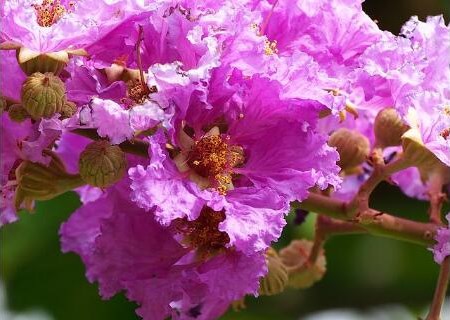
I. Methods for planting Queen's Crape Myrtle seeds
Select semi-lignified young seedlings and transplant them into the field. Before planting, apply sufficient base fertilizer in the holes.
During the growing period of young trees, fertilize once a month, and pay attention to pinching off buds and training the trunk. After the plant matures, fertilize twice a year. During the flowering period, apply a compound fertilizer mainly containing phosphorus to promote abundant flowering. After leaf drop and dormancy in winter, prune once.
Cut off remaining flower branches, fruit branches, overly dense branches, and diseased or pest-infested branches, and apply base fertilizer around the base (mainly organic fertilizer). This can promote growth the following year and vigorous flowering.
Pests and diseases are rarely seen. Pest damage includes scale insects, which harm the branches. They should be killed early or prevented and controlled by spraying pesticides such as dimethoate.
II. What effects and benefits does Queen's Crape Myrtle have
1. Medicinal effects of Queen's Crape Myrtle
The bark, leaves, seeds and roots of Queen's Crape Myrtle can all be used as medicine, and different parts have different medicinal effects. Its bark and seeds are natural laxatives, while the seeds of Queen's Crape Myrtle have strong anesthetic properties and can provide pain relief. Normally, the leaves of Queen's Crape Myrtle are mostly used in the treatment of human diabetes. They can lower blood sugar while improving the body's antioxidant capacity, which is greatly beneficial for delaying aging.
2. Industrial uses of Queen's Crape Myrtle
Queen's Crape Myrtle is a tall tree. Its trunk is upright and its wood is hard, giving it an important role in industrial production. It can be used to produce furniture, ships and railway sleepers. In addition, the wood of Queen's Crape Myrtle is also present in bridges in some areas. It is not easily spoiled or deformed in water and has strong corrosion resistance.
3. Queen's Crape Myrtle beautifies the environment
Beautifying the environment is also one of the important roles of Queen's Crape Myrtle. This plant not only has a long flowering period, but its flower colors are also especially brilliant. It can be planted in garden scenic areas in various places for people to admire, and it can also be planted on both sides of roads and streets, playing a role in greening and beautifying the environment.