How to grow red plum bonsai? Detailed explanation of pruning methods and flowering time
For red plum (Prunus mume), choose a tall, full plant and grow it as a solitary specimen in an important position or focal point of view, such as near an entrance, in a courtyard or on a lawn, forming a standalone landscape; it can also be cultivated as a bonsai. So, do you know how to grow red plum bonsai? How to prune it? When does it bloom? According to Uncle Chen, who grows red plum bonsai, red plum usually blooms in late winter (January-February) or early spring (February-March).
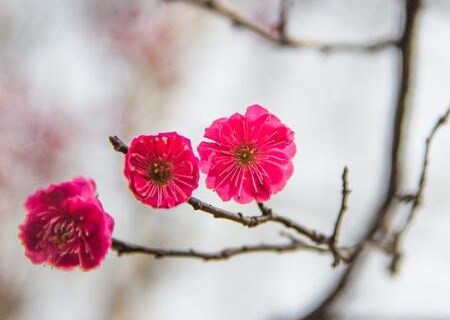
I. How to grow red plum bonsai
1. Placement
Red plum loves sunlight, so it must be placed in a spot with ample sunlight and good air circulation. Red plum is best placed in a sunny, well-ventilated location. Although red plum is relatively cold-hardy and can bloom proudly through frost and snow, it still prefers warmth and is suited to the southern climate. If grown in cold northern regions, it should be placed indoors to overwinter in winter.
2. Pot selection and soil
It is best to choose a clay pot with good drainage and air permeability; a purple clay pot can also be used. But do not use porcelain pots or plastic pots. For soil, loose and breathable soil is best; you can mix 40% garden soil, 30% coal cinder, and 30% humus soil.
3. Watering
Red plum is very afraid of waterlogging, so the amount of watering should be flexibly controlled according to weather changes and growth conditions. Generally, the principle is to keep the pot soil moist, and not to water until it is dry. When the branches and leaves wilt after a long dry period, first water lightly for 2-3 days so it gradually recovers; never immediately water heavily, which can cause massive leaf drop or even death. In June, when the branches grow to 15-20 cm, flower bud differentiation begins. At this time, water restriction should be carried out, that is, reduce the amount of watering for the plum plant so that the shoot tips wilt, then water lightly again. Repeat this 2-3 times so the shoot tips wilt completely and stop growing, then resume normal watering. This method is difficult to master. A simple way is: when the branches grow to 15-20 cm, pinch off the tips; if new buds grow again at the top, remove them again. Only when the top stops growing can the flower buds grow well and bloom normally. Each time, water with aged water so that the water temperature is basically consistent with the pot soil temperature.
Normally, keep the pot soil moist, taking care not to water until it is dry, and prevent water accumulation in the pot. From mid-to-late May to early-to-mid June, that is, from flower bud germination to formation, “water restriction” treatment is required, meaning let the pot soil dry until the old leaves slightly curl and the new shoots shrink before watering again. Repeat this several times to destroy the growth points of the new branches, stop the new shoots from extending, and increase flower bud formation, then gradually resume normal watering.
4. Fertilizing
Red plum loves fertilizer. After the flowers fade each year, organic fertilizer should be placed at the bottom of the pot. During the growing season, apply thin fertilizer once every half month to promote strong growth. Before flower bud formation, it is best to apply more phosphorus fertilizer. In addition to applying an appropriate amount of base fertilizer when repotting after pruning in spring, after flowering you can apply dilute decomposed soybean cake water or other decomposed organic fertilizer. In spring and autumn, fertilize once every half month, applying thin fertilizer frequently; avoid concentrated fertilizer. In summer and autumn, mainly apply phosphorus and potassium fertilizer; you can use a 2/1000 potassium dihydrogen phosphate solution to water or spray the leaves, 1-2 times a month, until flowering. Pay attention to the fertilizing season. Generally, when repotting, place bone meal, soybean cake, etc. at the bottom of the pot as base fertilizer. From mid-to-late May before flower bud formation, apply cake fertilizer water 1-2 times as a top dressing; in early August, apply 1-2 more times; in early autumn, apply one more top dressing.
5. Repotting
Red plum bonsai is generally repotted once every 1 to 2 years, preferably after flowering. When repotting, remove about one third of the old soil, cut off dead roots, shorten overly long old roots, and replace with humus-rich leaf mold mixed with chaff ash and sandy soil, so that the pot soil is both fertile and loose and drains well.
6. Pruning and repotting
Red plum forms flower buds on new branches of the current year, so after the flowers fade each year, prune promptly: cut the old flowering branches short, leaving only 2 to 3 buds, and make sure the buds grow outward. Thin out crossing branches, parallel branches, overlapping branches, opposite branches, water sprouts, and overly dense or weak branches that affect the beauty of the tree shape. Red plum has strong branching ability and tolerates pruning; only current-year branches can form flower buds, so it should be pruned once a year. Do this after flowering or when the flowers are about to fade and the leaf buds begin to sprout: cut away overly dense branches and diseased or weak branches, leave 2-3 bud eyes at the base of each branch, and cut off all the rest. At the same time, repot and change the soil; replace the pot soil once every 2-3 years. First knock the plum plant out of the pot, remove 1/3-1/2 of the original soil, cut off rotten roots, apply an appropriate amount of base fertilizer, add the prepared pot soil, plant it firmly, water thoroughly, and move it to a sunny place for care.
7. Controlling the flowering period
After red plum drops its leaves in winter, move it to a cold room where it will not freeze, or place it on a low-temperature balcony, and be sure to open windows for ventilation so it undergoes a period of low-temperature stimulation. At the same time, strengthen water and fertilizer management, spray water daily on the branches and around the pot, and keep the air moist. About 1 month before Spring Festival, begin to raise the temperature. Initially keep the room temperature at about 10°C and provide ample sunlight. 10 days before Spring Festival, raise the room temperature to 15-20°C, and it can be made to bloom for the festival.
8. Pest and disease control
In hot, humid summers with poor ventilation, powdery mildew can occur. For sooty mold, etc., spray 70% thiophanate-methyl wettable powder at 1500 times dilution, or 50% carbendazim powder at 1000 times dilution. Common pests are aphids and spider mites, which can be killed by spraying 1/5000 deltamethrin, or 1/1500 fenpropathrin (fenpropathrin), once a week for 2-3 consecutive times, with good results. Do not use DDV or dimethoate to avoid phytotoxicity and death.
II. How to prune red plum
1. Thinning branches
That is, thin out various crossing branches, parallel branches, overlapping branches, opposite branches, water sprouts, and overly dense or weak branches that affect the beauty of the tree shape. Follow the thinning principle of “do not touch old branches, keep the strong and remove the weak.”
2. Heading back
That is, on the basis of thinning branches, cut off the upper part of the current-year branches after flowering. The degree of shortening depends on the styling needs and growth vigor: for strong growth, cut less; for poor growth, cut more. According to styling needs, a few long branches may sometimes be appropriately retained. When heading back, also choose the direction of the bud opening according to the direction and angle of the branch, so as to achieve an appropriate balance of density and spacing.
3. Bud removal
That is, around April, when the current-year leaf buds grow to about 3 cm, remove some unnecessary buds according to the bud position, density, and the tree's styling needs. For buds on old trunks, remove them as soon as they appear.
4. Pinching
That is, in late June, when new shoots reach a certain length, pinch off the terminal buds to control branch growth; the length should generally be 15-30 cm. For red plum with poor sprouting ability, pinch earlier to encourage it to sprout again. When red plum trees are too old, the tree vigor often weakens. To make declining plum trees “young again,” the following measures can be taken:
① Over successive years, remove side branches on the main trunk in batches, or shorten the side branches year by year until they are removed from the base, so as to achieve renewal.
② When renewing thick branches, be sure to protect the wounds to prevent the invasion of pests and diseases.
③ Place the plum pot in the ground for cultivation, preferably in a place with good ventilation and light and fertile, loose soil, and at the same time thin out the branches. Repotting: Red plum bonsai should be repotted once every 1-2 years, preferably after flowering in March; November-December in winter is also acceptable. When repotting, remove 1/3-1/2 of the old soil, cut off dead roots, shorten overly long old roots, and replace with humus-rich leaf mold or frozen and loosened pond mud mixed with chaff ash and sandy soil.
Red plum pruning places great emphasis on seasonality. Especially in early spring after red plum finishes blooming, it has consumed a large amount of nutrients. At this time, red plum should be pruned immediately. Never wait until after budding and branch sprouting to prune, otherwise it will affect the growth of that year and weaken the tree vigor. Sometimes winter pruning is also needed to ensure the quantity and quality of red plum flowers. Do not prune more when there is time and manpower, and not prune when there is no time and manpower. In addition, before newly planting a plum tree, it is best to prune the red plum moderately. Because the root system of newly planted red plum is damaged and its nutrient absorption capacity is weak; if too many branches are left, nutrient and water supply cannot keep up, and normal growth of the plum tree is affected, ranging from weakened tree vigor to possible death.
Avoid being greedy for more and faster pruning:
Red plum pruning should be repeated and persistent, not a once-and-for-all task. Never do one heavy pruning and then ignore it for several years, letting it grow freely. Otherwise, the vigor of the red plum tree will be damaged, it will bloom sparsely or even have no flowers to enjoy, and it will become a miscellaneous tree with no ornamental value. Red plum growth varies according to annual climate and environmental changes and different daily management levels. When pruning, the plan should be determined according to the growth situation of that year, ensuring that each tree has a good shape and blooms abundantly the following year.