How to Grow Red Plum from Seed? Differences from Wintersweet and a Detailed Price Guide per Tree
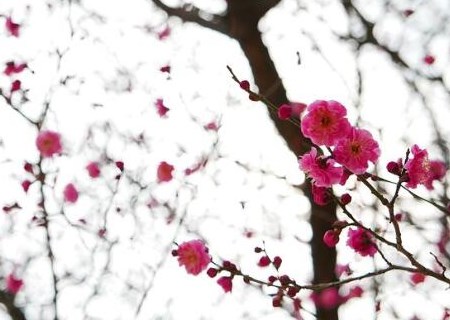
Red plum is a type of plum blossom. This plant can be used in gardens, green spaces, courtyards and scenic areas, and can be planted alone, in clumps or in groups; it can also be planted naturally in front of houses, on slopes, beside rocks and along roadsides. So do you know what methods there are for growing red plum from seed? What is the difference from wintersweet? And how much does one tree cost? In the red plum trading market we learned the latest prices of red plum: red plum with a ground diameter of 2cm sells for 12-16 yuan, with a ground diameter of 6cm sells for 120-160 yuan, and with a ground diameter of 10cm sells for 450-800 yuan.
I. Methods for Growing Red Plum from Seed
1. Sowing
It is generally used for breeding new varieties. Seeds are collected in August-September, stored dry until sowing in April of the following year, and have a high germination rate. If the seeds are first soaked in warm water, they germinate even more easily. One-year-old seedlings reach up to 20cm in height, and after 3 years of cultivation they can bloom.
2. Division
This is done after leaf fall in autumn until before bud break in spring. When dividing, simply dig up the red plum, remove the soil and divide it into several small plants. Each small plant must have 1-3 stems, cut back leaving locm, and then planted. They take root easily. In the autumn of the following year a dilute liquid fertilizer can be applied, and after 2 years they can bloom.
3. Layering
Air layering uses the pot-flow method, carried out in February-March, and separated from the mother plant in November. Mound layering is done in spring, and separated into individual plants in November.
4. Grafting
Grafting is the main propagation method for red plum. Dog-claw red plum and wild red plum are used as rootstock. Cleft grafting is carried out in spring when the leaf buds of the mother plant swell to the size of a grain of rice; approach grafting is carried out in the two seasons of spring and summer, with May being the most suitable. Management: red plum is generally transplanted after leaf fall in autumn and winter until before sprouting in spring. Large seedlings are moved with soil, small seedlings without soil, but the roots must not be left exposed for too long. The planting depth should be the same as in the original location. When planting below ground level, fill in soil to raise the ground surface to prevent waterlogging. After planting, shaping and pruning should be done promptly; it is best to keep a section of trunk 20-30cm long so that side shoots grow out from the trunk. Once the current year's side branches grow to 3-5 nodes, pinch them once to prevent excessive vegetative growth. After the tree grows taller, prune according to the shape of the crown: seedlings are pruned into a clump form, and grafted seedlings are pruned into a single-trunk form. After the flowers fade, cut back leaving about 20cm to encourage side buds to differentiate into flower buds. For garden fertilization, apply once each year from late autumn to early winter at the critical moment of flower bud differentiation. In winter, the tree plate should be dug over to improve the soil and benefit growth the following year.
5. Cuttage
Propagating plum blossom by cuttings is simple to carry out and the technique is not complicated. Treating the cuttings with a quick dip in 500ppm indoleacetic acid or 1000ppm naphthaleneacetic acid solution increases the survival rate, and can also promote rooting in varieties that are difficult to root. For plum blossom cuttings, November is the best time, because the leaves have fallen then and the branches store sufficient nutrients, making rooting and survival easy. Choose vigorous one-year-old branches 10cm to 12cm long as cuttings. When inserting, bury most of the branch in the soil, leaving only two or three centimeters above the soil surface and one bud exposed. The cutting bed requires loose soil with good drainage. After inserting, water thoroughly once and cover with plastic film; this maintains temperature and humidity in a small area and increases the survival rate of the cuttings. After they survive the following year, gradually give them ventilation so they adapt to the environment, and finally remove the film. In the spring of the third year they can be planted out at their final spacing.
II. What Is the Difference Between Red Plum and Wintersweet
1. Different colors
Plum blossom comes in various colors such as white, pink, purple-red and deep red; wintersweet is mainly wax-yellow, with other colors being relatively rare.
2. Different flowering periods
Wintersweet mostly opens around the twelfth lunar month, about 2 months earlier than the flowering period of plum blossom.
3. Different tree crowns
Plum blossom is a tree with a trunk and can grow to several meters. Its branches usually have thorny spurs. Besides straight branches, there are also weeping and twisted branches, and the crown is an irregular rounded shape; wintersweet is a shrub with clustered, upright branches and a very well-developed root crown that is block-like. The clustered branches are 2-4 m tall, and the main stem is 4-10 m.
4. Different leaves
Plum blossom leaves are alternate, broadly ovate to ovate, about 4-10 cm long; wintersweet leaves are opposite, nearly leathery, oblong in shape, rough and green on the upper surface, and smooth and gray on the underside.
5. Different fragrance
Plum blossom gives off a subtle, fresh and elegant fragrance; although wintersweet also gives off a light scent, its fragrance is richer and stronger than that of plum blossom.