The Dutch National Flower Tulip: Benefits and Uses, Types, and Planting Time
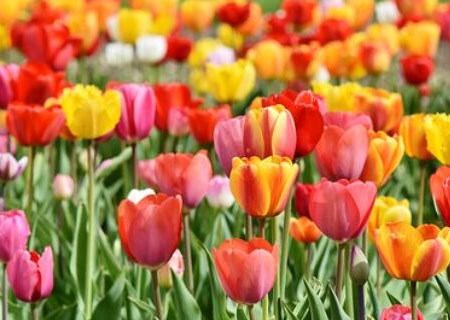
Tulips bear a single terminal flower that is large and showy, with tepals that are red or mixed with white and yellow, and sometimes white or yellow. Because of their brilliant colors, they are popular with the public. So do you know what benefits and uses tulips have besides looking beautiful? What types are there? When should they be planted? According to a tulip grower, Sister Li, the best time to plant tulip bulbs is in September or early October (before the arrival of autumn frost), and the tulips will bloom in April or May of the following year.
I. What benefits and uses do tulips have
1. Medicinal use
Probably few people know that it can actually be used as medicine. To be honest, its taste is bitter and pungent like traditional medicine, but in fact its effects are quite significant. It mainly helps resolve turbid qi in the spleen and stomach, and if the chest feels tight, it can also be used as medicine. In addition, if you feel your tongue coating is especially greasy, it can still be used. Furthermore, it can also treat bad breath. In our traditional herbal medical books, it is written that this mainly removes foul odors, and some foul qi in the abdomen will also be treated because of it. Besides this, it can also be used as an aromatic medicine. In addition, if dampness is relatively heavy, using it to remove dampness is also quite good; of course, the dampness here refers to dampness in the body. Our method of use is very simple: just use 3 to 5 grams and decoct it in water to drink directly, and it takes effect. In addition, an appropriate amount of the plant can also be soaked in water and then used to rinse the mouth.
2. Pharmacology
There is now a saying that its flowers and leaves both contain a certain toxic alkaloid. The effect of this alkaloid lies in the many kinds of amino acids it contains, which inhibit certain undesirable bacteria. However, because of the influence of this toxic substance, we cannot keep it directly indoors, otherwise it can easily cause adverse reactions such as fainting and hair loss.
3. Ornamental value
This flower is famous throughout the world, and a large reason for this is its beautiful flower shape. The flower is not delicate, but it is large and especially outstanding. Everyone goes to flower shops to buy one or two stems to give as gifts or to take home directly for flower arranging. In addition, its cut flowers are also excellent; the leaves are very elegant, and paired with the flowers they do not appear weak. Abroad, it has its own symbolism, representing victory, and many countries call it their national flower, so if everyone likes it, they can plant it in large numbers.
II. What types of tulips are there
There are as many as 8,000 or more horticultural cultivars of tulips. They are usually divided by flowering period into early, mid, and late; by flower shape into cup-shaped, bowl-shaped, lily-flowered, fringed, parrot, star-shaped, and so on. Flower colors include white, pink, red, purple, brown, yellow, orange, black, green-marked, and bicolor, and so on. The flower colors are very rich, except that blue is the only one lacking. In 1981, tulips were divided into 4 classes and 15 groups according to traits such as flowering period, flower shape, and flower color.
Yellow flowers speckled with red dots on the petals are called “King's Blood”; red flowers with stripes distributed on the petals are called “Olympic Torch”; and crimson flowers with petals curled around each other are called “Lover's Hot Kiss”, and so on.
Carotenoids turn the petals bright orange and yellow; anthocyanins bring light pink, rose red, and deep purple; tiny air bubbles between petal cells make the flowers appear crystal-clear pure white.
As for black tulips, the most classic variety is named “Queen of Night”, and its color is produced by the projection of raised cells. The flowers of Dutch varieties such as “Daiyan Widow”, “Peerless Beauty”, and “Black Queen” are not pure black.