Is Banks' rose (Rosa banksiae) poisonous, and in which month does it bloom? A guide to growing, pruning, fertilizing, and seedling prices
Banks' rose, also known as mixiang, qingmuxiang, wuxiang, wumuxiang, nanmuxiang, and guangmuxiang, is a climbing small shrub that can reach a height of 6 m and has high horticultural value. So, is Banks' rose poisonous? In which month does it usually bloom? How do you grow it? How do you prune and fertilize it? How much does a seedling cost? According to the Suqian garden seedling base, Banks' rose seedlings 15-25 cm tall cost 2.5-4.5 yuan each; seedlings 80-120 cm tall cost 15-22 yuan each; seedlings 150-180 cm tall cost 25-35 yuan each; and seedlings 200-250 cm tall cost 60-80 yuan each.
Is Banks' rose poisonous?
Banks' rose is not poisonous.
Its flowers contain aromatic oil, which can be used to make essences and cosmetics. Root bark: astringent, neutral. Astringes and relieves pain, stops bleeding. Used for chronic dysentery, bloody stool, diarrhea in children, boils, and traumatic bleeding.
Note that it should not be taken in large doses; an overdose can cause nausea, vomiting, and other gastrointestinal reactions.
In which month does Banks' rose usually bloom?
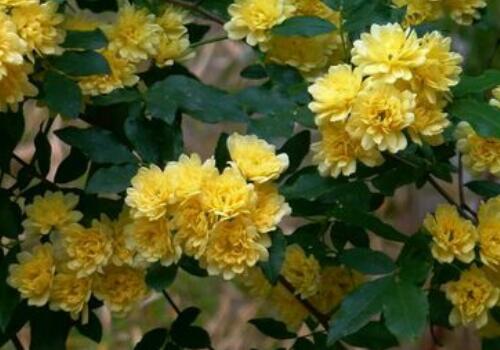
1. Banks' rose flowers are small, several forming umbels, with flowers 1.5-2.5 cm in diameter; pedicels 2-3 cm long, hairless; sepals ovate, apex long acuminate, entire, the hypanthium and outer sepals both hairless, the inner surface covered with white pubescence; petals double to semi-double, white, obovate, apex rounded, base cuneate; carpels numerous, styles free, densely pubescent, much shorter than the stamens. The flowering period is April-May.
2. Banks' rose can absorb exhaust gases, block dust, and purify the air. Its flowers are dense and strongly fragrant, and its autumn fruits are bright red; it is an excellent vertical greening material, suitable for arranging flower columns, flower stands, flower corridors, and walls, and is a material for hedges, very suitable for home planting. A famous ornamental plant, it is often cultivated for climbing over trellises.
How do you grow Banks' rose?
1. Pot and soil selection
For potted Banks' rose, you need to choose a relatively large flower pot and use suitable soil. Banks' rose likes loose, breathable, fairly fertile soil with good drainage. Applying some base fertilizer can increase the soil's fertility.
2. Light and temperature
Banks' rose likes a growing environment with plenty of sunlight, can tolerate partial shade, likes warmth, can tolerate cold but dislikes heat. To grow Banks' rose, you need to ensure a suitable temperature; in summer, when temperatures are high, cooling measures can be taken, and in winter, when temperatures are low, it can be placed indoors to prevent frost damage. Note that Banks' rose is relatively afraid of direct light during the seedling stage and needs shading.
3. Watering and fertilizing
Banks' rose likes a moist growing environment. During the growing period, the soil needs to be kept moist, but waterlogging must be avoided. Watering is generally done by watering thoroughly once the soil has dried out, and attention should be paid to maintaining air humidity. In addition to applying sufficient base fertilizer, you also need to ensure adequate nutrients during routine care. A diluted, well-rotted liquid fertilizer can be applied once every 20-30 days. Be careful not to apply too much nitrogen fertilizer, so as to avoid excessive vegetative growth and fewer flowers.
How do you prune and fertilize Banks' rose?
1. Pruning
Banks' rose is generally pruned in late summer or after flowering, and can also be pruned in winter. Cut off the vigorous water sprouts and dead or diseased branches of Banks' rose. After the flowers fade, the spent flowers and some branches can be cut off, which allows strong new branches to grow and produce more flowers the following year. Note that when pruning, do not prune heavily; cutting off too many flower buds will reduce flowering.
2. Pests and diseases
The main disease of Banks' rose is root rot, mostly caused by water accumulating in the pot. The main pests are aphids and scale insects. They need to be detected early and preventive measures taken.
3. Propagation
Banks' rose is mainly propagated by cuttings and layering, and propagation is relatively simple.