Bonsai Ficus (Moraceae) Cultivation Methods, Fertilization Tips and Causes of Leaf Drop
Ficus bonsai is a potted Ficus bonsai shaped into a unique artistic form through pruning, branch training, wiring and bending, grafting, careful cultivation, and long-term control of its growth and development. So do you know what the cultivation methods for Ficus bonsai are? How should it be fertilized? What causes leaf drop?
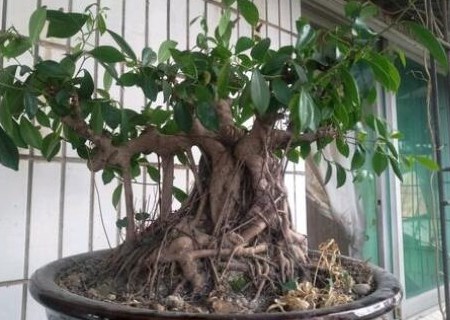
I. Ficus Bonsai Cultivation Methods
1. Seedling Selection and Planting
You should buy one-year-old seedling plants grown in nutrient cups, with stems about 5 mm thick and 200-300 mm tall; it is even better if the lower part of the stem has already sprouted many side branches. Stems that are too thick are unsuitable for shaping and break easily. Planting should be done from the end of March to early August, with the best time being March to April.
It is best to plant in a clay pot with a diameter of about 35 cm, because plant growth requires oxygen. When soil aeration is poor, due to the activity of anaerobic microorganisms, organic matter decomposes and releases carbon dioxide, which inhibits root respiration and affects growth. Therefore, preparing the growing medium is very important and is also one of the prerequisites for fast cultivation and growth. Base fertilizer must be composted for more than half a year before use; it contains cinder, refuse mud, and vegetable garden soil, one third of each by volume, mixed evenly. Do not use adhesive soil for planting. Before planting the sapling, soaking it for half an hour in a 5-10 ppm naphthaleneacetic acid solution or 5 ppm indolebutyric acid solution can promote earlier new root growth. When planting the seedling, first fill three quarters of the pot with growing medium, tear off the nutrient bag, place the seedling into the pot and pile growing medium over it, just enough to cover the root crown of the stem. Do not pack it firm and do not bury it deeply, otherwise few roots will develop or double roots will form.
2. Shaping and Cultivation
Shaping serves the purpose of dwarfing so that in the future it can present “the large within the small.” Shaping is the most important step in determining whether the tree stump, once formed into a landscape, has ornamental value and economic value. If shaping is poor, after several years of cultivation you will end up with an ordinary tree stump with no ornamental or economic value, wasting time, manpower, and material resources, and discouraging enthusiasm. Generally, shaping work can begin within 20 to 45 days after planting, and you can use metal wire to bend and train the tree according to the stump style shape you prefer. Regardless of the style, there is one principle: curved is beautiful. First set several wave shapes or alternating front-and-back bends within a large S-curve, then add a small S-curve, and do not forget to include several wave shapes as well. It should be rich in variation; it is enough that it not be balanced and identical. Provide more care and prune cautiously. In the first year, pruning is not allowed; you can only appropriately bend and train the lower side branches (trailing branches) or rear support branches and shape them, which can shorten the time needed to reach the final form. In the second year, when growth reaches about 50 cm in height, you can control the top of the main trunk by “topping” (that is, cutting it shorter when it exceeds the desired height) to encourage the lower horizontal branches to grow and thicken and to broaden the stem. By the third and fourth years, after some horizontal branches have grown larger, pruning can be carried out to control the plant shape, and attention should be paid to finishing the crown and ending the main trunk. By the fifth year, the head stem will be at least about 8 cm, and the side branches, rear support branches, and others can basically be pruned through two to three stages, and the tree stump will have basically taken its final form. Watering and fertilizing are long-term tasks. Three months after planting, the sapling begins to enter its growth period, and you can supply chemical fertilizer water (dissolving chemical fertilizer in water) to supplement the nutrients needed for the rapid growth of the Ficus sapling, with emphasis on potassium chloride, followed by urea; applying potassium dihydrogen phosphate together with urea gives notable results. By the second year, the Ficus enters its most vigorous growth period, with a stout trunk and prominently thick horizontal branches. After a year of cultivation and use, the limited potting soil has had its nutrients consumed and heavily leached, so at this time a 2-4 cm thick layer of base fertilizer should be spread along the surface of the pot. On the first sunny day after rain, immediately apply peanut cake fertilizer water or chemical fertilizer (peanut cake must be composted for half a month before use). Watering and fertilizing cannot be done mechanically; they should be carried out according to each person's free time, cultivation techniques, geographical environment, and climate changes.
3. Use of Growth Regulators and Trace Elements
To stimulate more new roots and accelerate growth, appropriately use some growth regulators from May to September each year, such as about 20 ppm naphthaleneacetic acid solution or 2,4-D solution; indolebutyric acid solution can also be used. In midsummer, the concentration should be reduced by one third. Spray 10 ppm 920 on the leaf surface; 920 only needs to be used in the first and second years, from April to June. The above regulators should be applied after 4 p.m. on sunny days, and the effect is good when the temperature is 18°C-25°C. After the second year, each year it is necessary to supplement trace element nutrient solutions such as ferrous sulfate, copper sulfate, zinc sulfate, magnesium sulfate, manganese sulfate, ammonium molybdate, and boric acid twice, with the total concentration not exceeding 0.4%; foliar spraying can also be done, at a concentration of 0.05-0.1%.
4. Pest and Disease Control
Ficus should not be repotted frequently. If the roots are not severely damaged, generally no disease occurs. After repotting damages the roots, you can apply gentian violet or a low-concentration potassium permanganate solution to the cut or wound. Pests are relatively few, mainly thrips damage. After this pest causes damage, spraying pesticide is ineffective, so prevention should be the main approach. From early summer to late autumn each year, spray methamidophos once or twice a month at a concentration of methamidophos:water = 1:200, and combine this with applying carbofuran buried in the soil for notable results. Pesticides are highly toxic, so please pay attention to safety.
II. How to Fertilize Ficus Bonsai
The potting soil of Ficus bonsai is limited, so attention should also be paid to supplementing fertilizer at ordinary times. During the growing season in summer and autumn, apply decomposed cake fertilizer water once a month; in winter, fertilize less or not at all. In addition, when repotting once every two years, crush and decompose organic fertilizer and mix it into the pot in a certain proportion to slowly provide nutrients.
Quick-acting fertilization is to dilute organic fertilizer or chemical fertilizer and then apply it according to the seasonal growth needs of the tree stump. However, note that it must not be too concentrated. Newly planted tree stumps are not suitable for this type of fertilization. Fertilizing on rainy days causes the fertilizer effect to leach away and produces poor results.
Ficus likes fertilizer during growth, but applying fertilizer too many times can harm its growth. The amount of fertilizer applied should also vary according to the season.
Although Ficus likes fertilizer, applying about 10 or more granules of compound fertilizer each month is enough. When fertilizing, bury the fertilizer into the soil along the edge of the flower pot, and water immediately after fertilizing. The main components of the fertilizer are nitrogen, phosphorus, and potassium.
After the tree stump enters normal care, use decomposed human and animal manure or composted cake fertilizer as a top dressing, applying it as a foliar supplemental feed once or twice a day.
When transplanting or repotting, decomposed chicken manure, soybean cake, and bone meal can also be mixed into the growing medium as base fertilizer. Sufficient fertilizer will make the branches and trunk grow quickly and thicken quickly, allow more prunings per year, and achieve the goal of shortening the cultivation period.
During the summer and autumn growing season, apply decomposed cake fertilizer once every 15 days, and at the same time also spray potassium dihydrogen phosphate. For home care and fertilization, compound fertilizer or granular fertilizer can be used; the method is frequent application of light fertilizer. Grasp the fertilization season well, and stop fertilizing in winter.
It should be noted that Ficus fertilization should be carried out by the method of frequent application of light fertilizer, avoiding high-concentration chemical fertilizer or undecomposed organic fertilizer, otherwise fertilizer damage will occur, with leaf drop in mild cases and death in severe cases.
III. What Causes Leaf Drop in Ficus Bonsai
1. Improper Watering
Ficus likes a moist environment, and if the potting soil is too dry, leaf drop will occur. Of course, there is an even more serious type: the kind who works by fits and starts and waters the flowers only every few days, watering or not depending on mood. This kind of person cannot grow Ficus well, and leaf drop is only a small warning to you.
Solution: In fact, the root system of Ficus is very well developed, and even if the potting soil dries out, there will not be too much harm in a short time. If you go too far, that is another matter. After more than 1 month without water and after leaf drop, do not give a large amount of water all at once; proceed gradually and water little by little, otherwise it can easily cause poor root growth.
2. Improper Fertilization
Applying too much fertilizer causes fertilizer damage, affects plant growth, and leads to leaf drop in mild cases and death in severe cases.
Solution: Fertilize according to the method of frequent application of light fertilizer, and avoid using high-concentration chemical fertilizer or undecomposed organic fertilizer. Water promptly the next day after fertilizing to dilute the fertilizer concentration in the potting soil. If too much fertilizer was applied, you can use watering to let the excess fertilizer flow out from the bottom of the pot with the water, and then let the potting soil dry out.
3. Insufficient Light
Ficus leaves are luxuriant and need relatively more nutrients to support them, and an important source of these nutrients is sunlight. When light is insufficient, the leaves grow poorly and leaf drop occurs. Of course, in a stuffy and hot summer environment with excessive light, the leaves will also drop.
Solution: Adjust the light duration according to seasonal changes. In summer, light is stronger, so provide 50% shade at noon; normal light is sufficient in other seasons. When the temperature is below 32°C, no shading is needed.
4. Pests and Diseases
Common pests of Ficus include scale insects and red spider mites, which easily appear in poorly ventilated and dry-air environments. They are relatively small but cause serious damage and are not easy to control.
Solution: Wash the insects off with water and spray acaricide insecticides. Alternatively, use laundry detergent solution or essential balm solution for spraying; they are non-toxic and have very good control effects.