Podocarpus bonsai pruning, shaping, and leaf blight prevention and control methods
Podocarpus bonsai, with its tender green new leaves interspersed among the dense green foliage, has a quaint and elegant posture and is quite beautiful, making it a top-grade material for bonsai creation. So do you know how to prune and shape a Podocarpus bonsai? How do you prevent and control leaf blight?
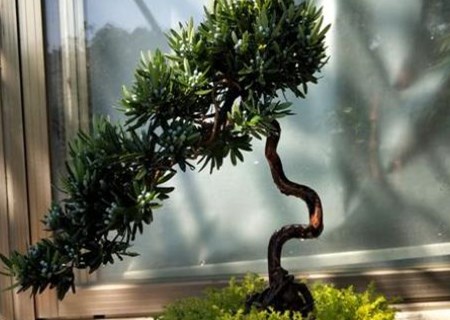
I. How to prune and shape a Podocarpus bonsai
1. Podocarpus thinning pruning method
Podocarpus thinning pruning means cutting branches off from the base. Thinning pruning improves ventilation and light penetration in the stump, concentrates nutrient supply, and promotes vigorous growth. Thinning pruning of young trees early on helps normal development and growth. When shaping, thinning pruning allows the retained shaping branches to receive sufficient nutrients and accelerates formation. In a formed stump bonsai, thinning pruning can balance nutrition and keep it old without declining. When thinning, cut off diseased and pest-infested branches and burn them immediately to prevent the spread of diseases and pests, and promptly remove branches that detract from the appearance. Generally, of two parallel branches growing very close together, one should be cut off; of stacked branches and opposite branches, one should be cut off; of whorled branches, only one should be retained and all the rest cut off; water sprouts, and upright branches, drooping branches, and reverse branches growing from the main branches should all be cut off. For forked branches and crossing branches, one fork should be cut off; for small branches sprouting on tree species with strong sprouting ability, except for leaving one branch at a gap position to slowly induce a replacement branch, all should be cut off early to avoid consuming nutrients and affecting tree vigor.
2. Podocarpus short pruning method
Podocarpus short pruning means cutting long branches back short to stimulate the axillary buds below the cut to sprout and form stronger lateral branches, thereby promoting branching and facilitating shaping. After thinning out surplus branches during shaping, the retained shaping branches should be short-pruned to encourage the shaping branches to sprout 2 to 3 times a year. Short-pruning once per flush of buds will rapidly increase the branching order of the shaping branches and can make each branch order very short without elongating the branches. Therefore, short pruning is an effective measure for controlling growth and maintaining dwarfness in stump bonsai, and is also an important means for giving the stump a large-tree form and achieving early formation.
3. Podocarpus renewal pruning method
Podocarpus renewal pruning means carrying out retrenchment pruning on perennial branches. It is a powerful measure for reducing a large tree and an important means of prompting new shoots to sprout and restoring tree vigor. For stump landscape plants with a good posture but a large crown and long main branches, short pruning and thinning pruning of one-year-old branches alone cannot meet the shaping requirements of the stump landscape; renewal pruning can make a large tree smaller, which is beneficial for stump landscape shaping. For some tree species with strong sprouting ability, the amount of renewal pruning can be greater, that is, cutting away all branches and leaves and retaining only the skeleton of the stump, to stimulate new branches to sprout below the cut.
II. How to prevent and control Podocarpus leaf blight
1. Disease symptoms
It damages the leaves on Podocarpus bonsai. In the early stage, light brown, grayish-white semicircular, elongated, or irregular lesions appear at the leaf tips, with a clear boundary between diseased and healthy tissue. In the later stage, dotted black granules appear on the lesions. Leaves in the lower layer of the crown are more severely affected. The pathogen overwinters as mycelium in diseased tissue or on diseased leaves in the pot. Conidia and acervuli spread via wind and rain, invading through tender leaves and wounds. High temperature and high humidity favor the occurrence of the disease. Poor ventilation or wounds formed by freezing injury or sunscald can aggravate the occurrence of the disease.
2. Prevention and control methods
Strengthen maintenance and management to enhance the disease resistance of bonsai plants; remove dead leaves and diseased leaves from the pot to reduce the initial infection source; when the disease occurs, use 50% zineb wettable powder at 1000 times dilution, or 75% chlorothalonil wettable powder, or 50% carbendazim wettable powder at 800 times dilution for control.