How do you correctly propagate, fertilize and water a Buddhist pine (Podocarpus macrophyllus)?
The Buddhist pine has an elegantly ancient tree form, and the combination of its seeds and seed stalks is unusual and endearing; it is widely planted in temples and courtyard homes in the south. It can be planted in pairs flanking a gate or as a solitary specimen in a central courtyard. So do you know how to propagate a Buddhist pine? How to fertilize it correctly? How should it be watered?
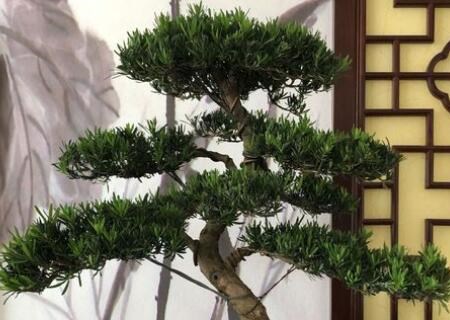
I. How to propagate a Buddhist pine
Sowing season
Sowing of the Buddhist pine is carried out in August each year. It can be done right after the seeds are harvested in August.
Sowing and care
Seedlings grow slowly, so the potting soil needs to be kept moist, and shade care is needed in midsummer. Fertilize mainly with dilute fertilizer; too high a concentration easily burns the young seedlings. When transplanting into pots, the seedlings need to be moved with soil around the roots.
Buddhist pine propagation method: cuttings
Softwood cuttings
Softwood cuttings refer to the cutting method that uses semi-mature shoots of the current year as cuttings during the plant's growing season; it is mainly suitable for evergreen and semi-evergreen woody flowering plants.
For softwood cuttings, in the first half of the year they are generally taken from mid-to-late May to early July, and in the second half of the year from mid-to-late August to mid-to-late September. For cuttings taken in the first half of the year, take care to prevent high-temperature burn and disease. For cuttings taken in the second half of the year, take care to keep them warm and protect them from freezing in the middle and later stages; the shade net is removed in late November, and in dry years the removal of the shade net can be postponed to late December.
Hardwood cuttings
Hardwood cuttings refer to the method of taking thick, fully lignified branches from the previous year and rooting them as cuttings in early spring, in February to March, during the dormant stage before the sap begins to flow.
Hardwood cuttings do not root as easily as softwood cuttings, so some measures to promote rooting are needed, such as applying some rooting powder to the cut end, then inserting it into the pot.
For early-spring hardwood cuttings, what needs attention is raising the soil temperature and controlling the temperature of the growing environment.
II. How to fertilize a Buddhist pine correctly
1. What fertilizer is good to use
For the Buddhist pine, organic fertilizers such as cake fertilizer and manure are suitable. Fertilizing should be done in spring, applying 1-2 times a dilute cake fertilizer solution; do not apply too much or too concentrated. No fertilizing is needed in autumn, otherwise autumn shoots will sprout and the plant is prone to cold damage.
2. Fertilizing method
The Buddhist pine also needs nutrient supplementation, but it does not like concentrated fertilizer. During the growing season, decomposed organic liquid fertilizer can be used at concentrations of 1:6, 1:8 and 1:10, applied every ten days to half a month; on the second day after fertilizing, water once, which helps the roots absorb it. For Buddhist pines grown in the open ground, apply organic liquid fertilizer at a concentration of 1:4 once each before the spring shoots sprout and after the autumn shoots have grown. When applying, dig a trench, cover with soil afterward, and also give one thorough watering the next day; at ordinary times no fertilizing is needed. In long droughts without rain, water the plant. If the aim is to enjoy its emerald-green leaves, whether potted or ground-planted, every half month you can add a small amount of liquid fertilizer to water at a concentration of 1:15 and use it to water, practicing "watering flowers with muddy water".
Applying 2-3 times each in spring and autumn a dilute liquid fertilizer based mainly on nitrogen fertilizer is enough for good growth. On the second day after fertilizing, water once, which helps the roots absorb it.
III. How a Buddhist pine should be watered
1. Watering method
When cultivating a Buddhist pine, its requirements for water and fertilizer are actually not strict; the Buddhist pine is a plant with fairly strong vitality and is relatively tolerant of drought. However, when grown in a pot, watering still requires a certain method. First, a potted Buddhist pine needs to have a certain drainage capacity; be careful not to let water accumulate for a long time, otherwise it will cause root rot. When watering a Buddhist pine, the soil needs to be kept slightly dry, which is generally what gardeners call three parts wet, seven parts dry. Follow the principle of preferring dry over wet, and do not water excessively. Second, in summer, because summer temperatures are high and light is strong, evaporation will be vigorous, so at this time more water should be given, and the soil must not be too dry, lest the leaves turn yellow and wither.
2. Watering precautions
When watering a Buddhist pine, pay attention to the frequency of watering. The specific watering time cannot be rigidly fixed; whether to water should be decided according to the actual growth of the Buddhist pine, including the dryness of the flower pot and the soil. Basically, water when the water has evaporated and the potting soil is dry. If the water evaporates too quickly, you also need to spray water frequently. When watering, water thoroughly. When watering a Buddhist pine, note that it is best to water along the edge of the flower pot, that is, along the inner wall of the outer side of the pot. When watering, you must master the amount of water.