What are the cultivation methods for Japanese red maple bonsai of the Sapindaceae family? Does it lose its leaves in winter?
Japanese red maple is a small tree or shrub of the genus Acer in the Sapindaceae family, with numerous horticultural varieties and a wide diversity of leaf colors, tree shapes and leaf shapes, widely cultivated in many parts of the world. So do you know what the cultivation methods for Japanese red maple bonsai are? Does it lose its leaves in winter?
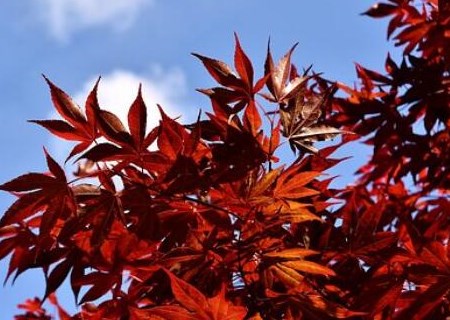
I. Cultivation methods for Japanese red maple bonsai
1. Temperature:
During the growing season it can be kept in a spot without direct sunlight, and especially must be protected from the western sun; during high summer temperatures it is even more important to avoid blazing direct sun, and it can be placed under a shade canopy or in the shade of other plants, otherwise the leaves will scorch and drop off.
2. Watering:
Water frequently to keep the potting soil moist and damp, but do not let water accumulate, so as to avoid root rot; when the air is dry, spray water on the plant and the surrounding background to increase air humidity and make the leaf color smooth and glossy.
3. Fertilizing:
During the growing season, apply a decomposed dilute liquid fertilizer or compound fertilizer once every fifteen days; during high summer temperatures or on rainy days, fertilizing must be stopped. The fertilizer solution should be based mainly on phosphorus and potassium fertilizer, with nitrogen fertilizer as a supplement; if phosphorus and potassium fertilizer are insufficient, the leaves will not turn red.
4. Leaf picking and pruning:
The most beautiful moment for red maple is when the new leaves have just grown out; to increase its ornamental value, leaf picking can be carried out once each year in June, applying fertilizer once a week before leaf picking, and after leaf picking the plant should be pruned and water and fertilizer management strengthened, so that in about fifteen days fresh tender red leaves can grow out. After the new leaves sprout, pay attention to pinching off the tips and removing the growing points, to promote the growth of fine dense young branches, making the leaves slender, small, numerous and dense, with high ornamental value.
5. Repotting:
Repot once every two to three years in spring before the buds sprout; the potting soil should be fertile and loose, containing abundant humus, and two parts leaf mold soil mixed evenly with one part sandy soil can be used.
6. Light:
When the temperature is above 15 degrees, a shade net should be put up to reduce light intensity, reduce water evaporation, and prevent the branches from dying due to lack of water. From 9:30 in the morning to 16:30 in the afternoon each day, cover with the shade net, and after 16:30 open the shade net, because the light is weaker at this time. On cloudy and rainy days the light is weaker, and the shade net should also be opened, so that the branches can carry out normal physiological activities and metabolism.
II. Does Japanese red maple lose its leaves in winter
Japanese red maple is a deciduous small tree, and it will lose its leaves in winter. After the leaves fall, the leaves dry up and curl.
Japanese red maple is a deciduous small tree or shrub. Its crown is flat-round or umbrella-shaped, its leaves are palmate with 5-9 deep lobes, the single leaves are alternate, the leaf tips are pointed, the leaf margins are serrated, and the leaf color is purple or red, ovate-lanceolate; this variety has red leaves in all three seasons of spring, summer and autumn, especially in spring and autumn; the leaf color in season is bright red, and in midsummer the leaves turn brownish red. It is known as the "four-season flame maple." After the leaves have all fallen in winter, its peculiar and highly ornamental branches still add a scene to the winter garden, and it is a famous foliage tree species.