How to grow calamondin (four-season kumquat)? Detailed explanation of flowering time and number of fruiting times per year
Calamondin is an evergreen shrub or small tree of the Rutaceae family and Citrus genus. The tree habit is upright, with dense branches and leaves, many branches, with or without thorns, dark green leaves, wavy blunt teeth on leaf margins, and narrow winged petioles. So how do you grow calamondin? When does it bloom? How many times does it bear fruit in a year?
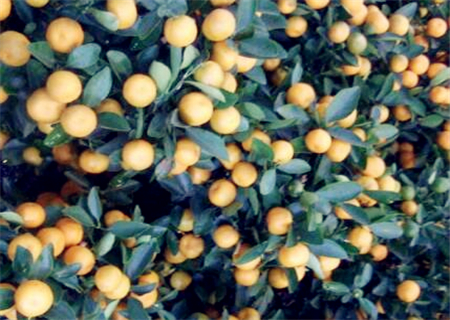
The production and planting methods of calamondin bonsai are as follows:
I. Seedling source
Grafting is mostly used to obtain seedlings. Trifoliate orange and citron are mostly used as rootstock, and cuttings can also be used to obtain seedlings.
II. Shaping
1. Potting usually begins after Qingming. Plain fired pots or purple clay pots can be used, and the potting soil can be made by mixing humus soil, garden soil, and coal cinder evenly. Decomposed cake fertilizer and human manure and urine can be used as base fertilizer.
2. When shaping, achieve the following two points:
First, understand the physiological characteristics of calamondin. Calamondin can bloom multiple times and bear fruit multiple times within one year. Its flower bud differentiation can proceed after the branches and shoots stop growing and on the basis of certain nutrition. Shoots that sprout in the current year can bloom and bear fruit.
Second, pruning and shaping. Before the spring shoots sprout each year, carry out one heavy pruning of calamondin, cutting off dead branches, weak branches, diseased and pest-infested branches, and overly dense branches, keeping healthy branches, with 2—3 buds retained per branch. Weak trees can be cut back to the first branching point to promote healthy spring shoots. When spring shoots grow to 15—20 cm long, pinching should be carried out, and phosphorus and potassium fertilizer should be applied at the same time, to form a neat crown, make the crown full, and the tree body robust and beautiful.
III. Maintenance and management
1. Watering. Calamondin likes warmth and humidity, but dislikes waterlogging. During the growing period, it is best to keep the soil moist. In summer, spray water twice a day and also spray the ground to lower temperature and increase air humidity. Dust must not accumulate on leaf surfaces, so the leaves should be rinsed frequently. During flower bud differentiation, water control should be carried out on the tree body to promote flower bud differentiation. Calamondin grows vigorously and requires a long period of water control. To avoid leaf drop caused by excessive drought, water can be controlled for 3 days and watered for 2 days, repeatedly and intermittently. Alternatively, after a period of drought, water for 5—7 days. After the tree vigor has slightly recovered, carry out girdling treatment to promote flowering.
2. Fertilization is mainly based on farmyard manure. During the flowering period, spray 2% borax plus 5% urea. After fruiting, apply phosphorus and potassium fertilizer, and spray 50 ppm gibberellin 1 month before fruit drop, to help improve the fruit-setting rate and extend the ornamental period.
3. Repotting once a year is advisable. Each time you repot, treat the roots and remove about 1/3 of the old soil.
4. Thinning flowers and fruits: based on the principle of removing the weak and keeping the strong, and even distribution, thin out overly dense flowers and fruits.
5. Pest and disease control: pay attention to effectively controlling pests and diseases such as scale insects, red spiders, aphids, and powdery mildew.
When does calamondin bloom?
The flowers are white and fragrant, and it blooms multiple times a year.
How many times does calamondin bear fruit in a year?
Once a year. From flowering to fruit maturity, calamondin takes about six months.