Care, pruning, shaping, and pest and disease control for small-leaf banyan (also known as elegant banyan) bonsai
The small-leaf banyan is a tree species and an important landscape plant, with dense greenery and a beautiful tree shape. At the same time, small-leaf banyan bonsai are extremely popular on the market and deeply loved by people. So do you know how to care for a small-leaf banyan bonsai? How to prune and shape it? How to prevent and control pests and diseases?
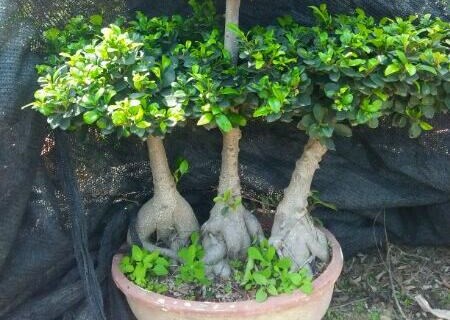
I. How to care for a small-leaf banyan bonsai
1. Watering
For a small banyan bonsai, it is enough as long as the potting soil covers the roots, with a layer of green moss or decoration on top for shade. Watering should depend on whether the potting soil is dry or wet; just keep the potting soil moist. Overwatering may cause the roots to turn black and rot.
2. Fertilizing
The small banyan likes plenty of water and fertilizer and can tolerate drought. Sufficient fertilizer and water can make the branches and trunk thicken and grow quickly, increase the number of prunings, and shorten the actual cultivation period.
3. Light
A small banyan bonsai should be placed in a ventilated and well-lit spot. Poor ventilation and air that is too dry will affect the plant's growth, causing the branches and leaves to turn yellow and dry, the plant to become weak, and pests and diseases to occur.
4. Pruning
A small banyan bonsai should not be pruned blindly. It should first be allowed to sprout; pruning is not advisable in the first year. Pruning must not be excessive, or it will affect the growth of the whole plant.
5. Repotting
Because it grows quickly, it should be repotted once every year in spring. The pot for a strip-planted specimen should not be too large, otherwise it easily leads to leggy branches and leaves. It likes acidic soil; if the growing medium is alkaline, the leaves will turn yellow. The substrate can be prepared from materials such as leaf mold, peat soil, loess, perlite, or coarse sand.
II. How to prune and shape a small-leaf banyan
1. How often should a banyan bonsai be pruned
Pruning a banyan, or more vividly speaking, shaping it, should focus mainly on pruning, with binding as a supplement, and once a year is best.
The banyan has strong sprouting ability, and pruning can be done throughout the year, but early spring is generally best. Cut off unnecessary forked branches, overlapping branches, dead branches, and diseased branches.
During normal care, leggy branches can be cut off at any time to keep the tree shape attractive. For vigorously growing branches, they can be cut 1-2 times a year, repeated over time, and within no more than 4 years a beautiful banyan bonsai will appear.
2. Pruning methods for banyan bonsai
① Pinching: This is a method to suppress the banyan's height growth, promote side buds to grow flat and spread out, and cut off the tender tips at the ends of the branches.
② Bud removal: During the growth of a banyan bonsai, many adventitious buds will grow on the branches and trunk. These should be removed at any time to avoid excessive branch growth that affects the appearance.
③ Leaf removal: The ornamental period of the banyan is often when new leaves sprout. Proper pruning of newly grown leaves helps multiple rounds of new leaf sprouting, and the leaf color will also be bright and pleasing, improving the ornamental effect.
④ Branch pruning: A banyan bonsai often grows many new branches. The pruning method should be decided according to the tree shape and your own aesthetic sense. If you think a branch's growth hinders the overall shape, you can cut it off.
⑤ Root pruning: Roots should be trimmed in time when repotting. If the root system is too long or too dense, it should be pruned. If the roots have not filled the bottom of the pot, the original pot can be used and root pruning is not needed; if the roots have already grown full, change to a slightly larger pot, thin out the dense roots, remove old roots, keep a few new roots, and replant.
III. How to prevent and control pests and diseases on small-leaf banyan
1. Control of leaf blight
Leaf blight mainly damages the leaves, causing the leaf tips, leaf margins, or individual parts to lose green at first, then forming light brown lesions with a light brown ring line at the edge, and the boundary between diseased and healthy parts is clear. This disease is caused by Macrophoma sp. In the early stage of the disease, spray 70% mancozeb wettable powder at 500 times dilution, or 40% chlorothalonil suspension concentrate at 500 times dilution, 50% thiophanate-methyl and sulfur suspension concentrate at 800 times dilution, or 50% carbendazim wettable powder at 600 times dilution.
2. Control of psyllids
The small-leaf banyan psyllid is the main pest of the small-leaf banyan, harming new shoots and leaves, with especially severe damage from April to September when new shoots emerge. It can cause banyan branches to dry up, leaves to fall off, and leaves to shrivel or even drop, hindering tree growth and affecting ornamental value. The excrement of the small-leaf banyan psyllid also easily induces sooty mold. Branches with severe pest damage can be pruned, and applying white can appropriately curb the transfer of banyan psyllids between banyan trees. Chemical agents can also be used: Dakang emulsifiable concentrate, imidacloprid wettable powder, and omethoate emulsifiable concentrate for control.