Cultivation Methods for Wu Zhuyu (Evodia rutaecarpa) of the Rutaceae Family, Its Differences from Shan Zhuyu (Cornus officinalis), and Poisoning Rescue
Wu Zhuyu is a plant of the Rutaceae family; the nearly ripe fruits of Evodia rutaecarpa and its varieties are a commonly used traditional Chinese medicine. It has a long history of cultivation in China. So do you know what the cultivation methods for Wu Zhuyu are? What is the difference between it and Shan Zhuyu? How do you rescue someone from poisoning?
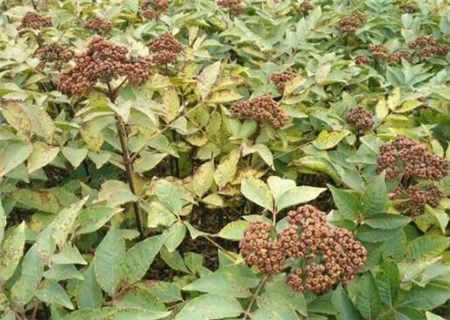
I. Cultivation Methods for Wu Zhuyu
1. Propagation methods:
① Root division propagation: Choose a vigorously growing old tree as the mother plant for propagation. Around the Beginning of Spring (Lichun), dig out several roots from beside the old tree (when digging, stay relatively far from the main root, and do not dig up too many lateral roots), cut them into several sections with a knife, each 13-17 cm long, and use them for raising seedlings. The seedbed should be 100-120 cm wide. At intervals of 17-20 cm square, insert one cut root section, burying about 3/4 or 4/5 of it in the soil, leaving only about 1.5 cm exposed outside, then apply a small amount of diluted human manure, cover with soil or barnyard manure, and water to keep the soil moist. Sprouting can occur in 30-40 days. By the spring of the second year, they can be transplanted.
② Sucker division propagation: Wu Zhuyu has strong suckering ability. In October to November, at a spot about 70 cm away from the mother plant, dig away the surface soil, and use a knife to make one or two cuts on the lateral roots at intervals of 7-10 cm. After cutting through the cortex, still cover with 3-6 cm of shallow soil, and pour some diluted human manure and urine around the roots at the base of the trunk, then cover with garbage or rice straw to keep the soil moist. By the spring of the second year, young shoots can emerge at the cut wounded areas; at this time, remove the covering material, and around Qingming (Tomb-Sweeping Day), the roots connected to the mother plant can be cut off for transplanting. Another method is to dig up the suckers (young seedlings) that have grown around the old tree in February and transplant them.
③ Cutting propagation: In early spring, before new shoots grow, cut from the mother plant the vigorous, sun-facing spring shoots from the previous year's growth, keeping several buds, and cut them to about 34 cm long. At a spacing of 35-50 cm square, insert 2-3 cuttings into the soil. When inserting the cuttings, choose a sunny day, and select land that faces the sun, has loose, fertile soil, and good drainage for insertion. After inserting, pay attention to shading, watering, and drought prevention. After Grain Rain (Guyu), the buds on the aboveground part can produce new branches, and about 3 months after insertion, a large number of new roots can emerge. By the spring of the second year, they can be planted out.
2. Transplanting: Choose sandy loam soil containing organic matter and well-drained land for planting. Spring and autumn are suitable for planting. When transplanting, first dig the holes, with a hole width of 50-70 cm and a depth of 34-50 cm, with row and plant spacing of 330-400 cm, and plant in a triangular or square arrangement. When digging the holes, pile the surface soil and subsoil separately, then apply decomposed barnyard manure or pond mud as base fertilizer; first put back the surface soil to prevent the base fertilizer from heating up and affecting plant growth; then place the seedling on the fine soil, first backfill the surface soil, then the subsoil, then gently lift the seedling upward a little and press down firmly so that the roots are tightly bound to the soil. Two to three years after planting, it will bloom and bear fruit.
II. What Is the Difference Between Wu Zhuyu and Shan Zhuyu
1. Different genus and species
Shan Zhuyu is a deciduous shrub or small tree of the Cornaceae family, also known as Shanyurou, Yaozhao, Zaopi, Shu Suanzao, Rouzao, Shuzao, Jizu, Shizao, Yurou, Yaozhao, Tianmuzi, Shanyurou, and Shizao'er.
Wu Zhuyu is a small tree or shrub of the Rutaceae family, also known as Wuyu, Chala, Qilazi, Choulazi Shu, Zuoli Chunyouzi, Milazi, and so on.
2. Different morphology
From the perspective of morphology, the biggest differences between Shan Zhuyu and Wu Zhuyu are the fruit and the flowers.
The drupe of Shan Zhuyu is oblong-elliptical, 1.2-1.7 cm long and 5-7 mm in diameter, and red or purplish-red in color. The fruit is plump and looks just like large red dates, bright and glossy. The fruiting period of Shan Zhuyu is September to October.
The fruits of Wu Zhuyu are dense or sparse, dark purplish-red in color, with large oil dots, each mericarp having 1 seed. The seed is nearly spherical, bluntly pointed at one end, slightly flat on the ventral side, brownish-black, and glossy. The fruit looks like small nodules, with a surface that is neither smooth nor showy, and appears more densely clustered. Its fruiting period is from October to November.
The flowers of Shan Zhuyu are yellow, blooming in a golden and dazzling display, while the flowers of Wu Zhuyu are white and relatively plain when in bloom.
3. Different medicinal value
Shan Zhuyu is slightly warm in nature and sour and astringent in taste, and has the effects of tonifying the liver and kidneys and securing essence and preventing collapse. It is used for dizziness and tinnitus, soreness and pain of the waist and knees, impotence and seminal emission, enuresis and frequent urination, uterine bleeding and leukorrhea, and profuse sweating with collapse, among other conditions.
Wu Zhuyu is hot in nature and pungent and bitter in taste, and has the effects of dispersing cold and relieving pain, directing qi downward and stopping vomiting, and assisting yang and stopping diarrhea. It treats conditions such as cold hernia and abdominal pain, cold-damp athlete's foot, abdominal pain during menstruation, distension and pain in the epigastrium and abdomen, vomiting and acid regurgitation, and chronic diarrhea due to deficiency-cold.
III. How to Rescue Someone from Wu Zhuyu Poisoning
1. Adverse reactions
After taking Wu Zhuyu, some people develop a scarlet fever-like drug rash. The skin of the legs and arms has a burning and itching sensation, followed by red papules, and the skin temperature also rises somewhat. In severe cases of Wu Zhuyu side effects, a person may show signs of poisoning, including severe abdominal pain, diarrhea, and blurred vision, and may even experience hallucinations. Dizziness and headache can also occur.
2. How to rescue
For this side effect of Wu Zhuyu, the scarlet fever-like drug rash, anti-allergic drugs such as prednisone and chlorpheniramine can be taken orally, or some drugs can be injected intravenously. For those showing signs of poisoning, gastric lavage is also required. For abdominal pain, atropine or belladonna mixture can be used. For blurred vision, vitamin B can be supplemented. For patients with visual impairment and hair loss, Scutellaria baicalensis, Eriocaulon buergerianum, and goji berry, among others, can be combined and decocted in water to be taken morning and evening.
The side effects of Wu Zhuyu range from mild to severe. Once an adverse condition occurs, reasonable measures should be taken promptly to resolve and treat it. For severe cases of poisoning, go to the hospital immediately and ask professional staff to take reasonable rescue measures to minimize the harm.