Can fresh honeysuckle be steeped in water to drink? Detailed explanation of propagation methods and reasons for not blooming
Honeysuckle, whose proper name is Japanese honeysuckle (Lonicera japonica), opens white and later turns yellow, which is how it got the name "gold and silver flower." Since ancient times, honeysuckle has been praised as an effective remedy for clearing heat and detoxifying. People love to use it to make tea. So do you know whether fresh honeysuckle can be steeped in water to drink? How is it propagated? Why does it not bloom?
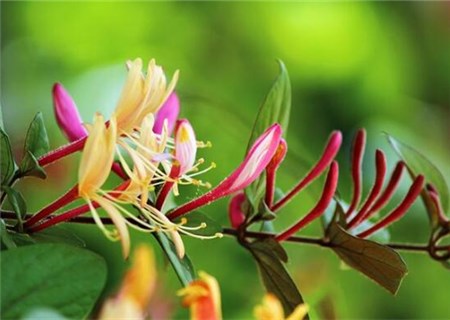
I. Can fresh honeysuckle be steeped in water to drink
Drinking it directly steeped in water is not scientific; fresh flowers carry many germs. You can stir-fry or dry them first, then select the good stems for drinking, with the length preferably kept at about 3 cm; the tea brewed that way has a very good appearance, all standing upright.
Most importantly, for honeysuckle you drink yourself, collecting it is quite particular: you must pick honeysuckle that has not yet opened, and you should pick it on a clear morning just after the dew has dried. The time for picking fresh flowers must be controlled to between 10 and 12 o'clock in the morning; at other times the extract content is not high. Dry them in the sun or in the shade promptly, so that the medicinal effect is best.
II. How is honeysuckle propagated
Honeysuckle is mostly propagated by cuttings, and can also be propagated by seed, division of roots, and layering.
Propagation by cuttings
There are two methods: direct cutting and raising seedlings from cuttings.
Cutting period: it can be done in spring, summer, and autumn. In spring it is best before new buds sprout, and in autumn from early September to mid-October.
Selection and treatment of cuttings:
It is best to choose robust, plump 1- to 2-year-old branches, cut them into cuttings about 30 cm long, each with at least 3 nodes. Then remove the lower leaves, keep 2 to 4 leaves at the top, cut the lower end near a node into a smooth slanted surface, tie every 50 into a small bundle, quickly dip the lower slanted end in a 500 ppm indolebutyric acid (IBA) solution for 5 to 10 seconds, let it dry slightly, and then carry out cutting immediately.
1. Direct cutting
On the prepared planting ground, dig holes at a row spacing and plant spacing of 150×150 cm or 170×170 cm, with each hole 40 cm in diameter and 40 cm deep, loosen the subsoil at the bottom, and apply 5 kg of decomposed stable manure or compost to each hole. Then spread the cuttings evenly, insert 3 to 5 into each hole, with the depth into the soil being 1/2 to 2/3 of the cutting, then fill with fine soil and press firmly with your foot, water once thoroughly, and keep the soil moist. Roots and sprouts will appear in about 1 month.
2. Raising seedlings from cuttings
On a leveled and finely raked cutting bed, draw lines at a row spacing of 15 to 20 cm, and every 3 to 5 cm make guide holes on the bed surface with a small wooden stick or bamboo chopstick. Then insert the cuttings obliquely into the holes at 1/2 to 2/3, press firmly, and water once immediately. If cutting in early spring at low temperature, build an arched plastic film frame over the cutting bed to keep warm and moist. In about half a month they will take root and sprout new buds; then remove the plastic film and carry out seedling-stage management. Those cut in spring are lifted and planted out in the same year's winter or the next spring. Those raised from cuttings in summer and autumn are transplanted the following spring. Raising seedlings from cuttings can produce a large number of vegetative seedlings in a short time.
3. Propagation by seed
Around Frost's Descent, when the honeysuckle berries turn black, collect the ripe fruits in time, rub them in clear water, skim off the fruit skin and impurities, scoop out the plump seeds that sink to the bottom, and dry and store them for later use. They can also be sown right after collection. If sowing in spring the next year, take the seeds out 40 days before sowing, soak them in 40°C warm water for 24 hours, scoop them out and stratify them with 3 times their volume of wet sand to promote germination; when 50% of the seeds have cracked and shown white, sieve out the seeds and sow them in drills.
4. Propagation by division
During the winter dormant period of honeysuckle, dig up the mother plant, properly prune the root system and aboveground stems, then dig holes and divide the plant, planting 1 to 2 plants per hole; flower buds can appear in the second year after planting. But the mother plant's growth is inhibited, and it blooms less that year, or even fails to bloom; therefore, apart from using root division for superior wild varieties, production areas generally use this less often.
5. Propagation by layering
Carry this out during the autumn and winter dormant period of the plant or before sprouting in early spring. Choose 3- to 4-year-old honeysuckle that has already bloomed, grows robustly, and has high yield as the mother plant. Bend a 1-year-old branch near the ground and bury it in the soil, notch the part of the branch in the soil, cover it with 10 to 15 cm of fine fertile soil, then fix and press it firmly with a forked twig, leaving the branch tip exposed above the ground. If the branch is longer, it can be bent and pressed into the soil continuously. After layering, water and fertilize frequently; in the following spring, the rooted layered seedling can be cut off from the mother plant and planted separately.
III. Why does honeysuckle not bloom
Honeysuckle needs sufficient sunlight to grow, so light must be guaranteed; the ventilation conditions of its environment will also affect blooming.
For the soil needed for honeysuckle growth, the soil's nutrients must be guaranteed, and phosphate fertilizer is indispensable.
During the growth period of honeysuckle, pruning work must also be done well; pruning branches and buds, as well as pruning unhealthy branches and buds, will also affect blooming.
Powdery mildew on honeysuckle will cause small white spots on the leaves, which then expand, affecting blooming or causing flowers that have already opened to fall.
If the above matters are not done well, they will all affect the blooming of honeysuckle.