A Detailed Guide to Oil Peony Planting Methods, Field Management and Uses
Oil peony refers to peony variety types with high seed yield, high oil content and high active ingredient content. Peony belongs to the genus Paeonia in the family Paeoniaceae, section Moutan, and has a wide range of uses and good economic benefits. So do you know what the planting methods for oil peony are? How should field management be carried out? What are its uses?
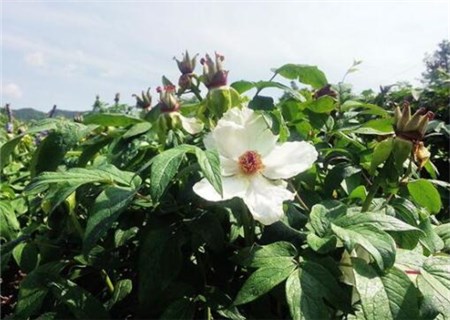
I. What are the planting methods for oil peony?
1. Land selection
For the cultivation site of oil peony, choose neutral plots with deep, fertile, loose, breathable soil and good drainage (pH 6.5-7.5). Sandy loam is the best soil texture. Plots with heavy clay, saline-alkali soil, low-lying land and continuous cropping are not suitable for planting.
The land should be deep-plowed and sun-dried one month in advance, to a depth of about 20-30 cm. Sun exposure promotes soil maturation and kills pathogens and insect eggs. Before plowing, apply 1000 kg of decomposed organic fertilizer per mu or 500 kg of peony-specific fertilizer.
2. Seedling treatment
Select high-quality strong seedlings of 2-3 years or older for planting. Usually before planting, cut off diseased roots and residual roots, sort the seedlings to a uniform specification, then soak the whole plant in 800 times dilution of 50% thiram or 800-1000 times dilution of 50% carbendazim for 10-15 minutes for disinfection.
3. Timely planting
The field planting time for oil peony is fairly strict. In northern regions, planting in September to October is best, while south of the Yangtze River it can be delayed to November. If transplanted too early, the higher temperature leads to a low survival rate of transplanted seedlings; if transplanted too late, new roots are difficult to form in that year and growth the following year is weak.
4. Reasonable density
The planting density of oil peony should be managed dynamically. At planting, it is generally about 3000 plants per mu, with a plant-row spacing of 30 cm × 80 cm or 40 cm × (90+50) cm wide-narrow row transplanting. A high-density cultivation with a plant-row spacing of 20 cm × 60 cm can also be chosen, and afterward one row of peonies is removed every 1-2 years.
5. Planting method
For large-area planting, use a peony planting machine to plant at the set plant-row spacing, or use a hole-punching machine to punch holes (25 cm × 30 cm) at the plant-row spacing for planting. When planting, first place the peony seedling into the hole, spread out the root system, fill the hole with soil and then lift the peony seedling so that the root crown is about 2 cm below the ground, then tread firmly so the roots and soil are in close contact. After planting, water thoroughly to settle the plants.
II. How to carry out field management of oil peony
1. Spring management
In the Central Plains region in a normal year, oil peony begins to sprout in mid-February. Before sprouting, water should be applied in time to promote sprouting; in early March, when the plants grow vigorously, carry out inter-row cultivation to conserve moisture and raise temperature, which helps promote new root growth; combined with cultivation and earthing up, apply 200 kg of peony-specific organic fertilizer and 10-15 kg of compound fertilizer per mu; from late March to early April, after the peony leaves unfold, foliar fertilization can be carried out with 0.1%-0.2% potassium dihydrogen phosphate solution; in mid-April the peony enters full bloom. During full bloom, pay attention to rain protection and observe the pollination of oil peony. Artificial supplementary pollination can greatly increase yield.
2. Summer management
After early May, the peony flowering period ends, the peony fruit expands rapidly, and the peony buds begin to enter the flower bud differentiation stage; in mid-to-late July the peony seeds gradually begin to mature. The key tasks of field management are:
3. Fertilizer and water management
A sufficient nutrient supply is the foundation for plump peony seeds and normal flower bud differentiation. Timely topdress with multi-element compound fertilizer, with a nitrogen-phosphorus-potassium ratio of 2:2:1, applying 15-20 kg per mu, and water promptly after application; depending on the growth of the peony, foliar spraying of 0.2%-0.5% potassium dihydrogen phosphate solution 1-2 times may also be done as appropriate.
4. Cultivation and weeding
Summer is a vigorous growth period for weeds. Weeds not only compete with peony for water and nutrients, but heavy weed growth also reduces ventilation and light penetration in the field, leading to increased pest and disease damage, weakened photosynthesis, and can also affect peony flower bud differentiation. Generally in summer, cultivation and weeding should be carried out 3-4 times depending on the weed situation.
5. Timely harvest: in late July, the fruit pods begin to turn yellow and the seeds begin to change from white to brown. Harvesting before the fruit pods split open and the seeds fall is best.
III. What are the uses of oil peony?
Besides harvesting peony seeds to process peony oil, peony petals, peony stamens, peony leaves and peony roots and stems each have their own uses. Peony petals can be made into petal tea, pressed for peony flower dew, and used to extract peony essential oil. Peony stamens can be made into stamen tea. Peony pollen is a precious health product. Tender peony leaves can be made into bud tea. Peony roots and stems can be used to extract the medicinal component paeonol. The moutan bark obtained from peony roots has always been an important traditional Chinese medicinal material.