Cultivation Methods, Precautions, Propagation Methods and Uses of Purple Coneflower
Purple coneflower is one of the indispensable flower varieties for courtyards, parks, street green spaces and street greening and beautification, as well as for holiday flower displays. So what are the cultivation methods and precautions for purple coneflower? How is it propagated? What are its uses? According to available information, purple coneflower is a long-day plant. During the flowering stage, it needs 14—16 hours of light per day, and also needs 7—8 weeks of high-intensity light. In northern regions, it generally blooms in late May, and the flowering period can last until September.
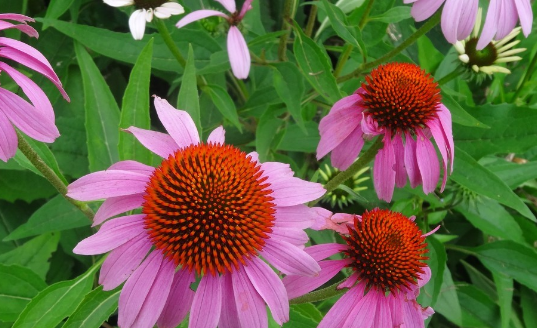
I. Cultivation Methods and Precautions for Purple Coneflower
Light
Purple coneflower is a long-day plant. During the flowering stage, it needs 14—16 hours of light per day, and also needs 7—8 weeks of high-intensity light. In northern regions, it generally blooms in late May, and the flowering period can last until September.
Temperature
During the growing period of purple coneflower, the daytime temperature should be kept at 16℃—24℃, and the nighttime temperature is best maintained at 10℃—16℃.
Fertilizing
For water-soluble fertilizer application, the nitrogen concentration is 50—75rrg/kg from radicle emergence to cotyledon unfolding, 100—150mg/kg from cotyledon unfolding to the growth of 4 true leaves, and 250mg/kg after planting out. Fertilizing can be done 1—2 times per week in each cycle.
Water
Purple coneflower is robust and drought-tolerant, so watering should follow the principle of “water when dry, stop when wet.” Wait until the potting soil is completely dry before watering, and water thoroughly in one go.
Soil
Purple coneflower is not strict about soil requirements, but it grows best in deep, fertile soil rich in humus.
Precautions:
Reasonable fertilizing
Appropriately supplement with 0.05% magnesium sulfate 1—2 times to prevent magnesium deficiency in the plant.
Likewise, supplement with chelated iron 1—2 times to prevent iron deficiency.
It is recommended to add a long-acting slow-release fertilizer to the potting soil when planting out.
Pay attention to cold protection in winter
In November, temperatures in northern regions are relatively low, so purple coneflower needs to be moved indoors for care. Keeping the room temperature above 0℃ will allow purple coneflower to grow healthily.
Pay attention to ventilation
Place purple coneflower in a ventilated, breathable location to keep the air circulating.
II. How Is It Propagated?
1. Sowing method
Sowing can be done in late April in spring or in early September in autumn. After deeply turning and leveling the open-field seedbed, water it thoroughly. Once the water has completely seeped into the ground, evenly broadcast the seeds.
When broadcasting, ensure about one thousand seeds are sown per square meter, keep the temperature at around 22℃, and seedlings will emerge in 13 to 15 days.
When the seedlings grow 2 true leaves, they can be transplanted.
2. Division method
Purple coneflower is a perennial herbaceous plant. For perennial mother plants, division propagation can be carried out in spring and autumn.
Take the mother plant's roots out of the ground, being careful not to damage the new roots. Remove part of the soil and get rid of old roots and diseased roots.
Use a knife to separate the mother plant at the rhizome, dividing it evenly into several plants, keeping 4—5 terminal buds on each plant, and then plant them into the prepared substrate.
3. Cutting method
For cutting propagation, prepare large mother plants and move them into a greenhouse for care in winter. Wait until spring, then take robust branches, keeping 2 to 4 true leaves and not keeping the growing point.
The length of the branches should be controlled at 5—6 cm. The cut should be below a node, and cuttings should be inserted immediately after being cut.
The cutting depth is one-third to one-half of the length of the cutting. The cutting seedbed should not be too wet, but the air humidity of the surrounding environment should be high. Keep the surrounding ambient temperature at 22℃, and roots will form in 20 to 30 days.
4. Planting out method
Plant out purple coneflower seedlings when they have 3 branches and are about 10 cm tall.
For pot cultivation, use 15×13 cm nutritional pots, planting 1 plant per pot. The potting soil should be a mixture of one-third farmyard manure, one-third garden soil and one-third fine sand, mixed and sieved.
After the seedlings are planted, the potting soil should be firmed, watered thoroughly, and placed in a shaded place. After 7—10 days, move them to a sunny place, and they will begin normal growth.
III. Uses
Medicinal:
Widely used in the United States and Europe, it is generally considered to have immune-enhancing effects. It contains a variety of active ingredients that can stimulate the activity of immune cells such as white blood cells in the human body and improve the body's own immunity.
Ornamental:
It can be planted as a background plant or used as material for flower borders and slopes, and can also be used as a cut flower.
Potted purple coneflower: The potting soil should be a loose, fertile mixed soil or culture soil. When planting, depending on the pot size, 3-5 seedlings can be planted per pot. In the early growth stage, pinching once is needed to encourage branching. It is best to renew the cultivated plants once a year.
Watering should not be excessive. During the plum rain season, when air humidity is high, watering should be controlled even more. During the growth period, apply diluted liquid fertilizer to promote growth. When flower buds form, fertilize once a week, and after each fertilizing, sprinkle clean water to avoid fertilizer sticking to the plants. To avoid rain, cultivation is generally carried out in a greenhouse, and the plants should be placed in a well-ventilated, sunny spot. The minimum temperature should not be lower than 10℃, and in hot summer, appropriate shading is needed.