Red-fleshed dragon fruit vine plant: origin, planting and harvest time, years to fruit, and cultivation techniques
Red-fleshed dragon fruit is a perennial vine plant of the genus Hylocereus in the cactus family, and it is an emerging fruit with good health benefits. So where is the origin of red-fleshed dragon fruit? When is it planted and harvested? How many years until it fruits? What are the techniques? According to the Hainan red-fleshed dragon fruit planting base, dragon fruit begins to flower and fruit 12-14 months after planting, can flower 12-15 times per year, with the fruiting period from April to November, and the fruit ripens 30-40 days after the flowers fade, with a single fruit weight of 500-1000 g. In the second year after planting, each column produces more than 20 fruits, and by the third year it enters the full fruiting period. With a higher level of management, the yield can reach 2500 kg/667 sq m.
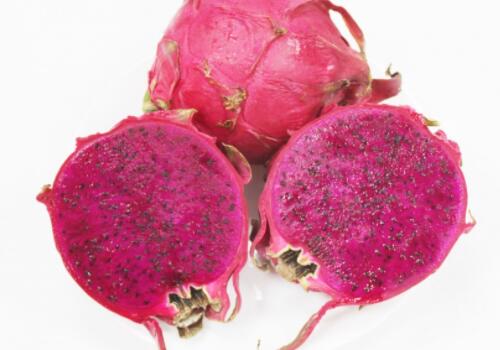
Where is the origin of red-fleshed dragon fruit?
1. Dragon fruit is a plant of the genus Hylocereus in the cactus family, also known as red dragon fruit and auspicious fruit. It is native to Costa Rica, Panama, Ecuador, Cuba, Colombia and other places in Central and South America, and dragon fruit is also produced in Vietnam and other places in Southeast Asia. Dragon fruit combines "fruit", "flower" and "vegetable" in one, and can be said to be a priceless treasure.
2. In China, it is only grown in Taiwan, China, Hainan, Guangxi, Guangdong, Fujian and some other provinces and regions.
When is red-fleshed dragon fruit planted and harvested?
Planting:
1. Red-fleshed dragon fruit is a tropical and subtropical plant. Its fruit is brightly colored and rich in nutrients, containing glucose, vitamin C and various minerals. It has nutritional and health benefits, and can help prevent constipation, care for the skin, and lower blood sugar and blood lipids. The flowers can be eaten, and when dried they make an excellent soup ingredient.
2. Red-fleshed dragon fruit can be planted throughout the year, with a suitable temperature of 20°C-30°C.
Harvest:
1. For dragon fruit, from May to November, there are both one or two concentrated flowering and fruiting periods and scattered, multiple flowering and fruiting periods in several batches. With proper cold storage and processing, visitors can taste fresh fruit, fruit-flesh ice cream and other delicious foods and drinks within half a year.
2. One year after planting, dragon fruit reaches the initial production period, with a yield of 1000 kg per mu; after two years, 2000 to 3000 kg; after three years, there should be no problem reaching 3000 to 5000 kg in the full production period. A density of 6000-7000 drooping stems and vines per mu is suitable, that is, about 10 per sq m. On average, each produces 1 fruit per year, with an average fruit weight of 0.3-0.4 kg, so 1 mu yields 2000-2670 kg per year.
What are the cultivation techniques for red-fleshed dragon fruit?
The vining nature of red-fleshed dragon fruit requires supports to facilitate growth, flowering and fruiting, and management and harvesting. The supports must be sturdy, resistant to heavy pressure and wind; resistant to soil corrosion; and their cost must also be considered. Based on practice, there are three types of supports to choose from.
1. Independent reinforced concrete column supports. A square reinforced concrete column 2 m long, 11-12 cm square in thickness, buried 0.5 m in the soil, with 1.5 m above ground. At the top there is 6-7 cm of exposed rebar so that a rebar cross disk with the column as the center and a diameter of about 0.7 m can be welded on. The column spacing is 3 m (row spacing) x 2-2.5 m (plant spacing), about 111-89 columns per mu. One seedling is planted on each of the four sides of the column. Relying on aerial roots and artificial tying, the stems climb up the column to the top, and when they extend further they rest on the iron ring and spread drooping to all sides. Only drooping branches are likely to form flower buds and bloom. Old tire casings can be placed on the iron ring to prevent the resting part from becoming too hot or breaking easily. Concrete columns have good strength, and the independent type also has good ventilation and light transmission, but they must be buried solidly, and the drooping stems and vines must be evenly distributed to all sides (with manual assistance) to prevent tipping.
2. Galvanized iron pipe rectangular row supports. Drive rows of wooden stakes at a row spacing of 3 m. The thickness, sturdiness and decay resistance of the wooden stakes should at least allow dragon fruit to climb and grow for more than one year without breaking. The stake spacing is 1 m, the height is 1.2-1.4 m, and two fruit seedlings are planted beside them. After planting, durable galvanized iron pipe (water pipe) supports are installed in a planned way, using pipe material with an outer diameter of 2.5 cm. With the wooden stake as the center, support legs are set 0.5 m to each side, that is, the support width is 1 m. Either pipe material or 7-8 cm square concrete columns (with rebar inside) can be used as support legs, and the latter will be more durable. The burial depth should be enough for sturdiness, and the buried pipe material should have a concrete pier foundation. The above-ground height is still 1.5 m, and the support leg spacing is 2-2.5 m (determined by the strength of the pipe material and the vigor of plant growth). Pipe material is welded horizontally and longitudinally between the tops of the legs. Within one year of planting, as the stems and vines of the fruit seedlings grow taller and branch, manual guidance is needed at all times to train the stems and vines onto both sides of the pipe support, so that the row support bears the heavy pressure. Row support cultivation is relatively easier to manage, and the yield is also higher. Jinkui Company mainly uses this method, with column supports second. Row planting should be planned in a north-south row direction so that both sides receive even light.
3. Crossed rebar support. Dr. Wang Qunguang of Taiwan, China, who abandoned medicine for farming and has grown dragon fruit for many years, believes from practical experience that this type of support is the most ideal. The method is to use ribbed rebar with a diameter of 5 fen (1.7 cm), cut into two lengths of 2 m and 3.2 m. The former is used as support legs. Two rebars are driven obliquely into the soil opposite each other to 0.5 m, crossing each other at the top, and the spacing between crossed leg supports is 3 m. Stainless steel wire or steel cable is used to clamp and bind the crossing point tightly (including the horizontal rebar resting on it). A rebar (or pipe material) must also be added in the middle of the horizontal rebar to prop it vertically so that it can withstand the heavy pressure later. Planting fruit seedlings and driving temporary wooden stakes are the same as in the second method, and after the stems and vines grow taller they rest on the horizontal rebar.
4. Others. For non-scale planting, dragon fruit can also climb on low walls, living tree stumps, and can even rely on tree trunks such as false betel nut with no branches or leaves on the lower part. However, trellis-style cultivation must not be used, because stems and vines extending horizontally branch more but form fewer flower buds and bloom less, and even if they bear fruit it is difficult to harvest. The branches on top of the trellis are densely packed and difficult to thin out, and under the trellis it is pitch dark, both of which are unfavorable for flowering and fruiting.
Dragon fruit is a long-lived plant, surviving for decades or even over a hundred years. Therefore, no matter which support is used, its sturdiness and durability should be put first. It should also be considered that if the support cannot bear the heavy load after several years, under the premise of appropriate thinning and pruning, it can be conveniently reinforced and strengthened with basically no impact on normal growth in that year. According to our several years of planting experience, attention should also be paid to the fact that when building a new orchard, the row spacing cannot be small, with 2.5 m as the minimum. Otherwise, when the stems and vines fully spread out, the overly narrow paths force managers and tourists to dodge everywhere from the very sharp short spines on the triangular stems, which is very uncomfortable and inconvenient.